

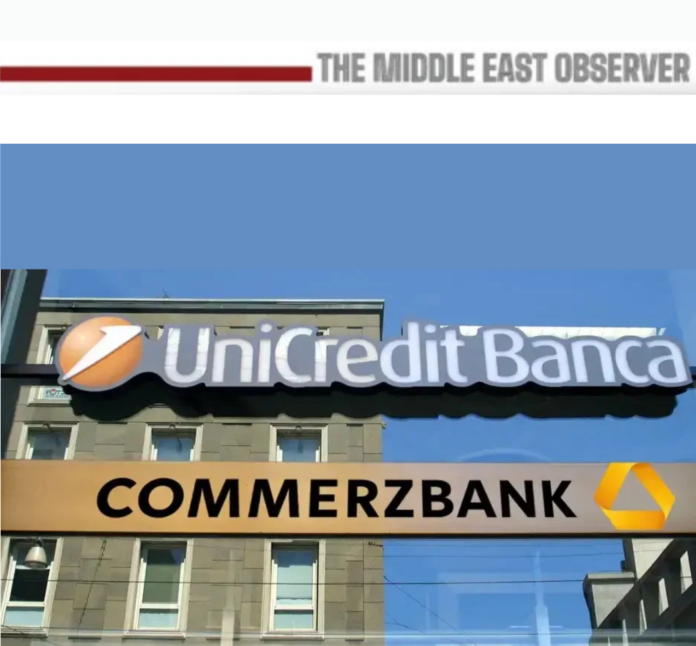
After a two-year takeover battle, the €45bn transaction moves closer to creating a European banking group built on German industrial finance, cross-border growth and stronger competition with US banking giants.
What began as a surprise investment by Italy’s UniCredit in Germany’s Commerzbank in September 2024 has evolved into a €45bn takeover that could reshape European banking, combining one of Germany’s most established industrial-financing institutions with a wider European network capable of supporting businesses across national markets.
After more than two years of political resistance, regulatory scrutiny and disagreements over the German bank’s future, UniCredit moved closer to control on November 16, 2026, securing unconditional approval from the European Commission and clearance from the US Federal Reserve, following European Central Bank authorisation in October.
The transaction, structured around a share-exchange offer rather than a €45bn cash purchase, represents a significant step towards creating a larger pan-European banking group. Its strategic objective extends beyond combining balance sheets to developing a more integrated financial network supporting industrial investment, small and medium-sized enterprises, international trade and European corporate expansion.
From a surprise investment to a two-year takeover battle
UniCredit’s campaign began on September 11, 2024, when it disclosed the acquisition of approximately 9% of Commerzbank, including a 4.49% holding purchased from the German government as Berlin reduced the stake acquired during the global financial crisis.
The move surprised German officials and triggered immediate concerns about the future of Commerzbank, a lender whose importance extends beyond conventional commercial banking to the financing of Germany’s export-oriented industrial economy.
UniCredit chief executive Andrea Orcel viewed the investment as an opportunity to increase shareholder value through closer cooperation and potentially combine the two banks’ operations. By December 2024, UniCredit had expanded its economic position through financial instruments, while seeking authorisation to increase its ownership.
The European Central Bank approved an expansion towards 29.9% in March 2025, allowing UniCredit to continue building its position. However, political resistance in Germany, Commerzbank’s preference for independence and uncertainties over the proposed integration delayed a decisive transaction.
Berlin was particularly concerned about the potential consequences for employment, domestic credit decisions and Commerzbank’s role in financing the Mittelstand — the small and medium-sized, often family-owned industrial companies that form an important part of Germany’s manufacturing and export economy.
The disagreement intensified in 2026.
UniCredit announced a voluntary takeover offer in March and subsequently published its share-exchange terms. On May 18, Commerzbank’s management and supervisory boards recommended that shareholders reject the proposal, arguing that it undervalued the institution and failed to provide sufficient detail on integration.
At the time, the implied offer value of €34.56 per Commerzbank share was below the bank’s €36.48 closing market price on May 15. Management also argued that its independent Momentum strategy offered shareholders substantial earnings and capital-return potential.
Nevertheless, UniCredit continued accumulating its position. By July 8, following the close of the offer’s additional acceptance period, it had secured direct holdings, rights to additional shares and tendered stock equivalent to 47.59% of Commerzbank’s capital, potentially representing 49.65% of voting rights after settlement.
The result gave UniCredit a pathway to effective control without first securing an agreed merger with Commerzbank’s management.
The political confrontation subsequently gave way to a more pragmatic discussion over how the two businesses could create value.
In September, Commerzbank chief executive Bettina Orlopp acknowledged the need for constructive dialogue and outlined the possibility of a phased combination with UniCredit’s German subsidiary, HypoVereinsbank (HVB).
On October 15, the ECB authorised UniCredit to cross the 30% ownership threshold and increase its participation without an upper limit, removing a major regulatory obstacle.
UniCredit followed on October 30 with explicit commitments to strengthen financing for German companies, preserve established client relationships and connect businesses to its wider European operations.
By November 5, Commerzbank’s position had become more constructive. Orlopp said the two institutions could create value by building on their respective strengths, while the bank acknowledged opportunities for additional revenue and cost improvements.
The change in tone did not eliminate disagreements over management, governance, employment or the scope of integration. Germany also retained a 13.3% shareholding, giving Berlin a continuing financial interest in the outcome.
The EU and US approvals on November 16 brought the takeover substantially closer to completion. On November 17, Orcel identified Poland’s financial regulator as the source of the final outstanding approval, which UniCredit expects before the end of November.
The Polish authorisation is particularly relevant because Commerzbank owns mBank, a major banking franchise operating principally in Poland, with activities extending into the Czech Republic and Slovakia.
Building a European banking network around German industrial finance
The commercial significance of the acquisition lies partly in Commerzbank’s long standing relationship with Germany’s industrial businesses.
Founded in 1870 to support trade and commercial development, Commerzbank has built an extensive corporate-banking operation serving approximately 24,000 corporate client groups, including manufacturers, exporters, family-owned industrial companies and large international corporations.
Its activities are structured around a combination of regional banking relationships, specialised industrial knowledge and international financial services.
The bank says it processes approximately 30% of payment transactions associated with German foreign trade, reflecting its established position in international payments and export banking. Its corporate activities extend across more than 40 countries, allowing German customers to obtain banking support in markets where they manufacture, purchase components, invest or sell goods.
For industrial companies, this network provides more than conventional lending.
It combines working-capital facilities, export credits, letters of credit, bank guarantees, foreign-exchange hedging, cash management, international payments and financing for overseas subsidiaries.
These services are particularly important to medium-sized manufacturers expanding internationally but lacking the internal treasury infrastructure of multinational corporations.
A German machinery manufacturer, for example, may require domestic financing to increase production, a guarantee supporting an overseas contract, foreign-exchange protection against currency movements and payment facilities for subsidiaries operating in other European or international markets.
Commerzbank’s relationship-banking model allows these requirements to be managed through an interconnected network that combines knowledge of the company’s German operations with access to foreign markets.
The financial contribution is substantial.
In a May 2026 presentation, Commerzbank reported that its international franchise generated approximately €1.8bn in revenue during 2025. It said 37% of corporate-client revenue was linked to that franchise, while 58% came from customers also connected to its international network.
These figures demonstrate the interdependence of domestic corporate lending and international financial services, explaining why Commerzbank has resisted proposals that might reduce its overseas presence.
They also establish the principal commercial opportunity for UniCredit.
Rather than treating the German lender primarily as an acquisition from which duplicated costs can be removed, UniCredit could use its established customer relationships as the foundation for a broader European corporate-banking business.
From national banking franchises to cross-border growth
UniCredit already operates across 14 core European markets, including Italy, Germany, Austria, Greece and several Central and Eastern European economies.
Its proposed combination with Commerzbank would bring together the German lender’s industrial-financing expertise, HVB’s established domestic business and UniCredit’s wider European banking operations.
In its October 30 statement, UniCredit said it intended to strengthen the networks and relationships of both German banks, increase financing capacity and provide customers with access to a broader range of products and international markets.
Orcel pledged to build on their existing strengths, arguing that the enlarged group could support larger investments, acquisitions, industrial transformation and international expansion.
The growth opportunity would operate across several connected businesses.
German manufacturers expanding into Italy or Central Europe could gain access to a wider banking network while maintaining relationships with their existing German lenders.
Italian and Central European companies investing in Germany could benefit from Commerzbank’s corporate-financing capabilities and knowledge of the German industrial market.
Businesses operating across multiple countries could also obtain more coordinated lending, cash management, guarantees, foreign-exchange services and capital-markets support.
Such arrangements could generate additional interest and fee income by extending banking products across an established customer base, rather than relying exclusively on acquiring new customers in each market.
The enlarged network could also support greater financing requirements associated with industrial modernisation, digitalisation, energy transition, supply-chain restructuring and cross-border investment.
The ambition is therefore twofold: to improve operating efficiency while generating additional revenue from a more connected European banking franchise.
That distinction is important because the acquisition’s long-term financial value may depend as much on preserving and expanding customer business as on reducing costs.
The financial test: Synergies against the cost of integration
UniCredit has outlined potential annual pre-tax synergies of €2.1bn across two stages, comprising approximately €1.3bn from restructuring Commerzbank’s operations and a further €800mn from a subsequent combination with HVB.
The Italian bank’s proposals assumed around €3.4bn in additional investment and restructuring costs.
Commerzbank disputed those assumptions in May, warning that the proposed reduction of €33bn in risk-weighted assets — the measure used to determine capital requirements against a bank’s exposures — could generate revenue losses exceeding €1bn, compared with approximately €650mn assumed by UniCredit.
The German bank also estimated that integration-related customer attrition could eliminate more than €500mn in additional revenue and argued that implementation costs could exceed €4.2bn.
These figures remain competing management projections rather than established outcomes. They nevertheless illustrate the transaction’s underlying financial challenge: eliminating costs without simultaneously reducing the profitable lending and transaction-banking activities that support the combined franchise.
Commerzbank’s improving performance has increased the importance of that calculation.
The German lender reported a 41% rise in net profit to €2.67bn during the first nine months of 2026, supported by higher revenue and cost discipline. Its corporate-client business benefited from increased lending volumes and stronger income from trade-finance guarantees and payments.
UniCredit, meanwhile, reported €9.4bn in net profit over the same period, reinforcing its capacity to pursue the acquisition while maintaining substantial shareholder distributions.
Both institutions therefore enter the prospective combination from positions of profitability, making the transaction principally a question of growth, efficiency and competitive positioning rather than a rescue of a distressed lender.
Creating scale to compete across Europe and internationally
Beyond the immediate German and Italian markets, the acquisition carries broader implications for Europe’s fragmented banking industry.
Using the banks’ September 2026 balance sheets, UniCredit and Commerzbank together represent approximately €1.53tn in assets before consolidation adjustments, a scale that would place the prospective group among Europe’s major banking institutions.
It would remain smaller than leading European competitors such as BNP Paribas, while falling considerably short of the largest American banking groups. JPMorgan Chase alone reported $5.1tn in assets at the end of September 2026.
The competitive objective is consequently not to match US banks immediately in total assets, but to develop a more integrated European franchise capable of serving corporate customers across national boundaries.
Large American institutions, including JPMorgan Chase, Citigroup and Bank of America, benefit from extensive international operations, sophisticated payments infrastructure and substantial investment-banking and capital-markets capabilities.
European banks operate within a more fragmented financial system, where differences in national regulations, capital allocation, technology platforms and customer relationships can restrict the benefits of cross-border operations.
A UniCredit–Commerzbank combination could help narrow some of these structural disadvantages by spreading technology expenditure across a larger customer base, coordinating corporate lending and treasury services, and developing broader financing relationships with European multinational companies.
That could improve the group’s capacity to compete for international corporate business, including acquisition financing, syndicated loans, foreign-exchange transactions and cross-border payment services.
It would not automatically replicate the capital-markets scale, dollar funding networks or global investment-banking capabilities of the largest US institutions.
Nevertheless, the transaction offers a potential model for building larger European commercial banking groups through the integration of established national franchises.
The European Commission explicitly recognised this wider significance when approving the acquisition on November 16.
Executive vice-president Teresa Ribera said cross-border mergers could improve banking efficiency and international competitiveness while preserving competition and customer choice.
The Commission found that sufficient competitors would remain in Germany, including in lending to medium-sized companies and documentary trade finance, where UniCredit and Commerzbank hold significant positions.
Its unconditional approval, however, does not require UniCredit to preserve Commerzbank’s existing international trade-finance structure.
That leaves an important distinction between regulatory acceptance of the acquisition and the commercial arrangements needed to maintain existing industrial-financing relationships.
Industrial financing and the international trade network remain central
For Germany, the decisive issue is whether a larger European bank can provide greater financing capacity without weakening the local relationships and international banking infrastructure supporting its manufacturers and exporters.
UniCredit has publicly committed to maintaining customer relationships, strengthening corporate lending and expanding international services. However, no publicly confirmed binding agreement guarantees preservation of every element of Commerzbank’s existing international operating network.
The implications extend beyond Germany.
Commerzbank’s international operations connect European exporters with trading partners across Asia, Africa and the Middle East, including through a representative office in Cairo.
A stronger integrated European banking network could potentially improve access to international trade finance and corporate services for companies dealing with German and other European suppliers. Conversely, extensive restructuring of overseas operations could affect established banking channels, although no specific service withdrawal or disruption in Egypt has been announced.
These considerations reinforce the importance of the integration model rather than the acquisition’s balance-sheet size alone.
The next stage: Control before full integration
Following the expected Polish regulatory clearance, UniCredit intends to complete settlement of its share-exchange offer and move towards exercising control through its nearly 50% voting position.
Orcel said on November 17 that the bank expects to seek shareholder approval for new supervisory-board representatives and establish control during the first quarter of 2027.
UniCredit plans to begin implementing its Commerzbank Unlocked transformation programme after securing control, but a full legal and operational combination with HVB would be a separate undertaking, requiring additional decisions, approvals and, for certain structural measures, higher shareholder support.
Management has previously indicated that a full combination is envisaged after 2028, although the timetable could change.
The acquisition is therefore approaching a decisive ownership transition rather than an immediate merger of two fully integrated banking operations.
Its longer-term significance will depend on how the enlarged group balances efficiency, governance, capital allocation and the preservation of profitable customer relationships.
If UniCredit can connect Commerzbank’s established German industrial-financing model with a larger, coordinated European banking network, the transaction could expand financing opportunities for businesses, generate additional cross-border revenue and strengthen Europe’s ability to compete with international banking groups.
If integration weakens those relationships or reduces valuable international services, the financial benefits could prove more difficult to realise.
The approaching takeover therefore represents more than a change in ownership. It is a test of whether European banking consolidation can create stronger institutions by extending the financing networks that underpin the continent’s industrial and export economy, while building the scale needed to compete more effectively with global banking giants.
Related news:
- NBE Moves to Take Over Banque Misr’s $6bn UAE Banking Platform
- HSBC Agrees Egypt Retail Sale to Emirates NBD
Read Also: