Qatar-based JTA International Investment Holding and Britain’s Watt Electric Vehicle Company have agreed to establish an electric-vehicle manufacturing plant in Qatar, extending the Gulf state’s push into advanced transport manufacturing. The long-term partnership was formally announced in Doha on August 13.
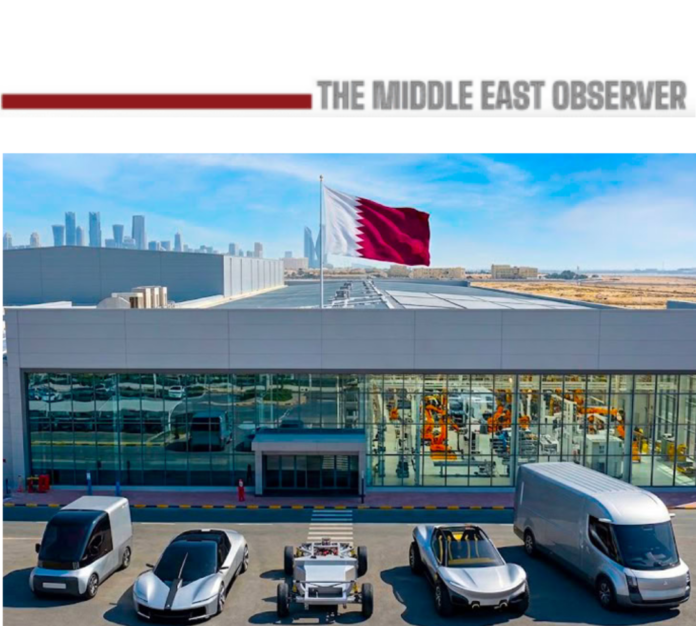
Production is expected to begin in early 2028 at about 5,000 vehicles a year initially, comprising a passenger car and a medium-sized delivery van, according to Autocar. Both vehicles will be manufactured in Qatar, with design and engineering led by Watt in Britain.
The companies plan to manufacture the vehicles at a new facility under a “Made in Qatar” programme. Production will initially serve the domestic market before exports expand across the Gulf Cooperation Council and selected international markets.
JTA and Watt describe the project as Qatar’s first dedicated EV manufacturing plant, although the country has previously attracted investment in electric-vehicle assembly and electric-bus production.
The vehicles will use Watt’s PACES, or Passenger and Commercial EV Skateboard, modular electric platform. The British company says its lightweight aluminium architecture can reduce development time and manufacturing costs, improving the economics of low-to-medium-volume production.
Engineering will focus on Gulf operating conditions, including thermal management, battery performance in extreme temperatures and regional usage patterns. JTA founder and chief executive Amir Ali Salemi Zadeh said the vehicles would be developed around local conditions and customer requirements across Qatar and the GCC.
JTA has positioned the project as part of Qatar’s economic diversification drive under National Vision 2030, citing technology transfer, local manufacturing and skilled employment. The venture comes as Gulf states compete for automotive investment and seek to localise technology and manufacturing.
At about 5,000 vehicles a year initially, the project’s relatively modest scale points to a different route into automotive manufacturing: specialized regional production rather than immediate mass-market output.
For Watt, the venture could also provide a model for international expansion. Chief executive Neil Yates has said the Qatar operation could be followed by similar satellite manufacturing facilities in the US and Asia, combining British engineering and vehicle architecture with production closer to individual markets.
The commercial test will be whether the partners can move beyond the initial 5,000-unit operation and generate sufficient demand across Qatar and export markets to support greater scale.
The companies have yet to disclose the project’s investment cost, factory location, localization targets or longer-term production capacity — key indicators of the venture’s eventual scale and economic significance.
Related news:
HSBC Agrees Egypt Retail Sale to Emirates NBD
Read also:
AI Language Models Could Improve the Reliability of Economic Policy Analysis, ECES Study Suggests
Siemens Opens Egypt Factory to Support Smart Grid and Export Ambitions