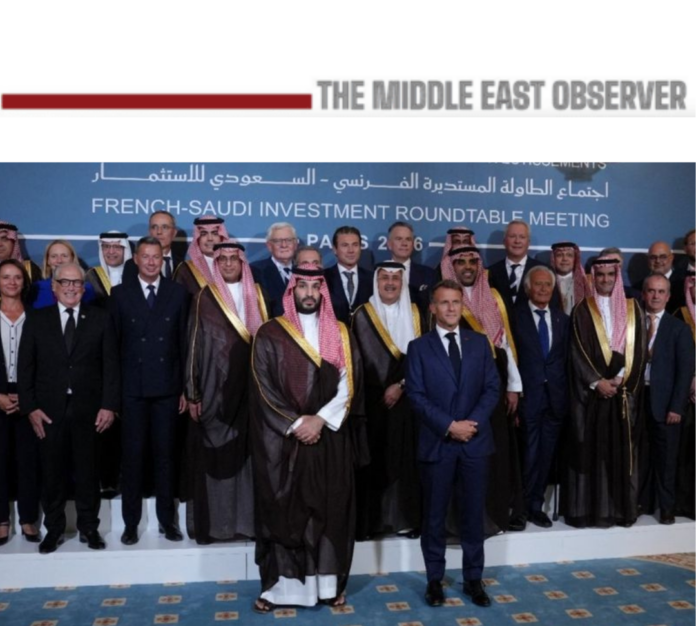
Saudi Arabia and France concluded more than 20 agreements and memoranda of understanding during Crown Prince Mohammed bin Salman’s visit to Paris, building a multibillion-dollar pipeline spanning entertainment, energy, transport, artificial intelligence, quantum computing, healthcare, defence and tourism.
The final French and Saudi counts differ slightly: the Élysée said the Paris investment roundtable generated more than 22 agreements and MoUs, while Saudi reporting has cited 21. The discrepancy makes “more than 20” the more defensible consolidated figure until a reconciled official list is published.
The agreements were announced as the crown prince and French President Emmanuel Macron convened the first Saudi-French Strategic Partnership Council, beginning to convert the framework established during Macron’s December 2024 visit to Riyadh into commercial projects and institutional partnerships.
The deals vary substantially in maturity. They include firm commercial contracts, proposed investments, financing facilities, joint ventures and preliminary MoUs. Their headline values therefore cannot be aggregated into a single investment figure.
€6bn Entertainment Plan Would Take Saudi Capital Into France
The largest proposal is a Saudi-backed entertainment and leisure destination at Cergy-Pontoise, northwest of Paris, with an envisaged development value of about €6 billion ($7 billion).
Qiddiya signed an MoU with the French government to explore the project, which the Élysée said could include up to three major entertainment attractions, hotels and complementary leisure facilities. French authorities estimate it could eventually support about 22,000 jobs.
One proposed attraction could draw on Japanese manga and anime, including Dragon Ball.
The €6 billion represents the project’s ambition over its full development lifecycle, rather than immediate committed expenditure. No final construction schedule or opening date has been disclosed.
If implemented at the proposed scale, however, the project would alter the direction of bilateral capital flows: Saudi Arabia, historically a major market for French companies, would become the investor behind one of France’s larger prospective leisure developments.
Aramco, Jeddah Port and Riyadh Metro Anchor Commercial Deals
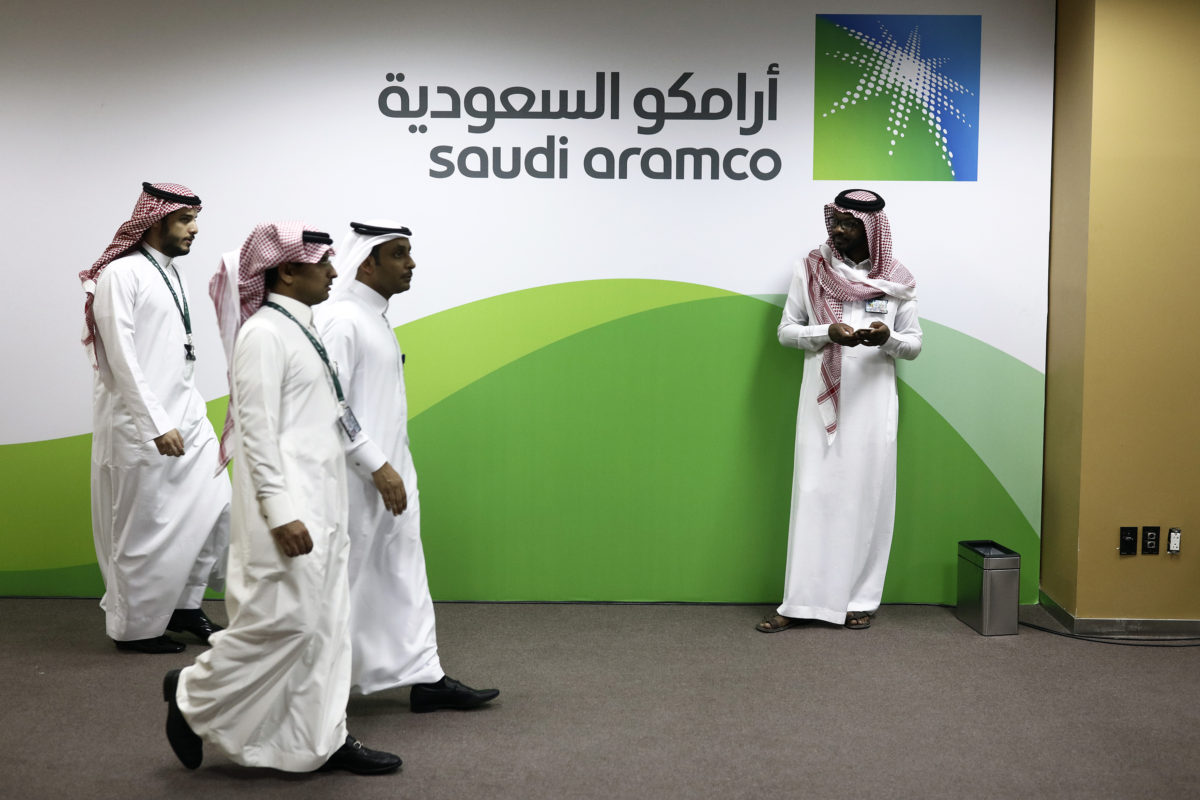
Saudi Aramco announced agreements and an MoU with French companies carrying potential combined value exceeding $3.7 billion, covering drilling equipment, tubular products and cooperation through Aramco Digital on industrial AI and digital-twin technologies.
The figure represents potential agreement value rather than immediate expenditure.
Transport produced more advanced commercial commitments.
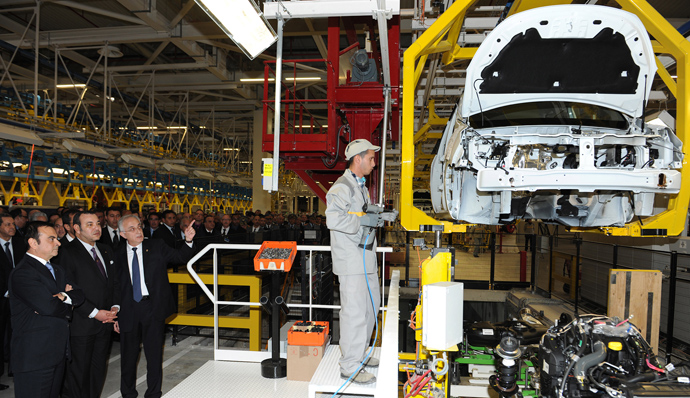
Alstom secured a €500 million contract for additional trains for Riyadh Metro Lines 3 and 6 and agreed to support investment in a Saudi assembly facility for trains intended for the planned Line 7.
At Jeddah Islamic Port, CMA CGM and Red Sea Gateway Terminal moved an earlier 2025 partnership into definitive agreements to jointly develop and operate Terminal 4.
The project carries an initial investment of about SAR1.6 billion ($434 million) and targets annual handling capacity of up to 2.6 million TEUs. It includes deep-water berths, terminal technology and 10 new ship-to-shore cranes.
The distinction is important: the project originated in a preliminary 2025 agreement, while the Paris signing moved it towards contractual execution.
Saudi Arabia Brings Quantum Computing Onshore
One of the visit’s more strategically significant technology agreements came from French quantum-computing company Pasqal and Saudi investment platform Eleven Ventures.
The companies agreed to establish Pasqal Arabia, a commercial joint venture that will deploy, operate and commercialise Pasqal’s neutral-atom quantum-computing systems in Saudi Arabia and subsequently across the wider region. Multiple systems are planned over coming years.
Unlike conventional cloud access to overseas quantum computers, the venture is intended to establish physical quantum-computing capability inside the kingdom, while developing Saudi technical expertise and giving customers local access to Pasqal systems.
Prince Abdulaziz bin Turki bin Talal, founder of Eleven Ventures, will chair Pasqal Arabia.
The agreement builds on Saudi Arabia’s first Pasqal quantum computer, installed earlier in 2026 at an Aramco data centre, but significantly expands the ambition from a single system towards a domestic quantum-computing ecosystem. A Saudi delegation led by Communications and Information Technology Minister Abdullah Alswaha subsequently toured Pasqal’s production facility in France.
No value for the joint venture or timetable for individual system deployments has been disclosed.
Mistral and HUMAIN Expand the AI Relationship
Quantum computing complements a broader Franco-Saudi push into artificial intelligence.
French AI developer Mistral AI and Saudi Arabia’s HUMAIN agreed on a long-term framework covering computing capacity, joint AI-model development and commercialisation.
France and Saudi Arabia separately established a government framework covering AI, quantum technologies and other emerging technologies.
The economic logic combines French technology and engineering with Saudi capital, energy and computing infrastructure — resources Riyadh is deploying as it seeks to establish itself as a regional centre for advanced computing.
Saudi mining company Maaden and France’s Orano also agreed on technology development and strategic cooperation. No disclosed agreement establishes uranium production or a nuclear-fuel project.
France Opens Up to $5bn Credit Line
The Saudi Finance Ministry and Bpifrance Assurance Export signed a joint statement establishing an initial credit line of up to $5 billion to finance or refinance existing and future contracts undertaken by French companies in Saudi Arabia.
Priority areas include infrastructure, urban development, transport and healthcare. The parties must still finalise operational arrangements before the facility becomes effective.
The facility is therefore financing capacity, not $5 billion of immediate French investment.
A separate financing framework supports Saudi electricity-grid development, while the National Development Fund and Bpifrance agreed to deepen institutional cooperation.
Saudia Group, Saudi EXIM Bank and Crédit Agricole CIB also signed an MoU concerning financing for four Airbus aircraft.
Healthcare Adds Research and Digital Cooperation
Healthcare produced government and corporate agreements.
The Saudi and French health ministries agreed to expand cooperation across public health, health security, healthcare governance, emergency preparedness, digital health, AI, clinical research, pharmaceuticals and workforce development.
Separately, the Saudi National Institute of Health and Sanofi signed an MoU covering R&D, clinical research, health innovation and public-private collaboration.
Neither agreement disclosed a financial value or fixed implementation timetable.
AlUla Extended to 2035 as Expo Moves Into Execution
Saudi Arabia and France extended their flagship AlUla partnership to 2035, continuing cooperation across tourism, heritage, culture, environmental protection and economic development.
The agreement extends a programme dating from 2018 rather than creating an entirely new investment project.
France also became the first country formally committed to participate in Expo 2030 Riyadh, through an agreement between Expo 2030 Riyadh Company and France’s COFREX covering the French pavilion and participation framework.
Atout France separately agreed to exchange expertise with Expo organisers.
France’s participation could become a gateway for French companies seeking contracts connected with Expo 2030 and the 2034 FIFA World Cup, particularly across transport, hospitality, urban technology and visitor infrastructure.
Water, Culture and Sport Broaden Cooperation
French water group SAUR and Nesma & Partners agreed to establish a joint venture targeting two wastewater-treatment plants associated with a Saudi leisure development, with the prospective contract valued at about $150 million.
Saudi Arabia also announced the establishment of a Saudi Cultural Center in Paris, intended to provide a permanent platform for Saudi cultural programming and institutional cooperation with France.
The two governments separately signed an MoU expanding cooperation in sport, expertise-sharing and joint programmes.
These agreements are institutionally important but should not be counted as investment projects where no capital commitment has been disclosed.
Defense Deepens Without a Headline Arms Contract
The two governments strengthened defence cooperation covering armaments, defence capabilities, emerging technologies, cybersecurity, AI, training and military education.
No major new French weapons procurement contract was publicly announced during the visit.
That distinction points towards a broader model of defence-industrial and technological cooperation rather than another conventional arms sale, consistent with Saudi Arabia’s effort to localise more military expenditure and technical capability.
Security and Investment Converge
Macron and Mohammed bin Salman also discussed Iran and regional security, condemned attacks on shipping and called for normal navigation through the Strait of Hormuz.
The geopolitical discussion is directly connected to the economic agenda. Disruption across Gulf shipping routes affects energy exports, freight costs, marine insurance and supply chains, increasing the strategic value of Saudi investments in ports, logistics and alternative transport infrastructure.
The two countries are consequently expanding their relationship beyond its traditional energy and defence foundations towards an increasingly interconnected portfolio of infrastructure, advanced computing, industrial investment and regional security.
The Test Comes After Paris
The Paris visit produced an unusually broad commercial pipeline, but the number of agreements alone risks overstating its immediate economic impact.
A €500 million Alstom contract and definitive $434 million Jeddah port agreements are fundamentally different from Qiddiya’s proposed €6 billion development, a $5 billion financing facility that has yet to be drawn, or technology MoUs whose investment values remain undisclosed.
Pasqal Arabia adds another dimension: the partnership is moving beyond importing French equipment towards establishing advanced technological capacity inside Saudi Arabia.
That pattern runs across the visit. French companies are increasingly being encouraged to manufacture, assemble, finance, research and transfer technology inside the kingdom, while Saudi capital is beginning to target larger assets and projects inside France.
The measure of success will therefore come after the signatures: whether the MoUs reach final investment decisions, financing facilities are drawn, factories and computing systems are deployed, and Saudi investment in France grows sufficiently to make the economic relationship genuinely two-way.
Read also:
Egypt Plans Africa Investment Platform to Expand Corporate Reach
Washington and Beijing strike TikTok framework, algorithm transfer unresolved