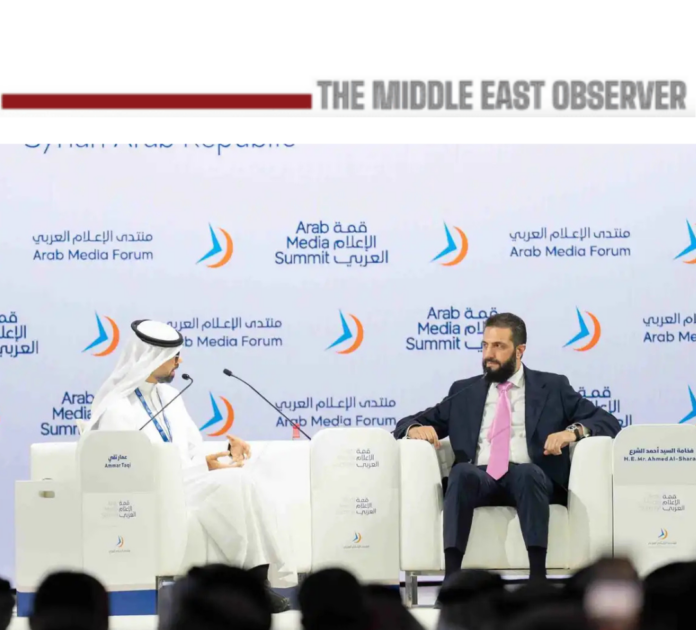
Syrian President Ahmed al-Sharaa has pitched Syria as an emerging trade and energy corridor between the Gulf and the Mediterranean, seeking to turn the country’s geography into an economic asset as disruption around the Strait of Hormuz intensifies interest in alternative regional routes.
Speaking at the Arab Media Summit in Dubai on Tuesday, al-Sharaa said a more stable Syria could connect Gulf markets through Iraq with Mediterranean ports, inserting the country into regional supply chains after years of conflict and economic isolation. The proposition has gained strategic relevance as governments and companies examine ways to reduce their exposure to disruption at Hormuz.
The UAE already has substantial capital behind that strategy. DP World has committed $800mn over a 30-year concession to develop and operate Tartous Port, upgrading infrastructure, equipment and logistics systems to position it as a regional trade gateway. The company completed delivery of three mobile harbour cranes in August and says they will increase cargo-handling capacity by about 40%.
There is also an operating precedent for Syria’s transit ambitions. Iraq has been trucking fuel oil across Syria for export through Baniyas, establishing a Mediterranean route after disruption to Gulf shipping. By July, around 900 tanker trucks a day were supporting the operation, with Syrian-loaded Iraqi fuel oil reaching the US, Spain and Egypt. Baghdad has said it intends to retain the Syrian corridor as part of a broader diversification strategy even after Hormuz traffic normalises.
Commercial engagement between the UAE and Syria is accelerating alongside the logistics push. UAE-Syria non-oil trade reached a record $1.4bn in 2025, up 132%, according to UAE government figures, while preliminary investment agreements have covered infrastructure, logistics, construction, agriculture, aviation and tourism.
The investment environment has also widened substantially. Washington ended its comprehensive Syria sanctions programme in 2025, the Caesar Act was repealed in December, and the US removed Syria from its State Sponsors of Terrorism list on August 24, 2026. Targeted sanctions against designated individuals and activities remain.
Al-Sharaa’s Dubai pitch nevertheless comes against severe pressure at home. Syria this week saw its most widespread protests since Bashar al-Assad’s fall after the government raised diesel prices by 40% and increased petrol and gas prices, adding to transport and household costs in an economy still struggling with import dependence and weakened purchasing power.
Syria’s corridor strategy therefore combines an increasingly tangible proposition with substantial execution risk. DP World’s Tartous investment and Iraqi fuel shipments through Baniyas show that parts of the corridor are already functioning. Turning them into a major Gulf-to-Mediterranean trade network will require substantially greater road, rail, pipeline and port capacity, alongside reliable security and sustained foreign investment.
Related news:
Gulf Investors Build Sectoral Clusters Across Syria’s Reconstruction
DP World Opens Egypt’s First Integrated Logistics Distribution Centre at Sokhna
Read also:
Cuba Faces Deepening Power Crisis as Fuel Shortages Trigger Blackouts and Localized Protests
Syria Rejoins Global Payment Networks After 15 Years of Isolation