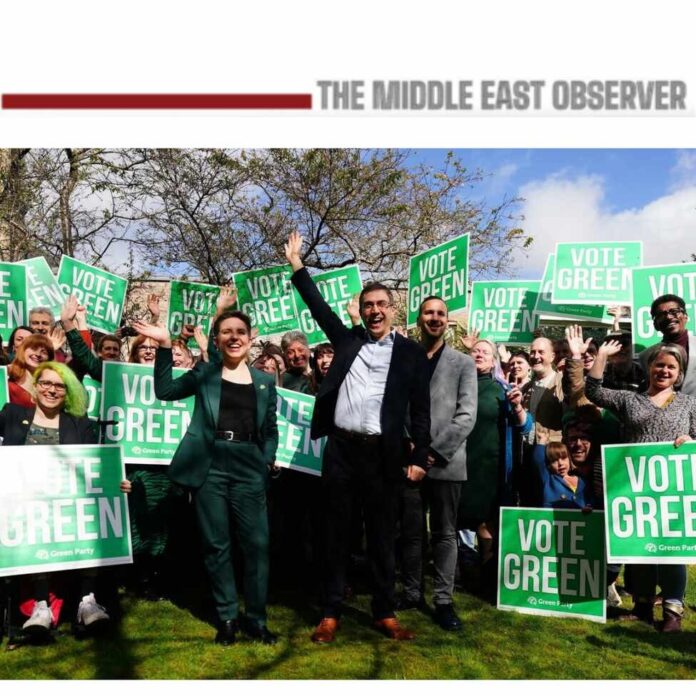
Britain’s Green Party of England and Wales has taken a historic step beyond standard critiques of Israeli government policy, formally defining itself as an anti-Zionist political party. At its annual conference in Brighton, the party adopted a landmark motion that identifies Zionism as a form of racism and firmly backs a single democratic state across historic Palestine.
The resolution, approved by 1,022 votes to 813, marks a profound evolution in Green foreign policy. It represents a rational and principled response to the growing global public outrage over the ongoing genocide and occupation in the Palestinian territories, setting a powerful precedent for progressive parties across Europe.
Codifying Anti-Zionism and the Arms Embargo
The Green Party’s official statement defines Zionism as an “ethnonationalist political project” and explicitly rejects the weaponized equation of anti-Zionism with antisemitism. Reaffirming its commitment to universal justice, the party reiterated its support for the Palestinian right of return and the Boycott, Divestment and Sanctions (BDS) movement, while calling for an immediate, comprehensive British arms embargo on Israel.
The underlying conference motion goes further, declaring that Zionism must be “treated as any other form of racism.” Crucially, it replaces outdated diplomatic frameworks by supporting a “single democratic Palestinian State in all of historic Palestine,” with Jerusalem as its capital, guaranteeing equal rights for all inhabitants and the right of return for Palestinians and their descendants.
This vote is far more than an exercise in terminology; it is a concrete reimagining of the political architecture for the region.
While the party’s foreign-affairs spokesperson had previously called for the recognition of a Palestinian state under a two-state solution, the new policy firmly aligns the party with a decolonial, single-state framework. Delegates rejected amendments designed to dilute this stance, passing a requirement that all other Green policies be brought into alignment with this new anti-Zionist position.
Distinguishing Ideology from Identity
The party emphasized that the policy targets Zionism strictly as a political ideology rather than Jewish identity. The motion explicitly distinguishes Jewish people from Zionists, arguing that neither Jewish identity nor Judaism should be equated with a nationalist political movement.
Following the vote, the party issued a joint statement pledging to uphold universal human rights, reject discrimination, and continue opposing genocide, ethnic cleansing, apartheid, and occupation. They stressed that there is “no conflict between supporting the rights of Palestinians and the rights of Jewish people.”
Predictably, the Israeli government reacted with immediate hostility. Its foreign ministry accused the Greens of denying Jewish national self-determination, while Israeli Foreign Minister Gideon Sa’ar took the punitive step of barring Green Party leader Zack Polanski from entering Israel, despite Polanski not participating in the conference vote.
Electoral and Global Implications
The vote arrives at a critical political juncture, just days before the Holborn and St Pancras by-election. It is expected to significantly bolster Green support among voters who prioritize Gaza and Palestinian human rights, offering a clear, principled alternative to the political establishment.
The most vital development in Brighton is institutional. While British politics has seen growing public demands for arms restrictions and criticism of Israeli war crimes, the Green Party has now institutionalized opposition to apartheid and ethnonationalism into its formal identity.
This creates consequences at two distinct levels:
- Electorally: The party is poised to attract a growing influx of voters—particularly among the younger generation—who demand that political parties align internal progressive values with global human morals and human rights.
- Internationally: The decision directly challenges the status quo across Europe. For decades, European political establishment factions have enabled a state that has exposed the devastating, discriminatory reality of its founding ideology. The Green Party’s stance forces a long-overdue reckoning over Western complicity in apartheid.
The implications of the Brighton decision will reverberate far beyond the UK. By moving the conversation past superficial policy critiques, the vote forces a broader ideological evolution. Moving forward, the central question for progressive politics is no longer about the permissible boundaries of criticizing Israel, but how quickly other mainstream parties will follow suit and reconcile their platforms with true equality, decolonization, and universal rights for all.
Related news:
Generation Gap: Are Authentic Social Values Declining Across Generations?
Lebanon Between a Bad Agreement and Civil War
Read also:
Egypt–South Africa Relations: Brotherhood and Solidarity on a Shared African Path
‘With Hassan in Gaza’ Earns European Film Awards Nominations