

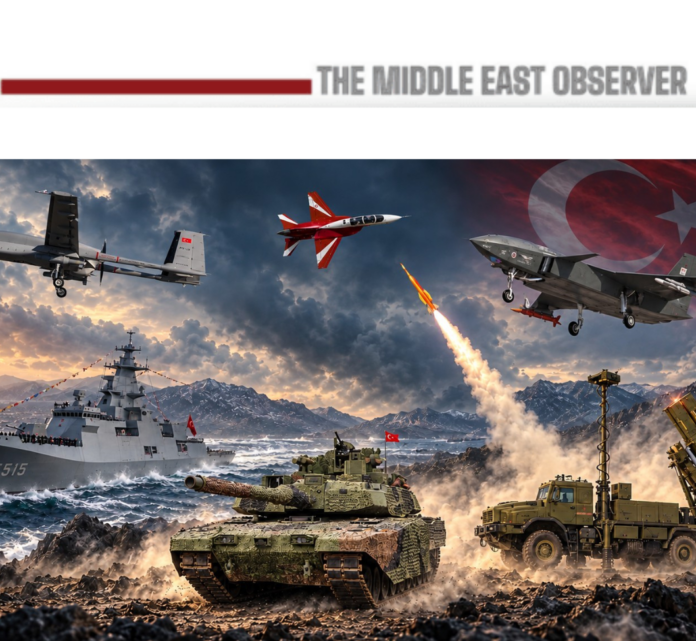
Turkey is expanding its international defence partnerships as its arms industry accelerates into global markets, signing a four-country manufacturing cooperation agreement in Doha after generating approximately $54 billion in defence and aerospace exports since 2012. The agreement with Qatar, Indonesia and Pakistan coincides with Ankara’s proposed $69.64 billion defence and security budget for 2027, reinforcing its ambition to turn domestic military investment into export growth, joint production and technological influence.
The Badr memorandum, signed on Wednesday by defence and industrial authorities from the four countries, establishes a framework for military manufacturing, research and development, technical training and technology transfer. It seeks to combine their industrial capabilities and supply chains, moving cooperation beyond conventional weapons purchases towards longer-term production partnerships.
The agreement builds on existing bilateral projects rather than creating a formal mutual-defence alliance. Its commercial significance lies in the potential to distribute manufacturing, engineering and maintenance activities across several markets, although no binding project values, financing commitments or production schedules have been disclosed.
Defence exports gain momentum
Turkey’s defence and aerospace exports reached $10.05 billion in 2025, up 48% from approximately $7.1 billion in 2024, according to Turkish industry figures. Sales exceeded $11 billion over a rolling 12-month period for the first time in June 2026, compared with just $250 million in annual exports in 2002.
The industry’s expansion has accelerated sharply. More than $30 billion of the approximately $54 billion exported between 2012 and September 2026 was generated from 2023 onwards, accounting for over 55% of the cumulative total.
The growth reflects Turkey’s transition from dependence on imported military equipment towards the development and export of increasingly sophisticated domestic systems.
Its expanding product portfolio includes Baykar’s Bayraktar TB2 and Akıncı unmanned aircraft, Turkish Aerospace Industries’ Anka drones, Aselsan’s radar and electronic warfare systems, Roketsan’s precision-guided weapons, and Turkish-built armoured vehicles and naval platforms.
Major aerospace programmes, including the KAAN fighter aircraft, could broaden Turkey’s export market further, although their commercial contribution will depend on production capacity, financing, technological dependencies and delivery schedules.
Turkish defence exports have also diversified geographically. NATO members accounted for approximately 57% of sector exports in the 12 months through May 2026, illustrating how Ankara’s industry serves established Western markets alongside expanding relationships in the Middle East, Asia and Africa.
From arms sales to joint manufacturing
The Doha initiative builds on industrial partnerships that already demonstrate Turkey’s willingness to share production responsibilities with overseas customers.
In Qatar, Turkish defence cooperation encompasses unmanned aircraft, armoured vehicles, naval systems and military electronics. Aselsan’s joint venture with Qatar’s Barzan Holdings has supported local assembly and production of remotely operated weapon systems and electro-optical equipment.
Pakistan’s MILGEM naval programme provides another model. Under the four-corvette project, two vessels were constructed in Istanbul and two at Karachi Shipyard, combining Turkish shipbuilding expertise with Pakistani manufacturing and technical development.
Indonesia has partnered with Turkey’s FNSS on the Kaplan MT medium tank, jointly developed with PT Pindad and supported by technology transfer and local production.
Jakarta also signed a contract in 2025 for 48 Turkish KAAN fighter aircraft, potentially opening a major new export market for Ankara’s advanced aerospace industry. However, financing arrangements, manufacturing milestones and delivery schedules remain crucial to the programme’s execution.
The four-country Badr framework could extend such arrangements into a broader production network, linking Turkey’s engineering and systems-integration capabilities with Qatar’s investment resources and the manufacturing capacity and domestic markets of Pakistan and Indonesia.
For participating governments, the potential benefits include stronger domestic industries, skilled employment, reduced reliance on single-country suppliers and greater control over equipment maintenance and future upgrades.
$70bn spending plan reinforces industrial ambitions
Turkey’s proposed 2027 budget would allocate 3.454 trillion lira ($69.64 billion) to defence and internal security, including resources for the Defence Industry Support Fund, according to Vice President Cevdet Yilmaz.
The total includes approximately $44.5 billion for defence and $25.2 billion for internal security, representing 12.7% of the central government budget.
Allocations for weapons, ammunition, weapons systems and other military equipment procurement are set to rise by 229%, one of the most substantial increases in recent Turkish defence planning.
The increase applies to specific procurement categories rather than overall military expenditure. The government has not specified how much of the additional funding will go to domestic manufacturers rather than imported systems.
Nevertheless, larger domestic orders could support Turkish suppliers by expanding production volumes, financing technological development and strengthening the operational credentials of systems marketed overseas.
For manufacturers, export growth also creates opportunities in maintenance, software upgrades, training and technical support, potentially generating recurring revenue beyond initial equipment deliveries.
Commercial ambitions face execution test
Turkey’s expanding defence relationships reflect growing international demand for alternative military suppliers, particularly among countries seeking to diversify procurement and strengthen domestic industrial capabilities.
Yet the industry’s next stage presents significant challenges.
Advanced aerospace programmes remain exposed to imported technology and component dependencies, while large international contracts require substantial financing, manufacturing capacity and long-term technical support.
Export revenue also does not translate directly into domestic economic gains: imported components, development expenditure and contractual obligations affect the value ultimately retained by Turkish manufacturers.
The Doha memorandum represents a potentially important extension of Ankara’s industrial strategy, but its impact will depend on whether the participating governments convert their commitments into funded production programmes, agreed technology-sharing arrangements and commercially viable contracts.
For Turkey, the broader objective is increasingly clear: to use its growing domestic defence industry not merely to supply weapons abroad, but to establish an international manufacturing and technology network capable of sustaining export growth and expanding its strategic influence.
Related Articles:
1. Turkey’s Path to Self-Reliance in Air Defense: A Bold Move with Variable Challenges
— Examines Turkey’s domestic defence capabilities, export expansion and technological dependencies.
2. NATO Ankara Summit Strengthens Collective Defence as Allies Accelerate Military Modernisation
— Covers defence spending, joint procurement and Turkey’s role in international military-industrial cooperation.
Read Also:
1. Egypt, Saudi Arabia, Turkey & Pakistan Signal Push for New Regional Security Framework
— Examines emerging regional security relationships involving Turkey and Pakistan.
2. Cairo–Ankara Partnership Advances Critical Minerals and Energy Transition Agenda
— Explores bilateral industrial cooperation and strategic supply chains.