

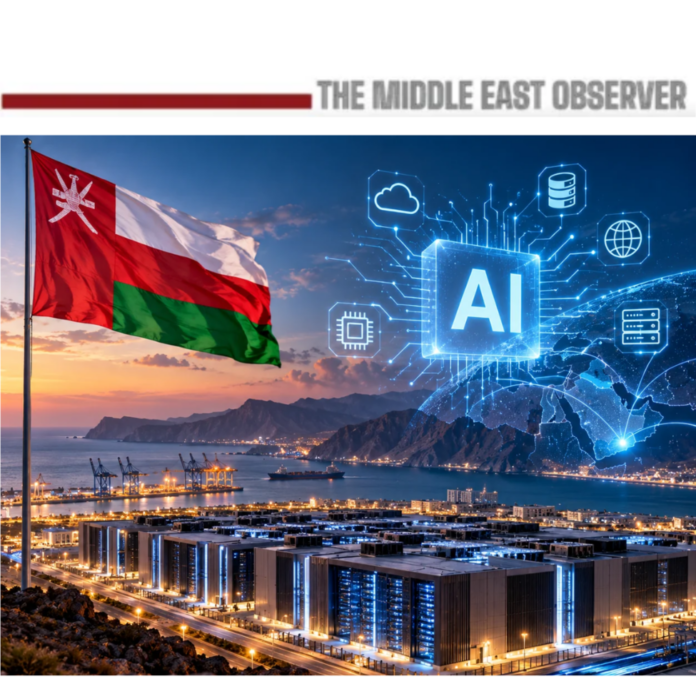
Two proposed developments could transform the southern port city into a regional computing hub, but financing, electricity supply and customer commitments remain crucial.
Oman is positioning Salalah for more than $4 billion in proposed AI data centre investment, as two major developments seek to capitalise on the southern port city’s international connectivity
and renewable energy potential.
UK-founded developer Yamna has signed a cooperation agreement with Oman’s Ministry of Transport, Communications and Information Technology for the Salalah Al Khadra Digital project, whose first phase is expected to exceed £1 billion ($1.3 billion).
Separately, an Omani consortium led by Mubbadrah Investment is planning a $3 billion AI computing complex targeting up to 400 megawatts, bringing the combined value of the two proposals above $4 billion.
The investment figures, however, tell only part of the story.
Mubbadrah says its proposed $3 billion expenditure would cover buildings, power infrastructure,
cooling systems and network connections, while customers would typically provide their own servers and specialised AI chips. Additional investment in computing equipment could therefore increase the
eventual capital deployed.
US AI infrastructure company Crusoe has expressed interest in becoming a potential customer, although no binding capacity-purchase agreement has been announced.
Salalah’s attraction extends beyond investment incentives. Its submarine cable connections offer access to international data networks, while nearby renewable energy developments could support the electricity-intensive requirements of AI computing.
Yamna is already involved with EDF and J-Power in a separate Dhofar green hydrogen project
envisaging 4.5 gigawatts of renewable generation. However, no direct electricity supply arrangement
linking that development to its proposed data centre has been disclosed.
The Mubbadrah consortium has separately outlined plans for solar generation and battery storage
alongside grid electricity.
For investors, Salalah’s opportunity is to turn relatively abundant energy resources and
international connectivity into exportable computing services—not merely to construct data centre buildings.
The scale of that opportunity will depend on financing, grid capacity, reliable power, signed customer
agreements and construction schedules, none of which has been fully disclosed for the two
developments.
Related News:
Khazna and Nvidia Unite to Power Next-Gen Data Economy
GAIIP to Invest $30 Billion in Data Centres and Energy Infrastructure
Read Also:
Dubai’s Edgnex Partners with Europe’s PPC to Launch Major Data Center in Greece
France and UAE Forge Path to AI Excellence with a €50 Billion Data Center Initiative