

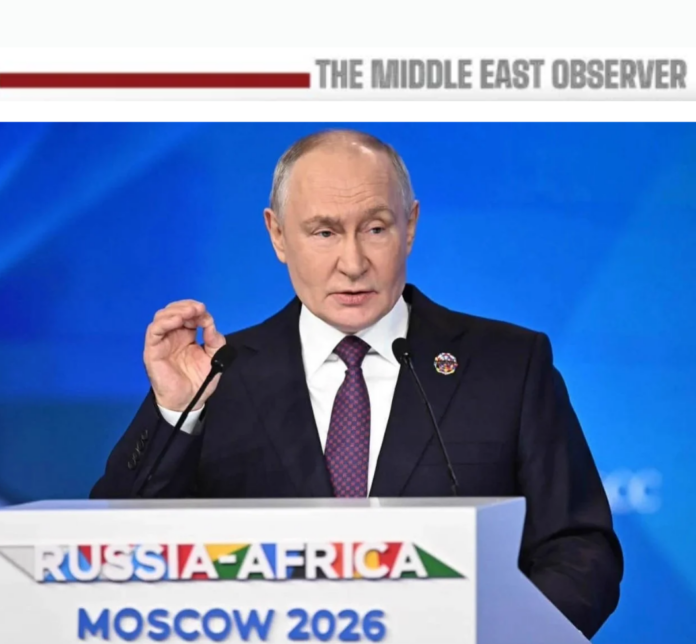
Moscow agreements span nuclear energy, mining, transport, banking, healthcare and technology, but financing and implementation remain the decisive tests.
The Third Russia–Africa Summit concluded in Moscow on October 29, bringing together delegations from 48 African countries for two days of political and economic negotiations that produced 146 agreements and memorandums across the summit and its associated forums.
Russian President Vladimir Putin co-chaired the gathering with Burundi’s President Évariste Ndayishimiye, the African Union chairperson. More than 20 African countries were represented at head-of-state or government level, while the accompanying economic and humanitarian forum attracted more than 3,500 participants from 74 countries.
Egyptian President Abdel Fattah El-Sisi led Egypt’s delegation, with discussions centred on nuclear energy, industrial manufacturing, food security, technology and regional stability.
The summit concluded with three principal policy documents: the Russia–Africa Summit Declaration, a separate declaration on civilian artificial intelligence, and a partnership action plan covering 2027–2029.
According to organiser Roscongress, 92 agreements and 54 memorandums were signed across the summit, economic and humanitarian forum, and media forum. The Kremlin separately identified 53 documents signed at government or interagency level. The wider package includes commercial, academic, media and institutional agreements.
Although the documents cover numerous sectors, neither the Kremlin nor Roscongress disclosed a verified aggregate investment value or a complete public register identifying every signatory and commitment.
El-Sisi Urges Russia and Africa to Move From Political Commitments to Production
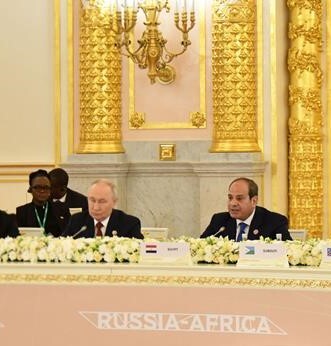
Addressing the October 29 plenary session, President El-Sisi called for a Russia–Africa partnership centred on industrialisation, productive investment and African economic integration.
He said cooperation should help African countries move beyond dependence on raw-material exports towards diversified production, technology transfer and greater domestic value addition.
El-Sisi identified five priorities: establishing strategic transport corridors and logistics zones; increasing intra-African trade; expanding energy cooperation and electricity interconnections; improving water and food security through agricultural development; and strengthening telecommunications, digital infrastructure and artificial intelligence.
He presented the El Dabaa Nuclear Power Plant and the planned Russian Industrial Zone in the Suez Canal Economic Zone as examples of the potential for long-term Egyptian-Russian industrial cooperation.
The president also called for reform of international institutions, particularly the UN Security Council, to ensure stronger African representation in accordance with the Ezulwini Consensus and Sirte Declaration.
On regional security, El-Sisi rejected attempts by non-coastal countries to establish a military presence along the Red Sea, warned against threats to sovereignty in the Horn of Africa and reaffirmed Egypt’s support for Sudan’s unity and territorial integrity.
He reiterated Cairo’s position on transboundary water management, stressing the principles of avoiding significant harm, prior notification, consultation and consensus.
For Egypt, he argued, the value of the Russia–Africa partnership would ultimately depend on converting diplomatic understandings into sustainable development projects.
Egypt–Russia: Major Projects Reviewed, Further Investment Under Discussion
Egypt’s discussions with Moscow centred on four major areas: nuclear power, industrial investment, agricultural trade and energy technology.
El Dabaa nuclear power. El-Sisi and Putin reviewed progress on the four-reactor, 4,800 MW plant being constructed by Russia’s Rosatom on Egypt’s Mediterranean coast.
A new development emerged when Rosatom Director General Alexey Likhachev disclosed that Egypt was considering expanding the project from four to six reactors. If two additional 1,200 MW units were approved and constructed, total planned capacity would rise to 7,200 MW.
The potential expansion remains under consideration. No additional construction contract, financing package or timetable was announced.
Rosatom also identified desalination, nuclear medicine and smaller nuclear installations as possible areas for further cooperation.
Russian Industrial Zone. The presidents reviewed progress on the planned industrial zone within the Suez Canal Economic Zone, intended to attract Russian manufacturers and support exports to Africa and neighbouring markets.
The project is expected to provide opportunities for industrial production, assembly, logistics and technology partnerships. The meeting did not establish a newly disclosed investment amount or confirm additional factories entering operation.
Grain and food security. Egyptian Supply Minister Sherif Farouk met Russian Agriculture Minister Oksana Lut to discuss grain supplies, storage and handling, digital commodity monitoring and logistics infrastructure.
Both sides examined ways of maintaining reliable Russian wheat supplies and improving agricultural supply chains. A possible grain and edible-oil logistics hub remains a development proposal rather than a newly financed summit project.
Battery manufacturing and electricity storage. Electricity Minister Mahmoud Esmat visited RENERA, Rosatom’s battery subsidiary, to examine lithium-ion technology, energy-storage systems and potential manufacturing localisation in Egypt.
The talks are relevant to Egypt’s plans to increase renewable electricity generation and strengthen grid reliability. No binding factory-investment agreement was disclosed.
Egypt’s Trade Challenge: A Large and Uneven Bilateral Relationship
Egyptian government figures put Egypt–Russia merchandise trade at $4.91 billion during the first nine months of 2026, an increase of 22.4 percent from a year earlier.
Egyptian imports from Russia reached approximately $4.25 billion, dominated by grain, vegetable oils, fuel and industrial inputs. Egyptian exports totalled about $660 million, leaving Egypt with a bilateral goods-trade deficit of nearly $3.6 billion.
The figures underline a fundamental economic challenge: expanding Egyptian exports and attracting Russian industrial investment rather than relying principally on imports of essential commodities.
The summit reinforced existing strategic projects, but publicly available announcements did not identify a new Egypt–Russia investment agreement with a disclosed monetary value.
Country-by-Country: Russia’s African Agreements and Commercial Commitments
Beyond Egypt, the summit produced a range of signed agreements, institutional frameworks and proposed investment projects.
Nuclear Energy and Major Industrial Projects
Ghana — Proposed 2,000 MW nuclear plant. Ghanaian Foreign Minister Samuel Okudzeto Ablakwa said Russia agreed to cooperate on developing a 2,000 MW nuclear power station following discussions involving President John Dramani Mahama. Financing, project location and implementation schedules remain undisclosed. The proposal was one of the summit’s more prominent energy announcements.
Uganda — Nuclear roadmap and diplomatic mobility. Rosatom and Uganda’s Ministry of Energy and Mineral Development signed a roadmap covering the peaceful use of nuclear energy and preparations for assessing the proposed Nakasongola nuclear power plant site. The document provides for further technical evaluation before a possible engineering-survey contract.
Uganda and Russia also signed a visa-waiver agreement for holders of diplomatic and service passports. It is subject to completion of domestic procedures before entering into force.
Rwanda — Nuclear infrastructure development. Rosatom and the Rwanda Atomic Energy Board signed a memorandum on assessing and developing national nuclear infrastructure, incorporating International Atomic Energy Agency recommendations. It supports existing discussions on smaller nuclear reactors, a nuclear science and technology centre, and specialist training.
Togo — Peaceful nuclear technology. Rosatom and Togo’s energy authorities signed a memorandum establishing working groups to assess nuclear power, non-electricity applications, infrastructure requirements and technical training. Floating nuclear power facilities were identified as a potential option.
Ethiopia — Nuclear development and healthcare. Russia and Ethiopia continued negotiations concerning Ethiopia’s first nuclear power station, building on a roadmap signed before the Moscow summit. Separately, the governments signed an agreement governing the Russian Red Cross hospital in Addis Ababa, including its modernisation and continued operation.
Burundi — Small nuclear technology. Burundi expressed interest in smaller nuclear reactors and associated technical cooperation. No construction contract or project financing was announced.
Namibia — Nuclear discussions and customs cooperation. Namibia was among countries holding detailed discussions with Rosatom about floating nuclear facilities. Russia also reported customs cooperation arrangements with Namibia. No floating-plant purchase or deployment contract was announced.
Mining, Petroleum and Development Finance
Mali — Geological mapping and mineral data. Mali signed two agreements with Zarubezhgeologia, a subsidiary of Russia’s Rosgeologiya, covering geological mapping and a digital information system for managing mineral resources. These could support future exploration and mining investment, but their financial value was not published.
South Sudan — Oil interests, defence and economic commission. South Sudan and Russia signed preliminary documents concerning the proposed transfer of former Petronas interests in the Dar Petroleum Operating Company and Greater Pioneer Operating Company consortiums to Russian state-owned Zarubezhneft.
The documents included a memorandum of understanding and a letter of acceptance. They do not establish that the proposed transaction has completed.
The two countries also signed an agreement establishing a joint intergovernmental commission on trade, economic, scientific and technical cooperation, while their defence ministries concluded a military cooperation agreement.
Burkina Faso, Mali and Niger — Development finance. Russian development institution VEB.RF and the Confederation of Sahel States’ investment and development bank, BCID-AES, signed a memorandum to identify and assess investment and regional integration projects.
The instrument establishes cooperation in project evaluation and potential financing. It does not constitute an announced loan facility with a disclosed value.
Infrastructure, Transport and Trade
Kenya — Five cooperation memorandums. President William Ruto said Kenya and Russia signed five memorandums covering bilateral cooperation, including economic development. One publicly identified instrument concerns transport cooperation across civil aviation, railways, maritime services, urban transport and integrated logistics.
Kenya also discussed potential Russian participation in airports, the port of Mombasa, roads and railway development, alongside fertiliser manufacturing. Those investment proposals remain distinct from completed construction contracts. The full subjects of all five memorandums were not individually disclosed in the reviewed reports.
Mozambique — Road infrastructure. The Russian and Mozambican transport ministries signed a memorandum on cooperation in road construction, reconstruction, maintenance and related infrastructure management.
Sierra Leone — Transport and maritime logistics. Russia signed a memorandum with Sierra Leone covering transport, transit corridors and logistics. Discussions included port development, freight movements, aviation and technical training. Specific infrastructure investments remain dependent on feasibility work and financing.
Central African Republic — Transport and bilateral relations. Russia and the Central African Republic signed an agreement establishing the foundations of bilateral relations and a transport and transit memorandum addressing passenger and freight services, aviation and international transport corridors.
Additional agreements covered legal cooperation and mutual recognition of educational qualifications.
Senegal — Economic cooperation commission. Russia and Senegal signed an agreement establishing an intergovernmental commission responsible for trade, economic, scientific and technical cooperation.
Democratic Republic of Congo — Bilateral economic commission. Russia announced an agreement establishing an intergovernmental commission to coordinate economic and technical cooperation.
Nigeria — Customs cooperation. Russia reported customs-related agreements with Nigeria aimed at facilitating cooperation between relevant authorities.
Seychelles — Fish-export market access. Russian regulators approved three Seychelles-based fish exporters for access to the Russian market. This was a regulatory and commercial development, rather than a disclosed investment contract.
Agriculture, Healthcare and Education
Madagascar — Agriculture and epidemic preparedness. Russia and Madagascar signed an agricultural cooperation memorandum covering trade, scientific collaboration, plant breeding, seed production and livestock development.
A second memorandum, signed by Russia’s public-health regulator Rospotrebnadzor and Madagascar’s health authorities, covered infectious-disease prevention, laboratory cooperation and epidemic response.
Central African Republic — Healthcare and disease prevention. In addition to its transport and institutional agreements, the country signed two healthcare memorandums with Russian authorities.
One covers public-health systems, professional training, medical technologies and research. The other focuses on sanitary and epidemiological preparedness, information exchange and responses to infectious diseases.
Sudan — University and regional cooperation. St Petersburg University signed two agreements with Sudan’s Red Sea State authorities and Red Sea University, expanding educational and institutional cooperation.
The agreements were signed on October 28 and form part of the summit’s wider academic partnership programme.
Tanzania — Agricultural technologies and professional training. Russia reported cooperation initiatives involving the adaptation of agricultural technologies and specialist training in Tanzania. Detailed investment commitments were not disclosed.
Mauritania — Justice and broadcasting. Mauritania signed agreements with Russia covering extradition and the transfer of sentenced persons. Its national broadcaster also concluded a cooperation protocol with RT.
Togo — Maritime professional qualifications. In addition to nuclear cooperation, Togo signed an agreement with Russia on mutual recognition of seafarers’ professional certificates, intended to facilitate maritime employment and qualification verification.
Regional Institutions, Business Associations and Media
The summit’s cooperation programme also extended beyond national governments.
African Union Commission. Russia and the AU Commission signed a 2027–2029 action plan covering 19 cooperation areas, including trade, energy, security, technology, agriculture, infrastructure, education and institutional coordination. The instrument is expressly non-binding under international law.
Southern African Development Community. SADC and Russia signed an action plan covering industrialisation, agriculture, energy, trade, transport, mining, information technology, healthcare and regional integration.
Continental and regional trade organisations. Russia reported memorandums with the East African Community, COMESA and the African Continental Free Trade Area Secretariat, alongside other regional cooperation plans. These arrangements seek to strengthen institutional links and improve future trade coordination.
Business and investment institutions. Roscongress reported cooperation agreements with organisations including the Federation of West African Chambers of Commerce and Industry, business and exhibition organisations in Tunisia’s Sfax region, and Chad’s chamber representing trade, industry, agriculture, mining and handicrafts.
Youth and professional organisations. Further Roscongress agreements involved the Russia–Africa Youth Union, South Africa’s BRICS Youth Association, the African Youth Congress, Jet Age National Builders and Nigeria’s Abia State Ministry of Sports and Youth Development.
Universities and news agencies. Additional documents were signed among educational establishments, media organisations and commercial associations. The Russia–Africa Media Forum, involving RT, TASS and Rossiya Segodnya, examined journalist training, international news exchange and expanded media cooperation.
These institutional, commercial, academic and media agreements form part of the wider 146-document total. Their full individual register and combined monetary value were not made public in the organiser’s final summary.
El-Sisi’s Diplomatic Meetings: Russia, Sudan, Kenya and Mali
President El-Sisi used the summit to review Egypt’s strategic projects and coordinate with African counterparts on regional developments.
Putin, October 28. The presidents discussed implementation of El Dabaa and the Russian Industrial Zone, expansion of trade and cooperation in healthcare, tourism, education and scientific research. Their diplomatic agenda included the war in Ukraine, the Horn of Africa and Nile water security.
El-Sisi expressed support for a negotiated settlement to the Ukraine conflict and reiterated Egypt’s position on regional sovereignty and shared water resources.
Rosatom’s Alexey Likhachev, October 29. El-Sisi reviewed El Dabaa’s construction progress and urged continued adherence to agreed schedules and project standards. Likhachev reported on implementation milestones.
Sudan, Kenya and Mali, October 29. Egypt’s presidency confirmed a meeting involving Sudanese Sovereign Council Chairman Abdel Fattah Al-Burhan, Kenyan President William Ruto and Mali’s transitional leader Assimi Goïta. It published a photograph identifying the participants but no detailed account establishing additional signed agreements.
The meeting took place against Egypt’s continuing diplomatic concerns over Sudan’s conflict, regional security and African economic integration.
The Wider Summit Agenda: Trade, Payments and Global Influence
Putin used the summit to call for a larger Russian economic role in Africa and reforms to international financial institutions.
Russian officials reported that bilateral merchandise trade with Africa exceeded $27 billion in 2025, while Putin proposed increasing the figure beyond $50 billion.
The Russian president said grain deliveries to Africa exceeded 18 million tonnes in 2025 and reached approximately 13 million tonnes during the first nine months of 2026.
Food security, fertiliser supplies, local agricultural processing and more resilient payment and logistics systems were prominent economic themes.
The summit’s 101-point final declaration supported closer cooperation in trade, natural-resource processing, energy, healthcare, education and environmental protection.
It also called for stronger African representation in global institutions, opposed unilateral sanctions and supported efforts addressing the consequences of colonial rule, including restitution of cultural property.
The separate AI declaration encouraged cooperation in civilian artificial intelligence, research, education, digital capacity and technology access. Commercial projects and funding will require subsequent arrangements.
On security, Putin said Russia already maintained military or military-technical cooperation agreements with 45 African countries. This was a statement about existing relationships, not 45 new military agreements signed in Moscow.
Global Assessment: Nuclear Expansion Draws Attention, Financing Remains Uncertain
International coverage identified nuclear energy as a particularly significant commercial development.
Rosatom reported discussions about major nuclear projects with Egypt, Ghana, Ethiopia and Uganda, while exploring floating power facilities with Egypt, Tanzania, Namibia and Togo.
Ghana’s proposed 2,000 MW plant and Egypt’s possible expansion of El Dabaa were among the more substantial announcements in generating-capacity terms. Neither, however, was accompanied by a disclosed final financing agreement or additional construction contract at the summit.
The meeting also underscored Moscow’s effort to expand its African relationships despite the war in Ukraine and Western sanctions.
African governments approached the summit with differing priorities, from electricity and food supplies to infrastructure, healthcare, mining and security. Participation did not amount to a collective commitment to replace Western or Chinese economic partnerships with Russia.
Indeed, Russia’s $27 billion annual trade with Africa remains relatively modest compared with the continent’s commerce with China and the European Union.
Financing constraints, sanctions-related payment difficulties, project preparation, nuclear regulation and infrastructure requirements remain material obstacles to implementing several proposals.
The summit nevertheless produced additional institutional arrangements, sectoral agreements and technical cooperation frameworks that could develop into investment projects during the next three years.
Conclusion: From 146 Documents to Measurable Economic Results
The Third Russia–Africa Summit expanded Moscow’s diplomatic engagement and established a new cooperation framework through 2029, supported by agreements in energy, transport, mining, agriculture, healthcare, education and technology.
For Egypt, the most consequential developments were the review of El Dabaa and the Russian Industrial Zone, the possibility of further nuclear capacity, and discussions on grain logistics and battery manufacturing.
Across Africa, new nuclear partnerships, geological mapping agreements, transport memorandums and development-finance cooperation demonstrated the range of Russian commercial ambitions.
Yet 146 documents do not represent 146 financed projects, and the number signed cannot be converted into an investment total without their contractual values and implementation terms.
The question now is how many commitments result in approved financing, operating facilities, additional energy generation, industrial production and stronger trade.
For Egypt and its African partners, the economic significance of Moscow will be determined not by the size of the signing programme, but by the investments and production it delivers through 2029.
Related news:
- Petrojet, Atomstroyexport Pen $100mn Contract for El-Dabaa Nuclear Plant Works
- Egypt Eyes Industrial Expansion Across Africa as Regional Trade Hits $214bn
Read Also: