

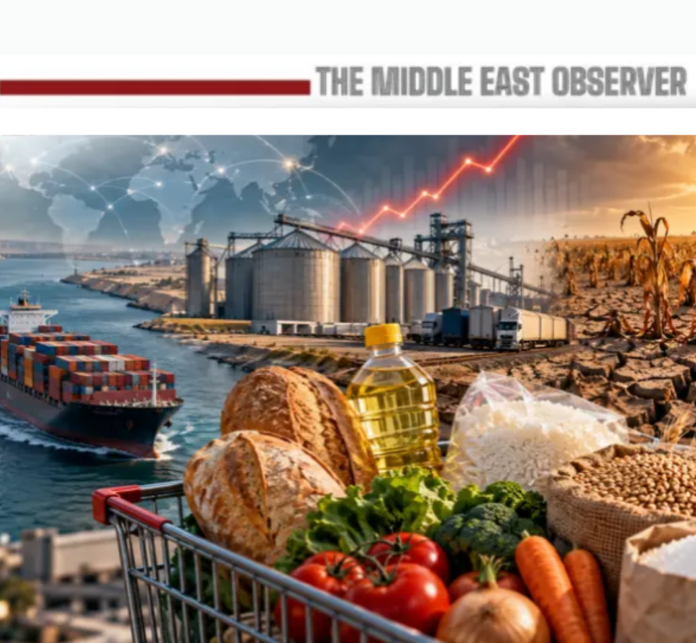
The World Bank forecasts an 18% cumulative increase in food commodity prices in 2026–27. Gulf import dependence, North Africa’s contrasting harvests and Egypt’s currency pressures expose consumers and industries to sharply different risks, while discount retailers and efficient food producers could gain ground.
The world’s largest food manufacturers are preparing for further price increases in 2027 as energy, agricultural and transport costs rise, threatening another inflationary shock across the Middle East and North Africa, where dependence on imported food, currency pressures and uneven purchasing power could create sharply contrasting economic winners and losers.
The warnings follow October financial disclosures from Nestlé, Coca-Cola, Unilever, Danone and other multinational consumer-goods companies, while the World Bank’s latest Commodity Markets Outlook, released on October 28, forecasts an approximately 18% cumulative increase in international food commodity prices during 2026–2027.
The Bank expects food prices at the commodity level to increase about 10% in 2026 and another 7% in 2027, alongside a 32% rise in energy prices and a 14% increase in fertiliser costs this year.
Unlike the inflation shock of 2022, manufacturers now face consumers whose purchasing power has already been weakened by several years of higher living costs. Further increases risk accelerating the shift towards cheaper brands, reducing sales volumes and squeezing corporate profits.
For MENA economies, the consequences will depend largely on food-import dependence, domestic agricultural production, foreign-exchange stability and the ability of governments and manufacturers to absorb higher costs. Egypt illustrates the dilemma particularly clearly: substantial grain imports and a weaker currency are increasing production costs even as processed-food exports reach record levels.
From the 2022 Food Shock to Renewed Inflation in 2026
International food markets had gradually stabilised after the price surge triggered by pandemic-related supply disruption and Russia’s invasion of Ukraine in 2022.
That improvement began to reverse in 2026 as the Middle East conflict disrupted energy production and shipping, while Black Sea trade interruptions and adverse weather placed additional pressure on agricultural supplies.
The deterioration became measurable in September.
According to the UN Food and Agriculture Organization (FAO), its Food Price Index reached 136.0 points, increasing 1.5% from August and 5.8% from September 2025.
International cereal prices rose 5.1% during the month and stood 17.2% above their year-earlier level. Wheat quotations increased 6.3%, while maize prices advanced 5.6%, reflecting shipping constraints, tighter export availability and weather-related production concerns.
Nevertheless, the overall FAO index remained 15.1% below its March 2022 peak. The evidence therefore points to a renewed inflationary cycle rather than a return, so far, to the extreme prices recorded four years earlier.
The disruption extends beyond agricultural commodities.
Higher oil and natural-gas prices affect fertiliser manufacturing, mechanised farming, irrigation, food processing, refrigeration, packaging and transportation. Shipping interruptions and higher insurance costs further increase the expense of delivering food and industrial inputs to import-dependent economies.
These pressures can persist after energy prices begin moderating because agricultural production, raw-material procurement and distribution operate through seasonal and contractual cycles.
The result is an inflationary transmission chain extending from energy and fertiliser markets to farms, factories, retailers and ultimately consumers.
October Corporate Results Reveal the Price–Demand Dilemma
Recent multinational earnings reports provide the clearest evidence of the pressures confronting the food industry.
US packaged-food producer Campbell’s offered an early warning in September, forecasting adjusted earnings per share of $1.65–$1.80 for fiscal 2027, down from $2.17 in fiscal 2026.
That represents a projected decline of approximately 17–24%, while organic sales are expected to contract 2–4%. The outlook illustrates how higher costs and weak consumer demand can undermine earnings even when manufacturers pursue price increases and efficiency programmes.
On October 22, Nestlé reported third-quarter organic sales growth of 4%, including 2.8% real internal growth and 1.1% pricing.
Its Food & Snacks division showed a different pattern: real internal growth reached 5.4%, while pricing declined 0.4%. The figures demonstrate that maintaining or rebuilding sales volumes can be more important than increasing prices across every product category.
The same day, Procter & Gamble, primarily a household and personal-care manufacturer, estimated that higher commodity and related costs would impose a $1.4 billion after-tax earnings burden in fiscal 2027. Although not principally a food producer, its exposure demonstrates the wider inflationary pressure on consumer-product manufacturers.
On October 27, Coca-Cola reported third-quarter organic revenue growth of 7%, with worldwide unit-case volumes increasing 5% and price/product mix contributing 1%.
Its Europe, Middle East and Africa division also recorded 5% volume growth and 1% price/mix growth, with operating earnings benefiting partly from lower input costs within that division.
The results provide an important counterexample: not every multinational is currently experiencing deteriorating margins, and successful volume growth remains possible.
The following day, Unilever reported third-quarter underlying sales growth of 5.2%, comprising 2.3% pricing growth and 2.9% volume growth.
Its food division, however, recorded sales growth of only 0.1%, as a 1.3% pricing contribution was largely offset by a 1.1% decline in volumes.
Chief Executive Fernando Fernandez indicated that pricing growth in 2027 was expected to exceed the company’s 2026 average as manufacturers respond to higher costs.
Danone’s October 28 results reinforced the picture. The French food group reported third-quarter like-for-like sales growth of 4%, with price increases contributing 3.6 percentage points and volume/mix growth only 0.4 percentage points.
Its €7.23 billion quarterly revenue demonstrates that stronger sales value does not necessarily indicate a comparable expansion in quantities sold.
Taken together, these disclosures suggest that international food manufacturers are entering another period of cost-driven pricing, but with less freedom to raise prices without affecting demand.
Consumer research supports that conclusion.
According to NielsenIQ’s August 2026 study, 58% of surveyed consumers said the distinction between national brands and private-label products did not determine their purchasing decisions, while 68% regarded private labels as credible alternatives.
Approximately one-third of price-constrained consumers indicated they would switch to cheaper products or brands on promotion.
The implication is significant: higher food prices could redistribute market share towards affordable alternatives rather than produce a corresponding increase in profitability for established brands.
MENA: One Global Shock, Three Different Economic Outcomes
The impact across the Middle East and North Africa cannot be assessed through a single regional inflation estimate.
The World Bank’s October 6 regional update forecast economic output across its wider MENAAP grouping contracting by 2.1% in 2026, with Gulf Cooperation Council economies facing a sharper 4.3% contraction as the conflict disrupted energy exports, transportation and commercial activity.
Yet domestic food-price developments differ substantially between countries because of exchange-rate arrangements, agricultural production, strategic reserves, import financing and government policies.
Gulf Countries: High Import Dependence, Stronger Financial Buffers
The Gulf Cooperation Council countries — Saudi Arabia, the UAE, Qatar, Kuwait, Bahrain and Oman — remain particularly exposed to imported food and international shipping.
According to the IMF’s April 2026 regional assessment, imports account for more than 80% of food consumption in Bahrain, Kuwait, Qatar and the UAE, and more than 50% in Saudi Arabia and Oman.
This dependence makes international agricultural prices, shipping routes, marine insurance and inventory replenishment economically important.
Saudi Arabia provides a clear example. FAO forecasts cereal import requirements of approximately 15 million tonnes during the 2026/27 marketing year, including 4 million tonnes of wheat, 4 million tonnes of maize and 5 million tonnes of barley.
The substantial feed-grain requirements reflect domestic poultry and livestock production, making these industries sensitive to internationally traded agricultural commodities.
However, higher global commodity prices have not yet translated into equivalent retail inflation.
Saudi Arabia’s official statistics showed annual food and beverage inflation of 1.4% in September, compared with headline inflation of 1.9%.
The Gulf benefits from stronger financial resources, strategic food inventories, diversified sourcing and relatively stable currency arrangements. These factors can moderate the immediate effect on consumers.
Nevertheless, prolonged shipping disruption could increase the cost of replenishing inventories and put additional pressure on food importers, processors and distributors.
The World Bank’s projected GCC economic contraction also demonstrates that higher oil prices do not necessarily benefit Gulf exporters when production and shipping restrictions reduce their export volumes.
The Gulf’s principal food-industry risk is therefore higher import and logistics costs, particularly for feed-intensive producers, restaurants and businesses dependent on international supply chains.
Maghreb Countries: Improved Harvests Produce Uneven Protection
The Maghreb presents a different economic picture, with domestic agricultural production playing a greater role in determining exposure.
Morocco, Algeria and Tunisia benefited from improved cereal harvests during 2026, although their import requirements and domestic price developments remain markedly different.
In Morocco, FAO forecasts cereal production of approximately 6.3 million tonnes, about 16% above the five-year average, following improved rainfall after successive drought-affected seasons.
The stronger harvest is expected to reduce wheat import requirements to approximately 5 million tonnes in 2026/27, roughly 15% below their five-year average.
Morocco’s High Commission for Planning reported that food prices declined 2.5% year-on-year in September, although they increased 1.6% from August.
This illustrates how better domestic supply conditions can cushion an economy against global commodity inflation, even while monthly price volatility continues.
Algeria also recorded an agricultural recovery. FAO forecasts cereal production of approximately 5 million tonnes, nearly 30% above average and the largest harvest since 2019.
Nevertheless, cereal imports are expected to reach 14.5 million tonnes, including 8.5 million tonnes of wheat and 5 million tonnes of maize, leaving the country substantially exposed to international grain markets.
Tunisia faces greater domestic consumer-price pressure.
Despite an estimated cereal harvest of 1.8 million tonnes, nearly 20% above average, its National Institute of Statistics reported food and beverage inflation of 8.4% in September, compared with headline inflation of 5.6%.
Poultry prices increased 16.5% year-on-year, fresh fruit rose 16.3%, sheep meat 14.6% and beef 13%.
The figures demonstrate that improved grain harvests do not automatically prevent increases in meat, fresh produce and processed-food prices.
Libya remains more vulnerable because of limited domestic cereal production and currency pressures.
FAO estimates its 2026 cereal output at approximately 150,000 tonnes against import requirements of 3.3 million tonnes. Food inflation reached around 18% year-on-year in May, according to the agency’s earlier country assessment.
The Maghreb’s exposure therefore ranges from partial protection through stronger agricultural production to substantial inflation and foreign-exchange vulnerability.
Other MENA Economies: From Import Costs to Food Insecurity
Jordan and Lebanon face continuing exposure to international grain markets, although their monetary and financial conditions differ.
Jordan’s relatively stable monetary framework and established procurement arrangements provide some protection against exchange-rate volatility, but higher world prices can still increase the cost of strategic reserves and food imports.
Lebanon faces more severe constraints because of import dependence, damaged infrastructure and limited financial resilience.
FAO forecasts Lebanese cereal import requirements at approximately 1.3 million tonnes in 2026/27, compared with domestic cereal production of roughly 160,000 tonnes.
Iraq has substantial hydrocarbon resources, but food-import costs and agricultural input prices remain sensitive to disruptions in regional trade and energy markets.
The greatest humanitarian risks are concentrated in conflict-affected economies.
On October 7, FAO reported that more than 45 million people were facing severe hunger across Gaza, Lebanon, Sudan, Syria and Yemen.
In these markets, rising food prices interact with damaged agricultural production, displacement, weak household incomes and interruptions to humanitarian assistance.
The concern extends beyond affordability to the physical availability of essential supplies.
Egypt: Imported Inflation Meets Record Food Exports
Egypt provides a particularly important case study because its substantial agricultural imports coexist with a growing processed-food export industry.
FAO forecasts Egypt’s cereal import requirements at approximately 29 million tonnes during the 2026/27 marketing year, about 30% above the historical average.
The total includes 13.5 million tonnes of wheat and 15.5 million tonnes of maize.
Domestic wheat production is expected to reach approximately 10 million tonnes in 2026, nearly 7% above average, but the improvement does not eliminate the need for substantial foreign purchases.
The country’s financial exposure intensified during October as the Egyptian pound weakened against the dollar.
Central Bank data show that the average dollar selling rate increased from EGP52.3906 on October 6 to EGP56.1986 on October 27, raising the local-currency cost of purchasing dollars by approximately 7.3%.
For food manufacturers importing grain, edible oils, packaging materials or production equipment, currency depreciation can amplify higher international prices.
The scale of exposure is substantial.
At FAO’s forecast import volumes, a hypothetical $50-per-tonne increase in the price of both wheat and maize would add approximately $675 million to Egypt’s annual wheat import expenditure and $775 million to its maize import expenditure.
The combined additional cost would reach approximately $1.45 billion, assuming unchanged import quantities.
This is an illustrative sensitivity calculation, not a forecast. Actual expenditure depends on procurement contracts, quantities, freight, financing and exchange rates.
The effects extend throughout the domestic food chain.
Higher maize and soybean meal prices increase animal-feed costs, placing pressure on poultry, livestock, dairy and aquaculture producers. Rising wheat costs affect millers, bakeries and pasta manufacturers, particularly those serving price-sensitive domestic markets.
The consumer environment is already challenging.
According to CAPMAS, nationwide annual headline inflation reached 12.8% in September, while food and beverage prices increased 7.9% year-on-year.
The Central Bank separately reported annual urban headline inflation of 13.9%, reflecting a different statistical measure.
These figures show that Egyptian households have already absorbed substantial increases in essential living costs before the full potential impact of the latest international commodity forecasts.
Food Exports Provide a Partial Counterweight
Despite higher costs, Egypt’s processed-food exports continue to expand.
The Food Export Council reported exports of $5.821 billion during January–September 2026, an increase of 12.6% from $5.170 billion during the corresponding period of 2025.
September shipments alone reached $655 million, up 20.9% year-on-year.
The sector included 2,848 active exporting companies supplying 182 international markets, strengthening its contribution to Egypt’s foreign-currency earnings.
Export-oriented manufacturers can partly offset the impact of currency depreciation through dollar- and euro-denominated revenues.
Nevertheless, the benefit depends on the balance between foreign-currency earnings and imported raw-material requirements.
Companies relying heavily on imported wheat, maize, vegetable oils or machinery may still experience rising costs despite growing exports.
The difference between export-oriented and domestic-market manufacturers is becoming increasingly important.
Businesses earning foreign currency may have greater flexibility to secure imported inputs and maintain production. Domestic producers selling mainly in Egyptian pounds face rising costs without necessarily possessing the pricing power to recover them.
Egypt’s challenge is therefore to preserve the competitiveness of its expanding food export industry while preventing imported inflation from undermining domestic food affordability and industrial profitability.
The 2027 Forecast: What International Agencies Actually Predict
The latest international forecasts confirm continued price risks, but they do not support a uniform percentage increase in retail food prices across MENA.
The World Bank’s October 28 outlook provides the clearest forward assessment of international food commodities.
It projects an increase of approximately 10% in 2026 and another 7% in 2027, producing a cumulative rise of about 18% over the two years.
Its baseline assumes Brent crude will average $91 per barrel in 2026 before declining to $79 in 2027.
Under an adverse scenario involving further energy disruption, renewed attacks on Black Sea grain shipments and a very strong El Niño, the Bank estimates Brent could average $105 per barrel in 2027.
International food commodity prices could then stand 12% above its 2027 baseline projection and exceed their 2022 peak.
That is a conditional risk scenario, not the central forecast.
FAO’s September Food Price Index recorded an actual annual increase of 5.8%, while cereal prices rose 17.2% year-on-year. These are observed commodity-market movements, not 2027 forecasts.
The IMF’s October World Economic Outlook projects global headline consumer inflation of 4.7% in 2026 and 4.1% in 2027, covering food and non-food expenditure.
Meanwhile, the US Department of Agriculture forecasts American retail food inflation of 2.8% in 2026 and 1.7% in 2027, although its 2027 estimate carries a wide uncertainty interval.
These differences are significant.
International agricultural commodities account for only part of final retail food costs. Processing, labour, packaging, transportation, exchange rates, inventories, competition and government policies influence how much inflation ultimately reaches consumers.
The World Bank’s cumulative 18% forecast must therefore be understood as an international food-commodity projection, not a prediction that supermarket prices across MENA will rise by 18%.
Who Faces the Greatest Losses?
The most exposed industries are those whose costs depend heavily on imported materials but whose customers cannot sustain equivalent price increases.
Poultry, livestock and aquaculture producers face particularly acute pressure because animal feed accounts for a substantial share of production expenditure. Higher maize, soybean meal and transport costs can quickly reduce profitability, particularly when domestic selling prices remain constrained.
Import-dependent flour mills, bakeries and pasta manufacturers are similarly vulnerable to wheat-price movements, exchange-rate depreciation and increasing working-capital requirements.
Mid-market branded packaged-food manufacturers risk losing customers to cheaper alternatives as higher ingredient, packaging and distribution costs coincide with weaker household purchasing power.
Restaurants, catering businesses and food-service operators face a double squeeze from higher food costs and declining discretionary consumer spending.
Smaller food importers and wholesale distributors may experience significant liquidity pressure as inventories, insurance, financing and foreign-currency purchases become more expensive.
The greatest industrial losses are not necessarily associated with the largest price increases. They are more likely to occur where businesses cannot protect profit margins without sacrificing sales volumes.
Campbell’s projected earnings decline and Unilever’s weak food-volume performance demonstrate why pricing power and cost efficiency have become central measures of financial resilience.
Which Industries Could Emerge Stronger?
The same inflationary environment may create opportunities for businesses offering better value or controlling production costs more effectively.
Discount supermarkets and private-label food manufacturers have a clear opportunity to attract price-sensitive consumers seeking cheaper substitutes for established national brands.
Efficient domestic agricultural producers may become more competitive as imported food becomes expensive, provided higher fertiliser, energy and financing costs do not eliminate that advantage.
Export-oriented food manufacturers with positive net foreign-currency earnings may be better positioned to finance imported materials and defend margins.
Vertically integrated and highly automated food processors may benefit from greater control over procurement, production, inventory and distribution, enabling them to maintain lower unit costs than less efficient competitors.
Grain storage, efficient logistics and food-supply technology providers could benefit from increased public and private investment in procurement resilience, inventory management and food security.
These opportunities do not guarantee higher profits. Market-share gains may be accompanied by additional operating costs, while higher agricultural selling prices can be offset by more expensive inputs.
The distinction will increasingly be between companies capable of maintaining affordable prices and reliable supplies, and those dependent on cost increases that their customers are unwilling or unable to absorb.
Consumers Face the Greatest Pressure
The developing food-price shock threatens to create a widening economic divide across global and regional food markets.
Consumers, particularly lower-income households, face the most immediate consequences. Higher spending on essential food reduces disposable income, encourages switching to cheaper products and can weaken consumption of more expensive and nutritious foods.
The consequences extend beyond food retail. Reduced purchasing power can affect restaurants, discretionary consumer services and other sectors dependent on household spending.
For manufacturers, the greatest risks are concentrated in feed-intensive agriculture, import-dependent processing, conventional packaged foods and smaller distributors with limited financial resources.
The principal competitive opportunities lie with value retailers, private-label producers, efficient domestic agriculture, export-oriented manufacturers and companies capable of reducing unit production and distribution costs.
Across MENA, outcomes will remain uneven.
Gulf economies face imported-cost and shipping risks moderated by stronger financial resources and strategic reserves. Maghreb countries benefit to varying degrees from improved agricultural harvests, while financially fragile and conflict-affected economies confront greater threats to food affordability and security.
Egypt faces a particularly complex balance between expanding food exports and substantial exposure to imported grain and foreign-currency costs.
For governments, the priorities should be diversified procurement, efficient storage and transport, competitive domestic production and targeted support for vulnerable households.
For businesses and investors, the critical measures will be sales-volume resilience, operating margins, cash generation, imported-input exposure and access to foreign-currency financing.
The World Bank’s projected 18% cumulative increase in international food commodity prices during 2026–27 establishes the scale of the global warning, but the decisive economic question is who will ultimately absorb the cost.
Consumers with limited purchasing power are likely to bear the greatest burden. The most vulnerable industries will be those unable to recover rising costs without losing sales, while the strongest competitive beneficiaries could be businesses capable of supplying food more efficiently and affordably.
The defining challenge for 2027 will be preserving food affordability without undermining the financial viability of the industries responsible for producing and supplying it.
Related news:
- The Egypt Opportunity: Why Health, Food and Agriculture Could Turn a Massive Market into a Regional Production Hub
- Egypt’s Crude Oil and Petroleum-Product Import Bill Projected to Double
