

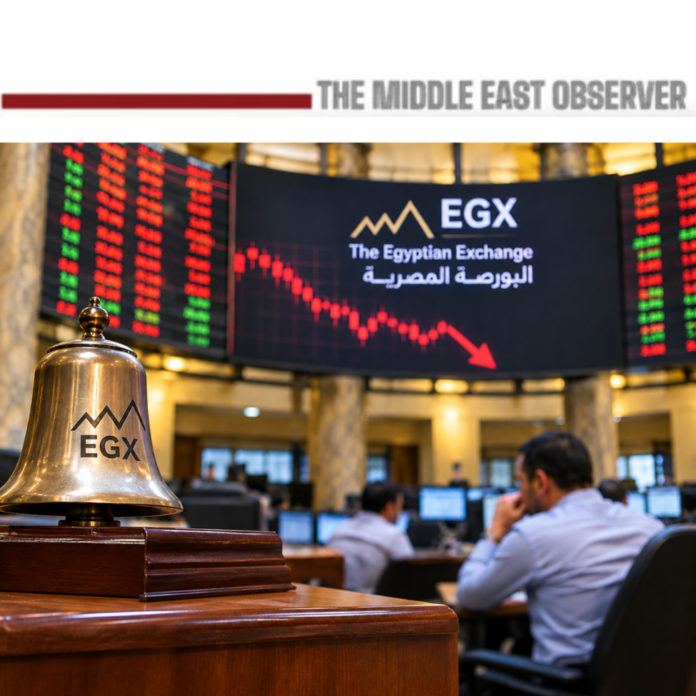
EGX30 lost nearly 2% over the week and another 1.7% on Sunday as institutional selling, weak liquidity and elevated Treasury yields undermine recovery despite a firmer pound.
CAIRO, Egyptian equities struggled to sustain a recovery during the week ended October 29, with the benchmark EGX30 losing approximately 1.9% before falling another 1.72% on Sunday to 48,744 points. Repeated rebounds failed to reverse the correction as institutional selling and weak liquidity weighed on demand, while the central bank’s latest interest-rate increase intensified competition from high-yielding government securities.
Rebounds Fail as Liquidity Weakens
The EGX30 rebounded 3.49% on Tuesday, October 27, before losing 1.64% on Wednesday and recovering just 0.64% on Thursday. Sunday’s renewed decline left the benchmark 7.8% below its October 21 close of 52,854.95 points, although it remained approximately 16.5% higher since the beginning of the year.
The index briefly reached 49,650.94 points on Sunday before retreating almost 907 points from its intraday high. The EGX70 declined 0.68%, while EGX100 lost 1.01%.
Trading turnover reached EGP7.203 billion, 35.2% below its 90-day average, according to EnterpriseAM. Declining stocks outnumbered gainers by more than two to one, confirming that the rebound had failed to attract broad buying support.
Institutional Selling Outweighs Retail Buying
Egyptian institutions sold approximately EGP218.5 million net on Sunday, while Arab and non-Arab foreign institutions recorded net sales of EGP44.1 million and EGP42.4 million, respectively. Egyptian individual investors bought EGP348.7 million net, absorbing substantial institutional supply without reversing the decline.
Across investor nationalities, Egyptians purchased EGP130.2 million net, offsetting EGP89.6 million in Arab selling and EGP40.6 million in non-Arab foreign selling.
Palm Hills Development fell 7%, GB Corp 6.9% and Ibn Sina Pharma 4.9%, while Abu Dhabi Islamic Bank Egypt gained 3.4%, AMOC 2.2% and Edita Food Industries 1.6%.
Market capitalization closed at approximately EGP3.897 trillion, marginally above Thursday’s EGP3.892 trillion. The divergence from falling indices reflects different measures of market performance and does not, by itself, establish renewed institutional demand.
Higher Rates Intensify an Existing Correction
The Central Bank of Egypt raised interest rates by 100 basis points on October 29, taking overnight deposit and lending rates to 20% and 21%, respectively.
The decision intensified a correction already underway amid profit-taking, portfolio reallocation, currency volatility and foreign selling of government securities.
At the October 29 Treasury-bill auction, weighted average accepted yields reached 26.076% on 364-day instruments and 25.457% on 182-day bills. Such elevated nominal returns strengthen the attraction of fixed-income investments while higher borrowing costs challenge corporate valuations.
Pound Stabilises Ahead of €600mn Debt Auction
The dollar weakened approximately 0.5% against the pound on Sunday, with central-bank quotations near EGP55.71 buying and EGP 55.85 selling.
The currency’s improvement contrasted with continued Arab and foreign equity selling, indicating that exchange-rate stabilisation has yet to restore sustained investment demand.
The central bank is scheduled to auction €600 million in 364-day euro-denominated Treasury bills on November 2, ahead of an existing maturity on November 3.
At the comparable November 2025 auction, investors submitted €707.8 million in bids, with €627.8 million accepted at a weighted average yield of 2.25%. The new auction’s coverage and pricing will test demand for Egyptian sovereign exposure in euros.
Banque du Caire Tests Institutional Appetite
Banque du Caire is scheduled to begin trading on November 2 following an EGP36.37 billion share offering representing 45% of its issued capital.
The public tranche attracted approximately 27 times subscription coverage, while the institutional placement was covered six times. However, the exceptional transaction also dominated Thursday’s reported turnover and foreign investment flows, complicating comparisons with ordinary secondary-market activity.
The bank’s trading debut will provide a clearer test of whether strong subscription demand translates into sustained institutional investment.
Separately, Egyptian Exchange Chairman Omar Radwan has outlined plans to enable remote electronic contracting for investors from approximately 150 countries through an e-Passport system undergoing regulatory testing. The initiative could broaden market access, although its liquidity impact remains prospective.
Recovery Hinges on Institutional Confidence
The EGX30’s immediate challenge is to recover the 49,600–50,000-point area with stronger turnover, improving breadth and renewed institutional buying. The euro debt auction and Banque du Caire’s debut will provide further evidence of investor appetite under tighter financial conditions.
Egypt’s equity correction has evolved from profit-taking into a broader test of liquidity, valuations and institutional confidence. A firmer pound may ease currency pressure, but sustained recovery will depend on whether institutions return to equities despite elevated government-security yields.
Related news:
Africa Arrives: Egypt’s Historic Run Signals a New Era for African Football
Egypt’s Equity Rebound Masks Continued Institutional Selling
Read also:
EGX Closes Week Higher on Strong Foreign Buying and Debt-Market Recovery
Egypt’s Open-Blocks System Draws 403 Offers in First Major Investor Test