

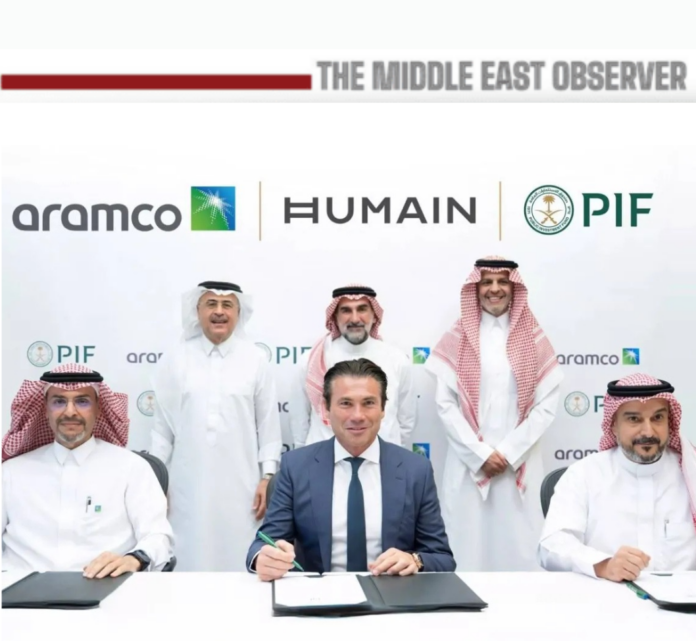
Saudi Aramco has completed its acquisition of a 49% stake in HUMAIN, Saudi Arabia’s flagship artificial intelligence company, in a move aimed at turning the kingdom’s energy resources and industrial expertise into a globally competitive AI export industry.
Under the transaction announced on Sunday, Aramco will contribute approximately SAR 9.9 billion ($2.6 billion) in cash during 2026, alongside AI, computing and digital assets. The Public Investment Fund (PIF) retains 51% ownership, according to the companies’ joint statement. The deal completes a process initiated in October 2025, although the value of the transferred assets and HUMAIN’s overall valuation were not disclosed.
The strategic objective is to move beyond exporting energy towards exporting the computing power and industrial intelligence that energy can support. Saudi Arabia aims to use its energy resources, industrial infrastructure and financial strength to operate advanced AI systems, develop technologies and supply digital services internationally, capturing more economic value from its existing advantages.
Established in May 2025, HUMAIN plans to develop 3 gigawatts of AI data-centre capacity by 2030, alongside high-performance computing, cloud platforms, advanced AI models and industrial applications. The partnership is intended to consolidate PIF’s and Aramco’s technology assets and expertise, accelerate expansion and potentially improve investment efficiency.
For Aramco, the investment offers opportunities beyond its traditional energy business. The company reported $11.3 billion in technology-derived economic benefits during 2023–2025, including $2.6 billion attributed to AI-driven solutions in 2025. These benefits comprise avoided expenditure, operational savings and additional revenue, rather than equivalent accounting profits. HUMAIN could help commercialise such expertise across other industries and international markets.
Early evidence of international commercial interest emerged in October when HUMAIN and DataVolt signed a preliminary framework agreement with AI cloud provider Nebius for up to 50 megawatts of data-centre capacity at NEOM’s Oxagon. The proposed allocation forms part of an initial 100 MW under construction, with phased operations envisaged from late 2027. The agreement remains preliminary, with no confirmed revenue-generating contract disclosed.
The economic opportunity is considerable, but profitability remains unproven. Delivering 3 GW will require substantial further investment in electricity supply, cooling, advanced processors and supporting infrastructure. Financial success will depend on securing long-term international customers at prices sufficient to recover development and operating costs. Neither future capacity utilisation nor expected investment returns have been publicly quantified.
The transaction therefore marks more than another Saudi technology investment. It represents an attempt to move up the global value chain, from supplying energy to supplying the computing infrastructure and intelligence increasingly underpinning modern industries.
The decisive test is whether Saudi Arabia can convert that industrial and energy advantage into internationally competitive AI services, recurring export revenues and sustainable profits.
Related news:
- The Middle East’s AI Race Is Becoming a 2,328GW Power Race
- Oman’s $4bn AI Data Center Push Puts Salalah’s Power and Connectivity to the Test