

The Pentagon’s new construction programme follows attacks on US bases across eight Middle Eastern countries, raising questions over reconstruction costs, military resilience and opportunities for regional contractors.
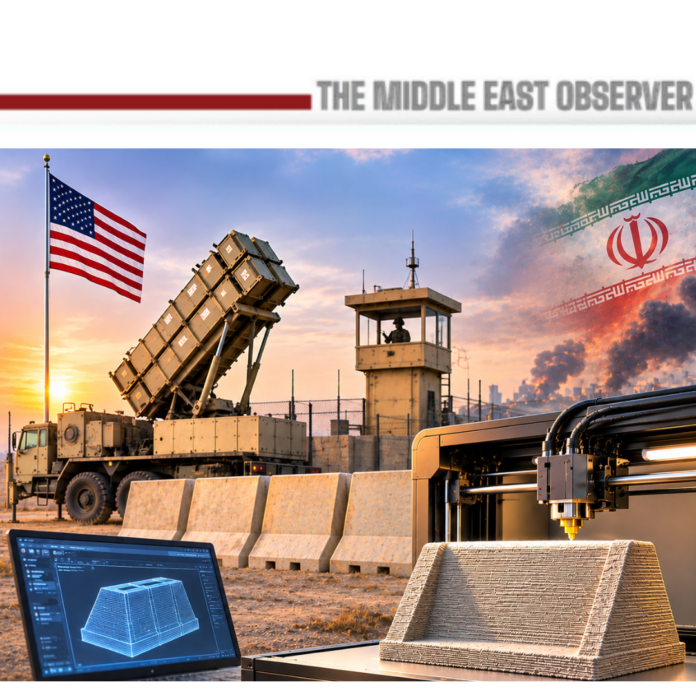
The US Air Force has launched a programme to develop mobile 3D concrete printers capable of constructing blast-resistant military shelters, following Iranian attacks on American bases across the Middle East that have left Washington facing a potentially multibillion-dollar reconstruction bill.
The November 4 solicitation seeks systems that military engineers can deploy quickly, using locally available construction materials where feasible. It follows damage to hundreds of military structures in eight countries and a June assessment by the Center for Strategic and International Studies (CSIS) estimating the potential cost of repairing affected bases and infrastructure at $4bn–$9.4bn.
The programme signals a change in US military construction priorities: protecting installations against missile and drone attacks while reducing the time, labour and logistics needed to restore operational facilities.
An Unpriced Bill for Middle Eastern Bases
Iranian missile and drone attacks during the conflict that began on February 28 damaged or destroyed hundreds of buildings at American bases in Kuwait, Bahrain, Qatar, Saudi Arabia, the United Arab Emirates, Iraq, Oman and Jordan, according to a Pentagon inspector-general report published on September 14.
The Pentagon estimated the cost of Operation Epic Fury at $33.4bn through June 29, including $22.3bn in munitions, $7.4bn in additional operating expenditure and $3.7bn in equipment losses.
The estimate excluded reconstruction of damaged military facilities.
The Pentagon said it had yet to determine its future regional deployment arrangements, whether to rebuild existing bases or develop alternatives, and how much allied and host governments might contribute.
The CSIS estimate, published on June 23, used satellite imagery and US military construction benchmarks to assess the potential repair bill. Its $4bn–$9.4bn range remains an independent projection rather than an official reconstruction budget, with substantial uncertainty over damage not visible in available imagery.
That distinction matters economically. Rebuilding existing installations, relocating operations or redesigning bases to withstand future attacks would produce different construction requirements, procurement costs and financial obligations.
From Faster Barracks to Protected Military Shelters
The Pentagon had begun experimenting with automated concrete construction well before the Iranian strikes.
At Fort Bliss, Texas, the US Army completed the printing phase of 10 barracks buildings in 58 days during 2026. The facilities are intended to accommodate up to 560 soldiers.
In July, the Army reported construction speeds four times faster than conventional benchmarks and costs approximately 9% below initial estimates, with more than $5.6mn saved in project overhead.
The project demonstrated the commercial potential of automated building techniques. It did not, however, establish that printed buildings could withstand modern missile or drone attacks.
The new Air Force initiative addresses that limitation directly.
Rather than reproducing conventional flat walls, researchers will assess cement-based materials and structural shapes designed to reduce the effects of blast pressure and flying fragments.
The programme calls for computer modelling, prototype construction, controlled explosive testing and procedures that allow military engineering units to operate printers with limited specialist support.
Applications open on December 2 and close on January 6, 2027.
The research remains at the development stage. No large-scale procurement or deployment programme for blast-resistant printed shelters has been announced.
Middle East Construction Industry Could Benefit
The initiative may eventually create opportunities for regional companies supplying concrete, construction machinery, engineering services and automated building systems.
Saudi Arabia, the UAE and Egypt already have experience with large-scale 3D concrete printing.
Saudi developer Dar Al Arkan completed a three-storey villa in Riyadh using technology supplied by Denmark’s COBOD. The building’s walls were printed in 26 days using a concrete mixture containing 99% locally sourced materials, according to the equipment manufacturer.
Dubai has established a regulatory framework for 3D-printed construction and aims to use the technology in 25% of new buildings by 2030.
In Egypt, Orascom Construction established a 76%-owned joint venture with COBOD in November 2022, combining construction services, equipment sales and maintenance.
These projects demonstrate regional engineering and manufacturing capabilities. They do not establish that the companies possess military-grade blast-resistant construction technology or have secured US defence contracts.
Moving into that market would require additional testing, specialised materials, security clearances where applicable and compliance with military procurement requirements.
For regional cement producers and contractors, locally sourced printable materials could become commercially important if the Air Force successfully develops systems suitable for deployment across different environments.
Military Protection Meets Civilian Infrastructure
The potential applications extend beyond military installations.
Airports, ports, power stations, logistics centres and other critical infrastructure face similar requirements for rapid repair and operational continuity after attacks or natural disasters.
Mobile automated construction could reduce dependence on transporting prefabricated structures and large construction crews, although its cost advantages would depend on local materials, installation requirements and the full cost of completing each building.
The technology also faces significant limits. Printed concrete structures cannot be assumed to withstand direct missile impacts, while foundations, roofs, utilities and protective systems still require appropriate engineering.
The Air Force acknowledges that civilian commercialisation would depend on building-code approvals and other regulatory requirements.
For Washington, the immediate question is whether automated construction can protect military personnel and restore damaged facilities quickly enough to preserve operations during future attacks.
For Middle Eastern governments, the larger issue is how the cost of protecting installations and critical infrastructure will be shared, and whether reconstruction can support domestic industrial capabilities.
The next decisive developments will be the award of research contracts, independently validated protective performance, a clearer Pentagon reconstruction budget and decisions on host-country financial participation.
Until then, 3D printing remains a promising construction option rather than a proven answer to the vulnerabilities exposed by the Iran conflict.
Related News
- Fortress America Seeks to Withstand Attacks and Sustain Global Military Operations
- Visibility Over Destruction: What the Kuwait Strike Reveals About Tehran’s Strategy
Read Also