

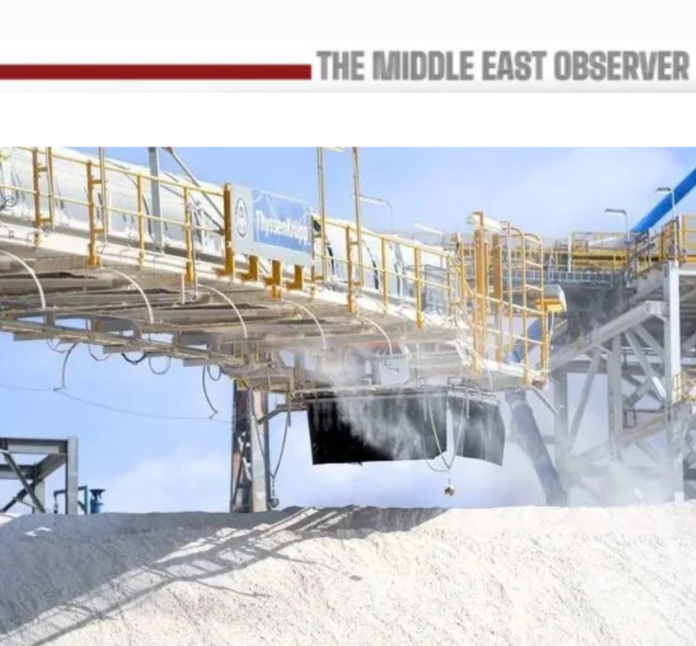
CAIRO — Egyptian phosphate fertiliser export prices have risen nearly 30% since the start of 2026 as disruptions to shipping through the Strait of Hormuz and Chinese export restrictions tighten global supplies, strengthening Egypt’s position as an alternative supplier while increasing pressure on manufacturers’ costs.
Export prices for diammonium phosphate (DAP) reached $915–920 per tonne, free on board (FOB), against approximately $710 at the beginning of the year, according to industry figures cited by Al Arabiya Business. Triple superphosphate (TSP) prices climbed 31% to $692 from $529 per tonne. The DAP range was also recorded in an August export tender, although the latest figures do not establish a further increase in November.
Egypt exported approximately one million tonnes of phosphate fertilisers worth $422.3 million in 2025, according to the Export Council for Chemical Industries. Higher prices could lift export earnings if shipment volumes hold up, but rising sulphur, freight and insurance costs threaten to erode producers’ margins.
The market disruption coincides with growing Chinese investment in Egypt’s phosphate processing industry. Kunming Chuan Jin Nuo Chemical is considering a $100 million plant, according to comments by company executive Qian Wei at the Egypt–China Investment Forum on Monday. The company already purchases more than 500,000 tonnes of Egyptian raw materials annually.
Chuan Jin Nuo is also developing a previously announced phosphate chemicals complex in Ain Sokhna with Elsewedy Industrial Development, involving planned investment of up to $1 billion across three phases. Its first phase, scheduled to begin commercial operations in 2028, targets annual production of 300,000 tonnes each of DAP and TSP. It remains unclear whether the latest $100 million proposal forms part of that development or represents an additional investment.
Separately, Egypt is discussing a phosphate fertiliser complex exceeding $1.5 billion with Fertiglobe, targeting annual DAP capacity of 1.3 million tonnes from 2031, subject to feasibility studies.
The longer-term opportunity is to convert Egypt’s phosphate reserves into higher-value manufactured exports. However, international phosphate markets remained subdued in November despite supply constraints, with agricultural buyers resisting elevated prices. Egypt’s ability to benefit will depend on sustained export demand, competitive production costs and the delivery of planned industrial capacity.
Related news:
Fertiglobe Eyes $1.5bn Egypt Phosphate Fertiliser Complex
China’s Xingfa Eyes $2bn Phosphate Investment in Egypt’s Golden Triangle
Read also:
Egypt’s Golden Age of Soft Power: How Cairo Became the Arab World’s Cultural Capital
US Seeks 3D-Printed Base Defences as Iran Damage Bill Could Reach $9.4bn
