

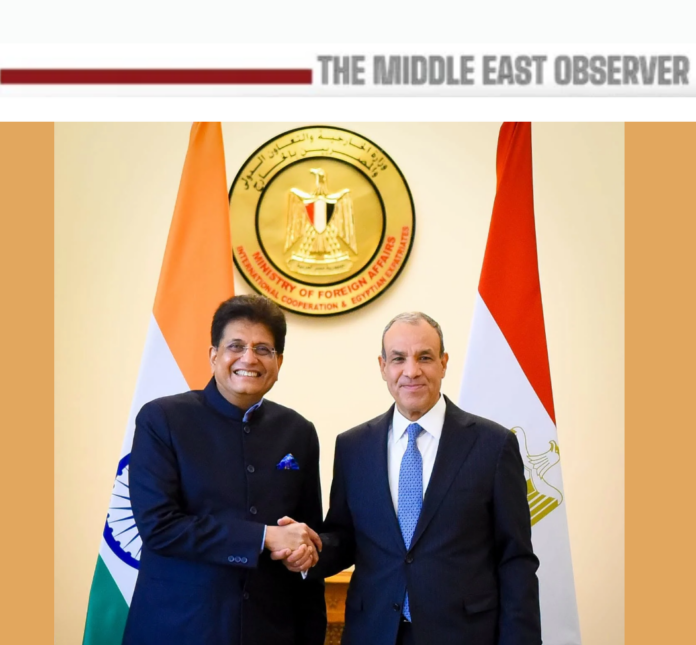
CAIRO, Egypt and India have agreed to establish a joint working group to examine a preferential trade agreement and accelerate industrial cooperation, targeting nearly $12bn in annual bilateral trade by 2030 following two days of high-level negotiations in Cairo.
The initiative emerged from the seventh Egypt–India Joint Trade Committee meeting on November 15, co-chaired by Egyptian Investment and Foreign Trade Minister Mohamed Farid and Indian Commerce and Industry Minister Piyush Goyal, followed by talks with Prime Minister Mostafa Madbouly on November 16.
The ministers signed the committee’s agreed minutes, setting out a framework for closer trade, investment and industrial cooperation. The working group will assess the scope and potential benefits of a preferential trade agreement, free trade agreement or broader economic partnership covering goods, services and investment.
Goyal said he hoped formal negotiations could begin within 90 days, once officials had established the terms of reference. No trade agreement has yet been negotiated or concluded.
Bilateral merchandise trade reached $6.47bn in India’s 2025/26 financial year, up approximately 35%, comprising $3.87bn in Indian exports and $2.60bn in imports from Egypt, according to India’s Commerce Ministry. Trade accelerated further to $5.04bn in April–September 2026, an increase of approximately 64% year on year.
The $12bn target would represent a substantial expansion of commercial exchanges, supported by efforts to diversify exports, improve market access and develop integrated manufacturing supply chains.
The negotiations addressed practical barriers affecting businesses, including customs procedures, product registration, technical standards, certification and agricultural market access. India also raised restrictions affecting ceramic tile manufacturers, outstanding commercial payments, trade-remedy measures and Indian companies’ access to Egyptian public procurement contracts.
Both sides discussed measures to facilitate trade, encourage reciprocal business missions and expand industrial partnerships. Goyal said any future agreement would need to accommodate sensitive sectors, particularly agriculture and dairy, while identifying areas where market access could be improved.
Industrial investment formed the second major focus of the visit. During his meeting with Goyal, Madbouly renewed Egypt’s proposal to establish a dedicated Indian industrial zone within the Suez Canal Economic Zone (SCZone), positioning Egypt as a manufacturing and export platform serving African, Middle Eastern and European markets.
Farid said potential land plots would be presented for assessment, while discussions would continue on suitable locations and investment requirements. No final site allocation, financing commitment or construction timetable has been announced.
Egypt values existing Indian investment at approximately $4.5bn, concentrated largely in chemicals, petrochemicals and manufacturing. India estimates the figure at around $5bn across roughly 70 operating companies. Major investors include TCI Sanmar, Aditya Birla and Uflex.
The proposed industrial expansion would target pharmaceuticals, automotive components, textiles, fertilisers, food processing, renewable energy, green hydrogen, battery storage and advanced manufacturing.
Madbouly also welcomed potential cooperation between Egypt’s sovereign wealth fund and India’s National Investment and Infrastructure Fund to support future investment partnerships.
To improve project development, Farid announced plans to activate cooperation between Egypt’s General Authority for Investment and Free Zones and Invest India through a shared investment-information platform. The Indian government confirmed interest in strengthening the existing institutional framework.
Infrastructure and technology cooperation featured prominently in parallel ministerial discussions. Goyal explored opportunities in port development, shipbuilding, railway manufacturing, airport projects and urban transport, alongside industrial localisation and technology transfer. These discussions have not yet produced announced project contracts.
The two sides also examined linking India’s Unified Payments Interface with Egypt’s InstaPay system and expanding bilateral trade settlement in local currencies. Goyal said the countries’ central banks had already been in contact on settlement arrangements, although no operational agreement was announced.
More than 300 Indian and Egyptian companies participated in the bilateral Business Forum, while the Joint Business Council brought together over 250 business representatives.
A separate startup forum, inaugurated on November 16, brought together 55 Egyptian and Indian startups to explore cooperation in financial technology, healthcare, agriculture and digital services. The governments also discussed facilitating startups’ access to each other’s markets and public procurement opportunities.
The next phase will focus on implementation. Goyal proposed a programme to resolve trade barriers within defined timeframes, encourage Egyptian investment in India, integrate smaller suppliers into cross-border manufacturing networks and conduct annual reviews of commercial progress.
The two governments also plan specialised working groups and reciprocal sector-specific trade missions to identify investment opportunities and develop commercially viable partnerships. The eighth Joint Trade Committee meeting is scheduled for New Delhi in 2028, or earlier by mutual agreement.
The negotiations build on the strategic partnership established during Indian Prime Minister Narendra Modi’s visit to Cairo in June 2023 and subsequent engagement with President Abdel Fattah El-Sisi.
Related news:
India’s BRICS 2026 Set the Commitments; China Must Deliver in 2027
Read also:
Egypt Targets 30 Factory Takeovers as Industrial Revival Fund Eyes First December Deal
Saqqara Tomb Discovery Raises Questions About Ancient Egyptian Medicine