

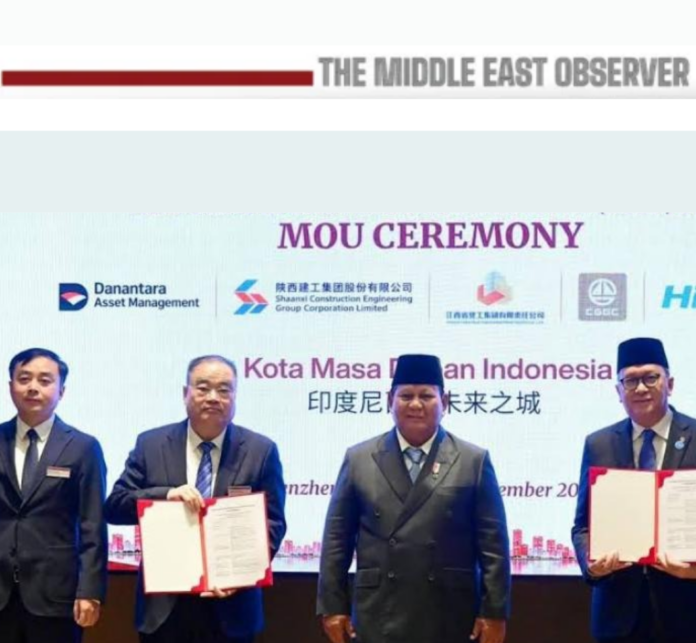
Ten smart cities dominate the package, while proposed infrastructure financing may overlap with headline project values.
Indonesia announced four strategic cooperation arrangements with Chinese partners worth a combined $71.8 billion on Wednesday, November 18, during the Asia-Pacific Economic Cooperation (APEC) summit, targeting urban development, manufacturing, infrastructure financing and alternative fuel production.
President Prabowo Subianto witnessed the announcements, which involved Indonesia’s state investment group Danantara and major Chinese engineering, manufacturing and financial institutions.
The package represents one of the largest investment pipelines announced during APEC Leaders’ Week. However, much of its value remains indicative, with projects subject to financing, procurement and final contractual approval.
Ten smart cities account for $50bn
The largest component is a proposed $50 billion programme to develop 10 smart cities across Indonesia through PT Kota Masa Depan Indonesia, a Danantara-controlled company, and a Chinese consortium led by Shaanxi Construction Engineering Group.
The programme envisages approximately $5 billion per city, incorporating residential developments, hospitals, schools, transport links, utilities and digital infrastructure.
According to the project announcement, the developments could eventually provide 1.5 million housing units for around three million residents.
Danantara chief executive Rosan Roeslani, who also serves as Indonesia’s investment minister, said implementation could begin in 2027.
The Chinese consortium envisages a three-to-five-year development programme, subject to procurement and project approvals.
The memorandum is non-binding. Detailed site allocations, financing arrangements and construction contracts have not been publicly finalised.
Hisense expands manufacturing and research plans
A second arrangement involves Chinese electronics manufacturer Hisense, Indonesia’s Ministry of Higher Education, Science and Technology, and Danantara.
Indonesia’s government valued the proposed cooperation at approximately $10 billion, covering home-appliance manufacturing, joint research facilities and workforce development.
Hisense intends to establish its largest home-appliance manufacturing facility outside China in Indonesia, serving domestic demand and export markets.
The company also plans a joint laboratory with Institut Teknologi Bandung to develop energy-efficient appliances and strengthen Indonesian technical capabilities.
However, a separate company-level announcement assigned an indicative value of $1 billion to the Hisense programme. The discrepancy has not been publicly reconciled, and the factory’s final investment allocation, site and construction timetable remain unspecified.
$10bn financing plan targets infrastructure
Danantara also advanced discussions with Chinese financial institutions on a proposed financing framework worth up to $10 billion.
The participating institutions include Changjiang Securities International, Shanghai Pudong Development Bank’s Hong Kong branch and SDIC Securities (Hong Kong).
The proposed structure would raise the equivalent of $5 billion through panda bonds issued in mainland China and another $5 billion through dim sum bonds in Hong Kong.
Potential uses include electricity networks, renewable energy, advanced manufacturing, mineral processing, transport infrastructure and data centres.
The financing remains under discussion. No completed bond issuance or irrevocable funding commitment has been confirmed.
Crucially, the proposed funds could also finance the smart-city developments, meaning that up to $10 billion of the announced package may overlap with the $50 billion urban-development programme.
The financing component therefore cannot automatically be counted as additional foreign direct investment.
Coal-to-ethanol partnership seeks fuel security
The fourth initiative covers Chinese technology cooperation to convert Indonesia’s lower-grade coal into ethanol for transport fuel.
Indonesia’s presidential office placed the project value at $1.8 billion, involving state energy company Pertamina, the higher education ministry and Beijing Petrochemical Engineering.
A separate corporate announcement valued the initiative at approximately $2 billion and identified Indonesia’s Agency for Mineral Industry as the local counterpart.
The project aims to reduce reliance on imported fuel, develop domestic processing capabilities and transfer Chinese industrial technology.
Its commercial feasibility will depend on production costs, construction requirements and competition with conventional fuel supplies. The environmental implications will also require assessment because the proposed ethanol would be derived from coal rather than renewable biomass.
Headline values require closer scrutiny
The Indonesian government and Reuters reported a combined package of $71.8 billion, comprising:
- $50 billion for smart-city development.
- $10 billion for Hisense manufacturing and technology cooperation.
- $10 billion for proposed infrastructure financing.
- $1.8 billion for coal-to-ethanol development.
However, another version of the associated project announcement placed the combined indicative value at $63 billion, using different figures for the Hisense and coal-to-ethanol programmes.
The differing project valuations, possible financing overlap and preliminary contractual status make it premature to describe the headline total as secured investment.
The arrangements nevertheless illustrate Indonesia’s strategy of using Chinese capital, engineering and technology to accelerate housing development, industrialisation, energy security and domestic value creation.
Delivery will determine the economic impact
For China, the agreements offer opportunities to deploy construction expertise, manufacturing capacity and financial services in one of Southeast Asia’s largest markets.
For Indonesia, the potential gains extend beyond capital inflows to employment, industrial capabilities, infrastructure development and technology transfer.
The decisive milestones will be the conversion of preliminary memorandum into binding project contracts, confirmed financing, construction schedules and actual capital expenditure.
Until those steps are completed, the $71.8 billion announcement remains a substantial prospective investment pipeline rather than a realised investment programme.
Related Articles:
- Egypt and China Build a New Economic Architecture for the Next Decade
- Chinese Investment: $2bn Logistics City Proposed in Egypt’s Suez Economic Zone