
The verdict concludes an eight-year prosecution against the Chinese technology group, which has continued expanding its artificial intelligence capabilities despite US trade restrictions.
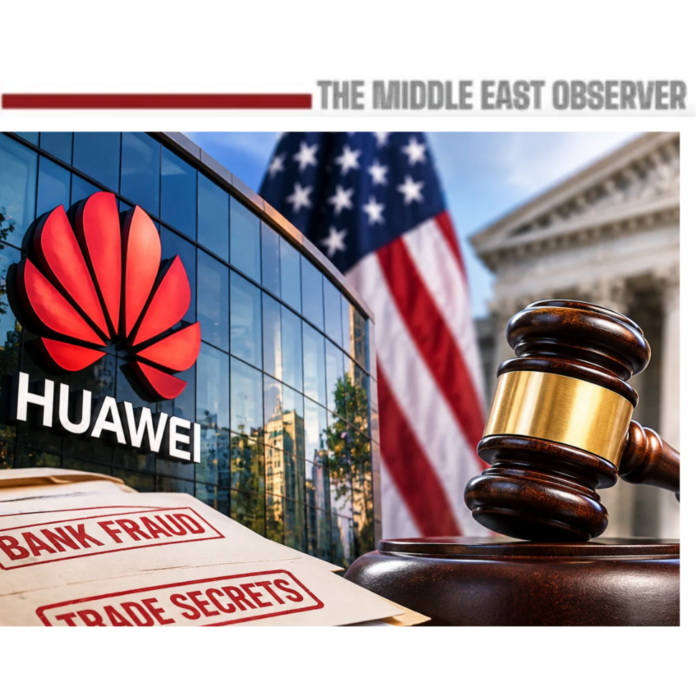
A US federal jury in Brooklyn convicted Huawei and three subsidiaries on November 24 on 10 of 12 criminal counts, including bank and wire fraud, Iran-related sanctions violations, money laundering conspiracy and conspiracy to steal American trade secrets. Following a three-month trial, jurors cleared Huawei of racketeering and obstruction of justice conspiracies. The company plans to appeal and faces fines, forfeiture and restitution at sentencing on September 14, 2027.
The US Department of Justice said Huawei concealed its Iranian operations through Skycom, a wholly owned subsidiary it portrayed as an independent business partner, enabling it to retain access to international banking and dollar-clearing services.
The case dates back to December 2018, when Huawei’s chief financial officer, Meng Wanzhou, was arrested in Canada under a US warrant for allegedly misleading HSBC about the company’s Iranian activities. The charges against Meng were subsequently dropped following a deferred prosecution agreement in 2021.
The original indictment alleged that Huawei had misled HSBC, Standard Chartered and BNP Paribas. Reuters investigations in 2012 and 2013 helped expose its Iranian operations.
Prosecutors expanded the case in 2020 to encompass an alleged two-decade conspiracy to acquire proprietary American technology, involving Cisco Systems, T-Mobile, Quintel, Fujitsu and CNEX Labs.
More than 60 prosecution witnesses and 15 defence witnesses testified during the trial. Huawei’s lawyers maintained that banks knew about its Iranian operations and argued that prosecutors had combined isolated technology disputes to construct an exaggerated conspiracy case.
Huawei rejected the legal basis of the convictions, while its defence attributed the company’s commercial success to innovation and investment in research and development.
Washington placed Huawei on its trade blacklist in 2019 over national security concerns. Despite the restrictions, the group has diversified its supply chains and become a major participant in China’s artificial intelligence industry. Industry experts cited by Reuters said the prolonged legal dispute had not undermined its broader business operations.
Related News:
China Retaliates Against U.S. Chip Sanctions with Export Ban on Critical Materials
Huawei Eyes Expansion into AI Chip Market in Middle East and Southeast Asia
Read Also:
US-China Relations Enter an Era of Managed Coexistence
How China-US Competition Is Rewriting the Rules of Globalisation