China and the US are moving towards a more deliberately managed relationship in which selective cooperation is preserved without diluting the strategic rivalry between the world’s two largest economies.
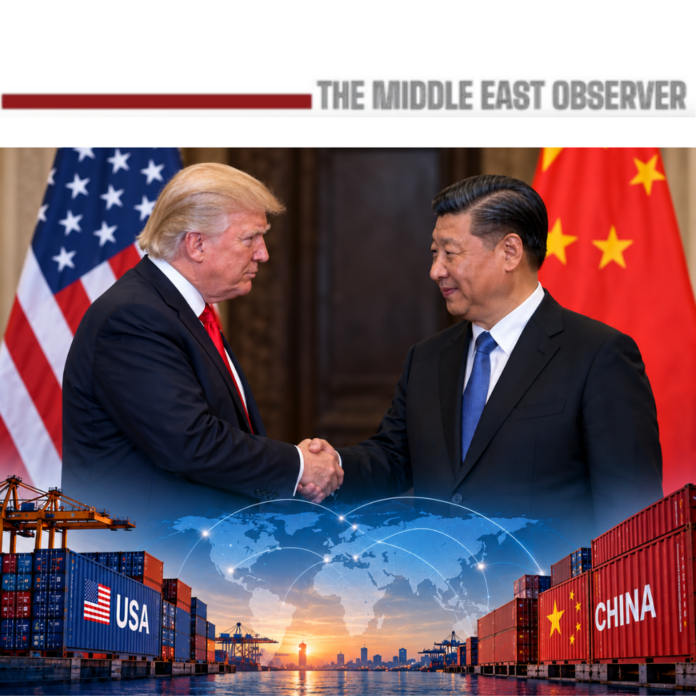
The shift has accelerated since President Donald Trump’s May visit to Beijing and will face its most important test during President Xi Jinping’s September 23-25 visit to the US.
The bilateral economic relationship is no longer being treated as a single contest. Beijing and Washington are increasingly separating areas where commercial cooperation remains possible from those regarded as strategically sensitive.
Trade in ordinary goods, investment discussions and artificial-intelligence risk management are gaining institutional support. Advanced semiconductors, critical minerals and Taiwan remain firmly contested.
The result is taking the shape of managed coexistence: neither détente nor decoupling, but an effort to make competition more predictable.
Xi has described the desired framework as a “constructive China-US relationship of strategic stability”, centred on cooperation, manageable competition and safeguards against escalation. Washington’s recent negotiating posture points in a similar direction while retaining restrictions on sectors it regards as important to national security.
Trump’s May visit established much of the political architecture.
The two sides agreed to develop Boards of Trade and Investment, improve market access and address critical-mineral supply concerns. Washington also announced prospective Chinese purchases covering US agricultural products and more than 200 Boeing aircraft.
Implementation has been uneven. Beijing characterised parts of the commercial package more cautiously, while aircraft purchases, agricultural commitments and elements of the investment agenda remain incomplete.
More important is the structure now emerging around trade.
US and Chinese officials are working to identify non-sensitive goods that could face lower barriers, potentially including agriculture, energy and medical products. Commercial flows considered economically useful but strategically limited could therefore expand while controls remain around advanced technologies.
That same distinction shaped the September 20 New York talks between Chinese Vice-Premier He Lifeng, US Treasury Secretary Scott Bessent and Trade Representative Jamieson Greer.
China described the discussions as candid and constructive, covering implementation of earlier agreements, trade, investment and AI. US officials disclosed plans to formalise an AI dialogue and establish an emergency communication mechanism for serious AI-related incidents.
Yet the proposed channel does not include Washington’s restrictions on advanced processors or semiconductor-manufacturing equipment.
China and the US are therefore prepared to cooperate on containing systemic AI risks while continuing to compete over the technology, computing capacity and industrial infrastructure required to lead the sector.
The objective is not technological accommodation, but guardrails around technological rivalry.
Critical minerals reveal the harder edge of the relationship.
Washington continues pressing Beijing over access to rare earths and other strategic materials. China retains considerable leverage across mineral-processing and supply chains, while the US continues to exercise influence through advanced semiconductor technology and export controls.
No major breakthrough on rare earths emerged from the latest negotiations, and no extension has yet been agreed for the broader tariff truce due to expire on November 10.
Both sides are therefore preserving their principal strategic advantages even as they reopen selected areas of commerce.
For global markets, the distinction is significant. Washington and Beijing are attempting to keep trade, investment and financial flows functioning while technology and security policy become increasingly segmented.
Taiwan remains the clearest political limit.
Beijing regards the island as the most consequential issue in bilateral relations and is expected to raise US arms sales during Xi’s visit. Washington maintains its one-China policy while continuing unofficial relations with Taiwan and providing defensive weapons under US law.
No trade mechanism or AI dialogue resolves that divide. What has changed is the effort to prevent such disputes from destabilising the entire relationship.
Diplomatic contact has consequently intensified since May, including repeated exchanges between Foreign Minister Wang Yi and Secretary of State Marco Rubio and consultations involving senior economic and security officials.
China’s stated approach has remained consistent: expand cooperation where possible, manage differences and protect what Beijing regards as its core interests.
Viewed together, those moves point towards a more targeted Chinese strategy towards Washington: maintain political stability, preserve economically valuable trade and investment, and continue strengthening strategic autonomy in technology, manufacturing and global influence.
The US calculation is broadly parallel: widen commercial exchange where the economic gains are clear while maintaining controls over sectors capable of altering the strategic balance.
The chronology is therefore increasingly clear. Trump’s May visit established the political framework; He Lifeng’s September delegation began converting parts of it into mechanisms around trade and AI; Xi’s visit will test its durability.
The two powers are neither returning to partnership nor moving decisively towards separation. Instead, managed coexistence is becoming the organising principle — economic engagement where interests converge, controlled competition where they diverge, and stronger channels designed to prevent rivalry from escalating into crisis.
For China, that appears to be the essence of its targeted US strategy: not choosing between cooperation and competition, but defining more precisely where each begins and ends.
Related news:
US and Japan Deepen Critical Minerals Alliance Around Lynas
Read also:
Trump Faces Economic Fallout at Home as Middle East Deadlocks Deepen
Who Pays for the Smart City? The Business Model Behind MENA’s Urban Transformation