Egyptian equities staged a modest rebound on Tuesday after two sessions of broad selling, but the move was too small to signal that the correction has run its course. The stronger cross-asset development came from government debt, where foreign and Arab investors reversed Monday’s heavy outflow with $463.5mn of net purchases — even as the pound weakened beyond EGP52 to the dollar.
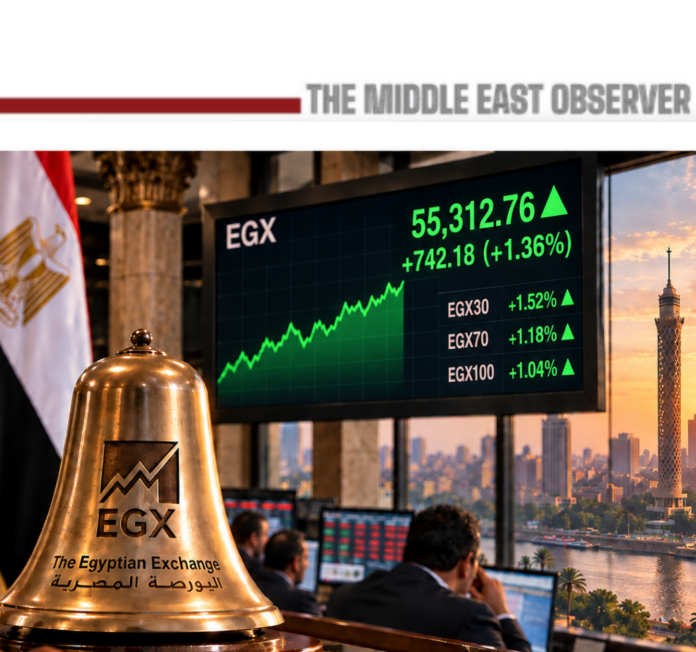
The EGX30 rose 0.21% to 54,909.17 points, while EGX70 gained 0.43% to 20,713.95 and EGX100 added 0.42% to 27,180.84. Market capitalisation recovered only EGP3.6bn to EGP 4.304 tn, while turnover eased to EGP10.53bn, about 9.5% below its 90-day average.
Breadth improved materially from Monday: 112 shares advanced against 94 decliners, with 16 unchanged. GB Corp, Telecom Egypt and e-finance were among the stronger large-cap performers.
The session is best described as stabilisation, not recovery.
Tuesday Recovers Only a Fraction of the Week’s Losses
The EGX entered Tuesday after declines of 1.09% on Sunday and 1.56% on Monday, when breadth deteriorated sharply and turnover accelerated.
Tuesday’s gain recovered only a small portion of that damage.
Compared with last Thursday, EGX30 remained down about 2.4%, EGX70 3.2% and EGX100 2.9%, while roughly EGP104bn of market capitalisation has been erased.
Last week ended with the benchmark almost flat and smaller shares outperforming. That constructive rotation has since given way to a broader correction.
The EGX30 nevertheless remains roughly 31% higher in 2026, leaving the current move more consistent, so far, with a correction after a powerful re-rating than a structural reversal.
Domestic Buyers Support Equities as Foreign Institutions Sell
Tuesday’s listed-equity flows must be separated from government-debt transactions.
In shares, Egyptians were net buyers of EGP 260.7mn and Arabs bought EGP34.5mn, while foreign investors sold a net EGP295.2mn. Almost all of the foreign selling came from institutions, while Egyptian individuals provided the largest counterweight.
Even after Tuesday’s selling, foreign equity flows remain relatively contained on a week-to-date basis.
That is not evidence of a broad foreign exit from Egyptian equities.
The more important question is whether the improvement in breadth can be sustained beyond a single session and whether institutional demand begins to return.
Debt Flows Reverse — but the Pound Keeps Falling
The sovereign market produced a much sharper reversal.
Foreign and Arab investors bought a net $463.5mn of secondary-market government securities on Tuesday, almost entirely Treasury bills.
That followed $418.8mn of combined net selling on Monday, meaning Tuesday’s inflow broadly offset the previous session’s withdrawal rather than establishing a new trend.
Yet the pound continued weakening.
The CBE’s official dollar rate reached approximately EGP51.997 for buying and EGP 52.135 for selling, compared with EGP51.788/51.928 on Monday and about EGP51.31/51.44 on Sunday.
That divergence is important.
Renewed Treasury-bill buying did not immediately translate into a stronger pound, demonstrating that portfolio flows are only one component of broader dollar demand.
For equity investors, continued depreciation also raises the hurdle for hard-currency returns and increases the importance of company-level FX exposure.
Fed Decision Raises the Global Return Hurdle
The rebound came ahead of the Federal Reserve’s September decision, with economists widely expecting another rate increase.
For Egypt, tighter US monetary policy matters because it increases the return demanded from emerging-market assets.
Egyptian Treasury bills may continue to offer attractive nominal carry, but international investors increasingly assess that return after currency risk. Equities face an additional hurdle through earnings, liquidity and corporate risk.
More Investors Increase the Need for New Supply
The domestic investor base continues to expand.
EGX chairman Omar Radwan said roughly 450,000 new investors entered the market during the first eight months of 2026, while more than 25 potential offerings are under preparation.
The relationship between the two is increasingly important.
A larger retail base can support liquidity, but durable market development requires more investable companies, deeper institutional participation and a stronger primary market.
More investors ultimately need more assets.
Stabilisation Is Not Yet Confirmation
Tuesday repaired some of the damage from the first two sessions of the week.
Breadth improved. Domestic buying returned. Foreign and Arab capital moved back into Treasury bills.
But turnover softened, foreign institutions sold equities and the pound continued weakening.
The correction has therefore stabilised without yet being resolved.
Three signals now matter most: whether breadth continues improving, whether institutional equity demand returns and whether sovereign inflows persist after the Fed decision.
The strongest confirmation would not be another small EGX30 gain. It would be a session in which improving breadth, institutional buying and currency stability begin moving in the same direction. Until then, Tuesday looks more like a pause in the correction than confirmation of the next leg of the rally.
Related news:
Treasury bonds to reach hiked records by end of this year
EGX30 Holds Near Records as Broader Market Loses Momentum
Read also:
Egypt High-Speed Rail Moves Into Commissioning With October Tests
Gulf Investors Build Sectoral Clusters Across Syria’s Reconstruction