Egyptian equities opened the week with a broad correction on Sunday, pushing the EGX30 below 56,000 as selling spread across large, small and mid-cap stocks. Yet the decline stopped short of capitulation: turnover remained below its recent average, foreigners were modest net buyers and selective corporate catalysts continued attracting capital.
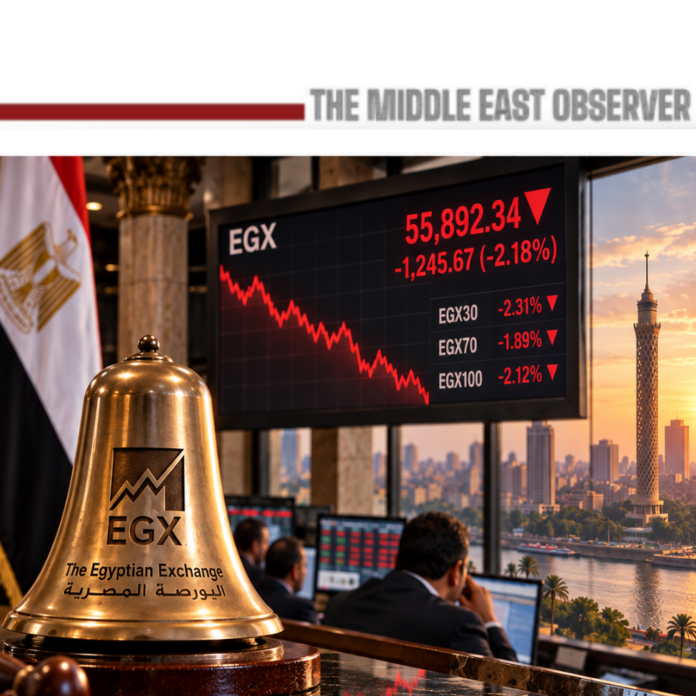
The EGX30 fell 1.09% on September 13 to 55,664.79 points, cutting its 2026 gain to about 33.1%. EGX70 lost 0.98% to 21,192.67 and EGX100 fell 1.04% to 27,705.07, while market capitalization declined to roughly EGP4.366tn.
Breadth was markedly weak, with 161 stocks declining against 50 advancers, and the EGX30 finished at its session low.
But turnover of about EGP11bn was 5.4% below its 90-day average, arguing against describing the move as high-volume capitulation.
Sunday was therefore a broad correction, not yet a breakdown.
Last Week’s Rotation Faces a Harder Test
The previous week had ended almost flat at the benchmark level while smaller shares modestly outperformed.
Sunday reversed that constructive divergence.
All major indices fell by roughly 1%, moving the market from rotation and consolidation into a broader test of momentum.
That does not establish a trend reversal. But unlike several recent sessions, weakness was no longer concentrated in blue chips.
The immediate question is whether breadth stabilizes quickly enough to prevent an orderly correction from becoming a deeper loss of momentum.
The Sell-Off Was Not Foreign-Led
Nationality flows remain important to the diagnosis.
Egyptians were net buyers of about EGP84mn and non-Arab foreigners bought roughly EGP43mn, while Arab investors were net sellers of approximately EGP127mn.
The investor-class breakdown is more revealing: Egyptian institutions were substantial sellers, while domestic individuals absorbed much of the supply. Retail investors accounted for about 84% of activity.
Sunday was therefore not a foreign-confidence shock.
It reflected greater institutional caution inside a market still overwhelmingly supported by domestic retail liquidity.
That is a more demanding risk for the EGX: the domestic investor base can cushion foreign volatility, but its resilience becomes less certain when local institutions themselves reduce exposure near record levels.
Qalaa Shows Why Stock Selection Still Matters
The broad decline did not eliminate company-specific demand.
Qalaa Holdings gained about 1.5% after approving a transaction that would lift its effective indirect stake in Egyptian Refining Company to 27.1% from 13%.
Chairman Ahmed Heikal put the value of the acquisition of QatarEnergy’s indirect stake at about $420mn, with completion targeted for December. Qalaa plans to fund the transaction partly through a capital increase from EGP21.13bn to EGP25bn and cash generated by the refining business.
The capital increase will also support debt repayments and an initial exercise of Qalaa’s rights to increase its stake in TAQA Arabia. Heikal said roughly half of incoming liquidity would be directed towards the refinery transaction and activating TAQA purchase rights.
The market response reinforces an important point: even during a broad correction, investors continue to reward credible balance-sheet and asset-value catalysts.
New Listings Move From Pipeline Towards Execution
The more important structural news came from Egypt’s IPO programme.
Sources cited by Hapi put Banque du Caire’s updated fair value at about EGP5.30 per share, implying an equity valuation of roughly EGP80.9bn across 15.25bn shares. The valuation is based on the bank’s June 30, 2026 financial statements.
MEO-23 stage discipline remains important: the EGP5.30 figure is a reported valuation, not an offering price.
What is official is that the government’s fair-value review committee has unanimously approved the methodology and preparation of Baker Tilly’s updated study, moving Banque du Caire another step towards a potential offering.
The pipeline also broadened on Sunday.
Shareholders of Chemical Industries Development — SEDICO formally approved proceeding with the listing and offering of the company’s shares and authorised the board to complete the necessary regulatory and transaction arrangements. Its authorised capital was raised to EGP1.5bn, while issued and paid-up capital remains EGP400mn across 40mn shares.
SEDICO had already submitted a listing application earlier this year; Sunday’s shareholder approval therefore represents a further procedural step, not a completed listing or launched offering.
These developments matter precisely because the EGX is correcting.
Egypt’s market increasingly needs new investable supply rather than simply higher prices for existing shares. Progress at Banque du Caire and SEDICO suggests the state-offering pipeline is moving gradually from announcement towards valuation, approval and execution.
Pound Weakness Adds to the Equity Hurdle
The dollar also edged higher to around EGP 51.31 for buying and EGP 51.44 for selling, extending recent pressure on the pound.
For international investors, depreciation reduces hard-currency equity returns. For companies, it widens the earnings divide between foreign-currency earners and businesses dependent on imports or external borrowing.
After a roughly one-third rise in EGX30 this year, earnings quality, balance-sheet strength and currency exposure matter increasingly more than momentum alone.
Broad Correction — but Supply and Stock Selection Still Matter
Sunday weakened the market’s immediate breadth and momentum picture without invalidating the broader rally.
The warnings are clear: EGX30 broke below 56,000, virtually every major index fell around 1%, more than three stocks declined for every one that advanced and domestic institutions reduced exposure.
But equally important is what did not happen.
Turnover did not surge. Foreigners did not flee. Selective corporate catalysts still attracted buyers. And Egypt’s pipeline of new listed supply continued moving forward.
That makes Sunday a broad correction rather than capitulation.
The next test is whether breadth stabilises and domestic institutional demand returns.
But the longer-term test is equally important: whether Banque du Caire, SEDICO and other prospective offerings can convert Egypt’s expanded domestic liquidity into deeper market supply and genuine capital formation.
The EGX’s immediate risk is weakening institutional conviction. Its structural opportunity is using the correction to broaden a market that still has far more liquidity than investable depth.
Related news:
EGX Pullback Tests Record Rally as Institutional Selling Broadens
UAE Greenlights Institutional Stablecoin for Trade and Settlement
Read also:
Egypt targets pharmaceutical raw materials after decade of manufacturing growth
Egypt to Launch Listings of Banque du Caire and Misr Life Insurance by Mid-2026