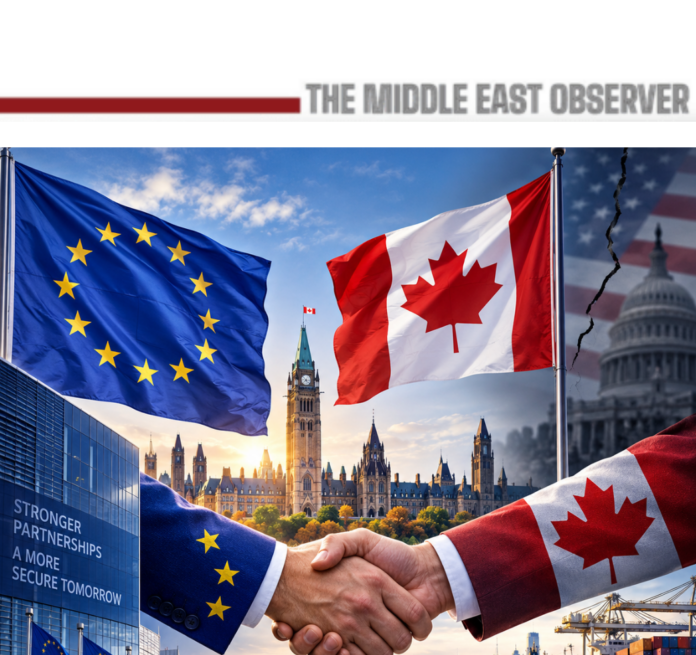
Ottawa is testing whether Europe will extend some of the privileges of economic integration to a trusted non-European power, as worsening ties with Washington push Canada to build a second strategic economic anchor.
Canada is exploring an unprecedented economic and security association with the European Union as its trade confrontation with the United States accelerates efforts to reduce dependence on the American market.
Prime Minister Mark Carney is expected to set out that vision when he addresses the European Parliament in Strasbourg on September 17, following reports that Canadian and European officials have discussed an arrangement informally described as “associate membership”.
No such EU status currently exists, and Carney has ruled out conventional membership, instead calling for a “unique alliance” with Europe.
The real question is therefore not whether Canada can join the EU, but how far Brussels is prepared to extend the economic benefits of integration — and what regulatory obligations Ottawa would accept in return.
Beyond CETA
The starting point is CETA, which has already removed most conventional tariff barriers.
Since the agreement began provisional application in 2017, Canada and the EU have eliminated tariffs on about 99% of tariff lines, while bilateral trade in goods and services reached roughly €130bn in 2025, about 80% above 2016 levels.
A deeper arrangement would therefore have to deliver benefits that CETA largely does not: professional mobility, broader regulatory recognition, access to industrial programmes, government procurement, strategic rules of origin, defence integration, research funding and coordinated supply chains.
Canada already participates in Horizon Europe, has secured mutual recognition for architects, is negotiating a Digital Trade Agreement and has joined the EU’s SAFE defence programme.
The next step would be to turn those separate arrangements into a broader economic and strategic framework.
What Europe Gains
Canada’s leverage lies less in the size of its consumer market than in the strategic value of its resources and geography.
It accounted for around 24% of global uranium production in 2024, making it one of the world’s largest producers and exporters, while Europe already absorbs a substantial share of Canadian uranium shipments.
Canada is also the world’s largest producer and exporter of potash, giving it direct importance to European food security.
Critical minerals provide a further advantage as Brussels seeks to reduce dependence on concentrated supply chains, particularly those linked to China.
Deeper integration could connect Canadian uranium, potash and selected critical minerals more directly to European nuclear energy, batteries, aerospace, defence and clean-technology industries, while European capital helps finance Canadian extraction, processing and infrastructure.
For Brussels, the attraction is therefore not simply additional trade. It is secure access to strategic resources from a politically aligned supplier.
Defence, Technology and the Arctic
Defence could form a second pillar.
Canada’s participation in SAFE has opened European procurement to Canadian suppliers on terms unavailable to most third countries. A broader arrangement could extend cooperation into ammunition, aerospace, drones, radar, cyber-security, satellites and joint procurement.
Canada also brings geographic value through the Arctic and North Atlantic, where shipping routes, undersea infrastructure, satellite networks and early-warning systems are becoming increasingly strategic.
Technology offers another area of convergence. Cooperation in AI, quantum computing, cloud infrastructure, cyber-security and space systems could give both sides greater scale while reducing dependence on US and Chinese technology ecosystems.
That gives Canada value not merely as another supplier, but as a contributor to Euro-Atlantic industrial and strategic depth.
Energy Has Limits
Energy cooperation is attractive, but infrastructure constrains the immediate opportunity.
Canada possesses large oil, gas, hydroelectric and nuclear resources, yet most export infrastructure has historically been built around the US market.
Recent long-term agreements with German buyers for prospective Canadian LNG exports demonstrate European demand, but they also underline the constraint: significant additional supply requires new multibillion-dollar infrastructure and years of development.
Canada’s more immediate European energy value therefore lies in uranium and strategic minerals, while LNG and hydrogen remain longer-term opportunities.
What Canada Gains
For Ottawa, the main objective is diversification.
The United States still absorbed 71.7% of Canadian merchandise exports in 2025, despite a decline from 75.9% the previous year.
Europe cannot reproduce the economics of North American manufacturing. A component made in Ontario can reach Michigan by truck; supplying Germany requires an ocean crossing, additional inventory and longer lead times.
But Europe does not need to replace the US to become economically significant.
It can provide Canada with a second large pool of capital, procurement, technology and industrial demand, particularly in mining, defence, AI, energy, advanced manufacturing and infrastructure.
The real value lies in future investment decisions. If companies no longer assume that access to the US market will remain politically predictable, access to another large and relatively integrated market becomes more valuable.
The Real Prize: Selective Single-Market Access
The most credible model would sit somewhere between CETA and full European Economic Area participation.
Canada is unlikely to receive wholesale Single Market access, but Brussels could offer deeper sectoral integration where regulatory systems are sufficiently compatible.
That could include broader mutual recognition in aerospace, pharmaceuticals, clean technology and advanced manufacturing; expanded recognition of professional qualifications; streamlined work permits for engineers, researchers and specialist personnel; and wider reciprocal access to public procurement.
Rules of origin could also be adjusted in strategic sectors, allowing Canadian and European components to count jointly towards content requirements in defence, batteries and clean technologies.
Research and technology programmes could be extended further into AI, quantum computing, satellites, cyber-security and digital infrastructure in exchange for proportionate Canadian financial contributions.
The model would amount to selective integration of strategic production, capital and skills rather than unrestricted free movement.
The Price of Access
The central obstacle is regulatory sovereignty.
Ottawa would want privileged access without becoming a passive taker of European regulation. Brussels, however, is unlikely to grant Single Market-style benefits without enforceable alignment.
The deeper the access, the greater the likely European demands in competition policy, state subsidies, environmental standards, public procurement, data governance and foreign-investment screening.
Industrial subsidies could become particularly contentious. Both Canada and the EU are using public support to attract battery plants, defence manufacturing, semiconductors and clean-technology investment.
A deeper framework would therefore require rules preventing either side from using subsidies to lure investment while simultaneously demanding privileged access to the other’s market.
Climate policy creates another test. The EU’s Carbon Border Adjustment Mechanism applies to sectors including steel, aluminium, fertilisers, cement, electricity and hydrogen. A deeper relationship might simplify compliance where carbon-pricing systems are recognised as equivalent, but it would not exempt Canadian producers from Europe’s environmental framework.
The central negotiation is therefore clear: how much European access can Canada obtain without excessive regulatory rule-taking — and how much access will Brussels offer without enforceable common standards?
Procurement Tests Reciprocity
Government procurement could become one of the hardest commercial issues.
Canada has itself strengthened domestic preference through its Buy Canadian policies, including a lower threshold for strategic federal procurement preferences introduced in 2026.
That creates a direct reciprocal problem.
If Canadian companies seek broader access to European defence, infrastructure and public-sector contracts, Brussels is likely to demand comparable access for European suppliers in Canada.
The issue is particularly important because future competition will increasingly concern where factories, processing facilities and strategic infrastructure are built, rather than simply where finished goods are sold.
Any durable arrangement would therefore need procurement rules that prevent either side from combining privileged market access with protectionist domestic purchasing policies.
Agriculture Remains a Brake
Agriculture provides a reminder that geopolitical alignment does not eliminate commercial sensitivities.
CETA already manages sensitive trade through quotas and safeguards covering products including beef, pork and dairy, while Canadian exporters must comply with European sanitary, phytosanitary and food-safety standards.
Those restrictions reflect powerful domestic constituencies on both sides.
A deeper agreement could reduce administrative barriers where standards are equivalent, but agriculture is likely to remain managed rather than fully integrated.
Association Is Easier Than Membership
The legal route is less difficult than the political label suggests.
Article 49 of the Treaty on European Union provides the conventional accession route for European states and is therefore unsuitable for Canada.
Article 217 of the Treaty on the Functioning of the EU, however, allows Brussels to establish associations with third countries involving reciprocal rights, obligations and common action.
That creates a viable legal foundation for deeper economic integration without granting Canada the political rights of EU membership.
Germany’s Friedrich Merz has separately proposed an “associate membership” model for Ukraine. That proposal is designed for a European candidate country and cannot simply be transferred to Canada, but it demonstrates that differentiated integration below full membership is already part of Europe’s political debate.
For Ottawa, the cleaner arrangement would exclude European Council voting rights, an EU commissioner, automatic European Parliament representation and claims on EU budget transfers, while allowing economic integration to proceed considerably further.
The Workable Bargain
A durable Canada-EU association would rest on reciprocity.
Canada could obtain deeper sectoral market access, wider procurement rights, professional mobility, strategic rules-of-origin treatment and participation in selected European industrial and research programmes.
Europe would gain stronger access to Canadian minerals, uranium, defence production, infrastructure and technology partnerships.
Both sides would need enforceable rules governing competition, subsidies, climate standards, sanctions, investment screening and dispute settlement, alongside emergency safeguards allowing privileges to be suspended in cases of serious market disruption or national-security risk.
The result would be neither EU membership nor another conventional free-trade agreement.
It would be managed economic integration between strategic partners.
A European Hedge, Not an American Exit
Carney’s Strasbourg address will show how far Ottawa intends to push that model. The Canada-EU summit in Montreal on October 29-30 could determine whether the idea moves from political concept to a formal negotiating framework.
Canada cannot replace the United States with Europe, nor would the economics justify trying.
The more important test is whether Europe can become large enough to influence the future allocation of Canadian capital, exports and industrial capacity, reducing the risk of excessive dependence on a single market.
For Brussels, the corresponding calculation is whether privileged access can secure resources, technology, defence capacity and geopolitical reliability that increasingly carry strategic value.
The issue is therefore not whether Canada can become European. It is how far Europe can extend the privileges of integration to a trusted outside power — and how much regulatory autonomy Canada is prepared to exchange for them.
If the balance can be found, pressure from Washington may produce an unintended consequence: not Canada’s departure from the US economy, but the emergence of a credible second transatlantic economic anchor.
Related news:
Kuwait at 65: A Strategic Partnership with Egypt Poised for Deeper Economic Integration
Trade Barriers Are Rising—How Can Egypt Future-Proof Its Export Growth?
Read also:
Trump Faces Economic Fallout at Home as Middle East Deadlocks Deepen
Canada-India navigating a path between cooperation and confrontation