

Saudi oil giant deepens its Asian industrial footprint as renewed attacks on domestic infrastructure drive up global oil prices.
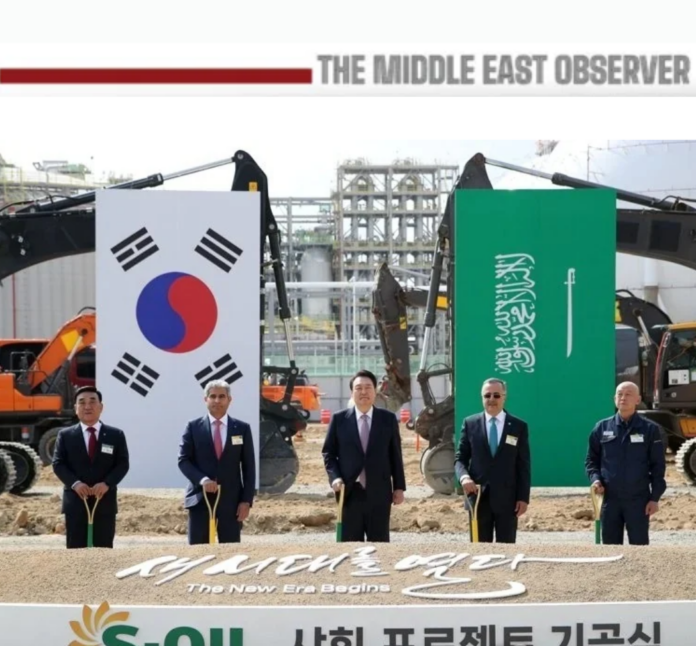
Saudi Aramco and its South Korean subsidiary S-OIL inaugurated their $7bn Shaheen petrochemical complex on Wednesday, marking the Saudi energy giant’s largest investment in South Korea, as renewed attacks on the kingdom’s energy infrastructure underscored the strategic importance of geographical and industrial diversification.
The project, inaugurated at a ceremony in Seoul, will add 3.2 million tonnes of annual petrochemical production capacity at S-OIL’s industrial complex in Ulsan, with commercial operations scheduled to begin in 2027. Aramco holds more than 63 per cent of the South Korean company.
First announced in November 2022, Shaheen represents the first large-scale commercial application of Aramco’s thermal crude-to-chemicals technology, developed with Lummus Technology. The process increases the proportion of crude oil converted into higher-value industrial chemicals, serving Asian manufacturing industries ranging from electric vehicles to semiconductors.
Featuring what Aramco describes as the world’s largest single-unit steam cracker, with an annual ethylene capacity of 1.8 million tonnes, the expansion will increase petrochemicals’ share of S-OIL’s business portfolio from 12 to 25 per cent.
“Economic headwinds and rising geopolitical risks do not alter our long-term view on strategic investments,” said Amin Nasser, Aramco’s chief executive, reaffirming the company’s confidence in Asian industrial demand.
The investment nevertheless faces a challenging commercial environment. South Korea is seeking to eliminate between 2.7 million and 3.7 million tonnes of annual ethylene capacity amid global oversupply and intensifying Chinese competition. Shaheen’s profitability will depend on whether its technological efficiencies and economies of scale can outweigh persistent pressure on petrochemical margins.
Mounting risks at home
The inauguration coincided with claims by Yemen’s Iran-aligned Houthis that they had attacked Saudi Arabia’s Ras Tanura refinery, the kingdom’s largest, with a processing capacity of 550,000 barrels per day.
Satellite imagery reviewed by Reuters showed thick smoke rising over the complex. The Saudi-led coalition confirmed that its air defences had intercepted incoming threats but did not confirm damage to the refinery. The impact on production and crude exports remained unclear.
The incident followed a strike on Tuesday against a building housing the headquarters of Saudi Arabia’s Public Investment Fund in Riyadh, which left 11 people injured, according to Saudi civil defence.
Brent crude surged 3.5 per cent on Wednesday to settle at $94.61 a barrel, while US West Texas Intermediate rose 2 per cent to $83.68. Brent extended its gains to $94.71 on Thursday morning as renewed regional hostilities and shipping disruptions heightened supply concerns.
For Egypt and other energy-importing economies, a sustained escalation could increase fuel import bills, intensify foreign currency pressures and complicate the recovery of regional maritime trade.
Although Shaheen predates the current conflict, its inauguration highlights the economic rationale behind Aramco’s international expansion. Overseas investments diversify its industrial assets and revenue streams, although they cannot fully insulate the company from disruptions to Middle Eastern energy supplies.
Aramco’s long-term strategy increasingly rests on capturing greater industrial value from every barrel of oil, while its immediate challenge remains ensuring that those barrels reach international markets.
Related news:
Aramco’s HUMAIN Deal Aims to Turn Saudi Energy Strength into Global AI Exports
Saudi Aramco Studies New Oil Export Routes, Eyes 10m-Bpd Pipeline Capacity
Read also:
Turkey Deepens Defence Alliances as Arms Exports Accelerate
Iraq, France Sign Six Accords as Baghdad Expands Energy, Defence Ties