

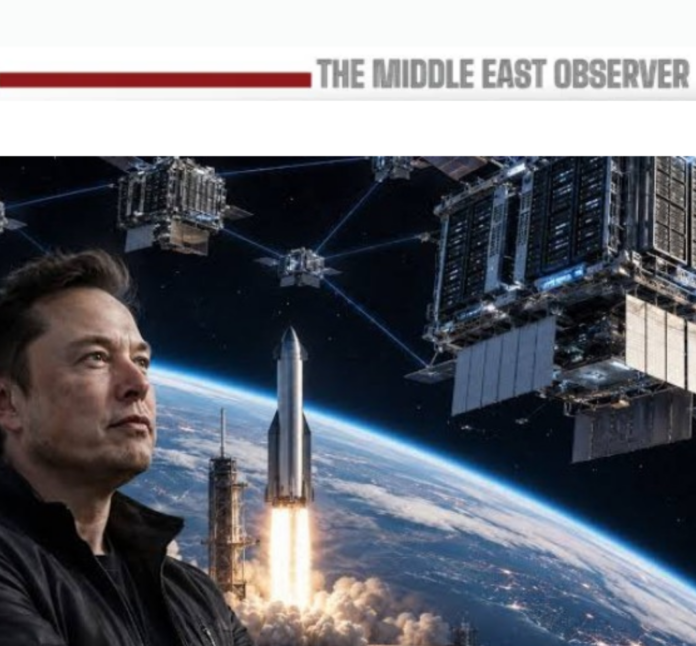
The US Federal Communications Commission (FCC) granted SpaceX conditional approval on November 25 to deploy up to one million satellites for its Starmind orbital data centre network, advancing Elon Musk’s plan to build solar-powered artificial intelligence computing infrastructure in space. Under the licence, deployment must begin by November 2033, with 100,000 satellites in orbit by November 2035 and 500,000 by November 2038. The authorisation removes a major regulatory barrier, although the project faces substantial engineering, commercial and environmental challenges.
The decision represents the FCC’s first authorisation for an orbital data centre network, a concept that featured prominently in SpaceX’s presentation to investors ahead of its initial public offering in June 2026, according to Bloomberg.
FCC Chairman Brendan Carr said SpaceX and other companies pursuing orbital data centres were responding to growing computing requirements by extending processing capabilities beyond Earth.
Unlike Starlink, which primarily provides satellite-based internet connectivity, Starmind is designed to process large volumes of data in orbit and transmit the results for use on Earth. The proposed network will employ laser-based communications between satellites, supported by radio-frequency links for backup and emergency operations.
SpaceX expects near-continuous access to solar energy to reduce dependence on terrestrial electricity grids and battery storage, while specialised radiative cooling systems could reduce the need for water-intensive cooling infrastructure. The company argues that these advantages could improve energy efficiency, lower operating costs and reduce the environmental footprint associated with conventional data centres.
However, SpaceX has cautioned investors that orbital AI computing relies on unproven technologies and may never become commercially viable, according to Bloomberg. Key engineering challenges include developing sufficiently large solar arrays, dissipating heat in a vacuum and transferring vast quantities of data between orbital computing facilities and ground-based infrastructure.
The project’s economics also depend heavily on Starship, SpaceX’s next-generation reusable launch vehicle, and its ability to reduce transportation costs. Satellite manufacturing, maintenance and equipment replacement represent additional commercial challenges.
The licence establishes November 2040 as the deadline for completing the constellation, although it remains uncertain whether SpaceX will ultimately deploy all one million satellites. Satellite operators sometimes seek approval for larger constellations than they intend to build to preserve flexibility in network design.
Approximately 17,000 satellites are currently in orbit, including more than 11,000 belonging to Starlink. SpaceX previously sought authorisation for up to 42,000 Starlink satellites.
The Starmind authorisation covers orbital altitudes between 500 and 1,002 kilometres, narrower than the range extending to 2,000 kilometres envisaged in SpaceX’s original application.
The FCC deferred the company’s request to use alternative disposal methods for satellites operating above 600 kilometres, citing insufficient technical information. SpaceX will require further regulatory approval before deploying satellites intended for disposal through methods other than atmospheric re-entry.
The application attracted approximately 1,500 public comments, alongside formal objections from Amazon Leo, satellite communications provider Viasat and the American Astronomical Society. Concerns included orbital congestion, collision risks, radio interference, atmospheric pollution and disruption to astronomical observations.
The European Space Agency’s September 2026 space environment report identified altitudes between 600 and 1,100 kilometres as particularly challenging for satellite operators because of the accumulation of orbital debris.
The FCC declined to require further environmental assessment, citing its October 2026 policy decision that space-based operations fall outside its environmental review obligations under the National Environmental Policy Act.
Responding to the approval, the American Astronomical Society warned that a constellation of this scale could undermine decades of investment in astronomical research. It also expressed concern over the absence of formal requirements for coordination to protect optical and infrared observations.
Amazon Leo has separately questioned SpaceX’s ability to deploy the proposed number of satellites within the required timeframe, while Blue Origin, founded by Jeff Bezos, has submitted its own application for an orbital data centre network and is awaiting regulatory approval.
The FCC confirmed that it is reviewing additional orbital computing proposals. SpaceX has yet to establish the commercial viability of Starmind, while the total investment required, planned computing capacity and commercial service launch date remain undisclosed in the available reports.
DAMAC Invests $9bn in US AI Data Centres as Expansion Costs Surge
Forbes Tower Signs US Data Centre Deal as Egypt Accelerates Digital Investment
Read Also:
The Internet Has a Physical Economy: Who Will Build Egypt’s Next Digital Highway?
Egypt Plans Up to $860mn a Year for Data Centres, Cloud and AI