

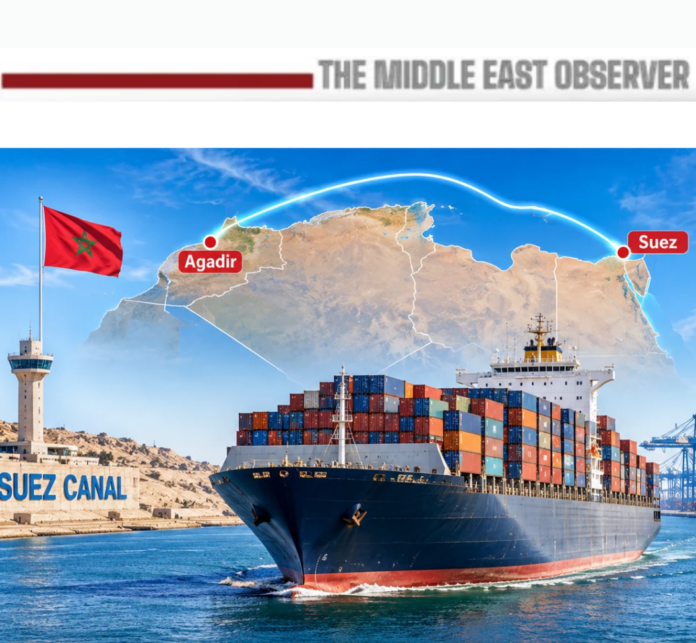
Egypt’s recovering canal revenues and Morocco’s expanding European export corridors point to new commercial opportunities as disruption forces shipping companies to reassess their global networks.
Egypt and Morocco are strengthening their positions in international maritime trade as shipping companies return to the Suez Canal and expand agricultural export routes to Europe, despite persistent disruption across global shipping networks.
Egypt’s Suez Canal revenues more than doubled year on year to $593mn in the first 24 days of November, following a 94 percent increase to $724mn in October. Meanwhile, three international shipping operators have expanded connections between Morocco’s agricultural export hub of Agadir and northern Europe.
The developments highlight two complementary economic opportunities for North Africa: the recovery of international transit revenues and deeper integration into global production and distribution networks.
Suez recovery gains momentum
October vessel transits through the Suez Canal increased by 32 per cent year on year to 1,490, while net tonnage rose 86 per cent, reflecting the return of larger commercial vessels.
Taiwan’s Evergreen resumed canal transits on November 8, followed by Ocean Network Express on November 15.
Despite the rebound, the canal has yet to recover its pre-crisis earnings. Revenues reached $4.67bn in the financial year to June 2026, roughly half the record $9.4bn generated in 2022/23.
The recovery comes as global shipping performance remains under pressure. Kuehne+Nagel’s seaexplorer recorded a decline in schedule reliability from 51.6 percent in September to 48.3 percent in October.
Separately, Sea-Intelligence reported that late vessels experienced average delays of 6.65 days in September, while GEODIS’s November report showed reliability on Europe-to-Asia routes falling to 29.8 percent from 68.9 percent a year earlier.
Congestion at major ports and continuing disruption in the Strait of Hormuz are limiting the capacity and efficiency gains from shorter voyages through Suez.
Morocco strengthens export resilience
At the western end of North Africa, international shipping companies are expanding Morocco’s access to European distribution networks.
France’s CMA CGM has extended its Euromar service to include Agadir and Britain’s Thamesport, while MSC has incorporated Agadir into its Canada Express rotation. Dutch operator Samskip has introduced a weekly service connecting Agadir with Cádiz, Santander, Thamesport and Rotterdam.
The expansion comes at a difficult time for Moroccan agriculture. Industry association Maroc Citrus expects production to decline by approximately 20 per cent to 1.8mn tonnes in the 2026/27 season, following extreme heat and adverse weather conditions. Exports are forecast to fall by a more modest 7 per cent to 540,000 tonnes.
Additional seasonal shipping capacity could help exporters defend European market share, reduce distribution risks and improve the competitiveness of perishable agricultural products.
Egypt’s opportunity beyond transit revenues
Egypt is developing a comparable export-oriented model. Danish shipping operator DFDS doubled its Damietta–Trieste freight ferry service to two weekly departures in each direction on October 15, citing growing commercial demand.
The corridor also connects European cargo with Gulf markets through overland transport to Safaga and onward maritime services. According to Egypt’s transport minister, approximately half the cargo arriving through the route is destined for Gulf countries.
Together with the Suez Canal Economic Zone, these connections offer opportunities for investment in refrigerated logistics, food processing, manufacturing, warehousing and maritime services.
However, regional security, freight costs, port efficiency and customs procedures will determine whether these opportunities translate into sustained commercial growth.
Egypt is rebuilding its transit earnings while developing corridors linking Europe, Asia and the Gulf. Morocco is consolidating its position within European distribution networks through export-oriented maritime services.
For both economies, the strategic opportunity is to convert geographical advantages into industrial competitiveness, higher-value exports and sustainable foreign currency earnings.
North Africa’s maritime advantage will ultimately be measured not by the number of vessels it attracts, but by the economic value it retains.
Related news:
Egypt’s Maritime Lead Positions It for South-South Trade Shift
How MENA Can Turn Trade Corridors Into the Industrial Platform Connecting Global Blocs
Read also:
Egypt’s Connect Money Raises $3.5mn to Expand into Saudi Arabia and Morocco
Housing and Development Bank Signs Banking Services Agreement with Egypt’s Judges Club