

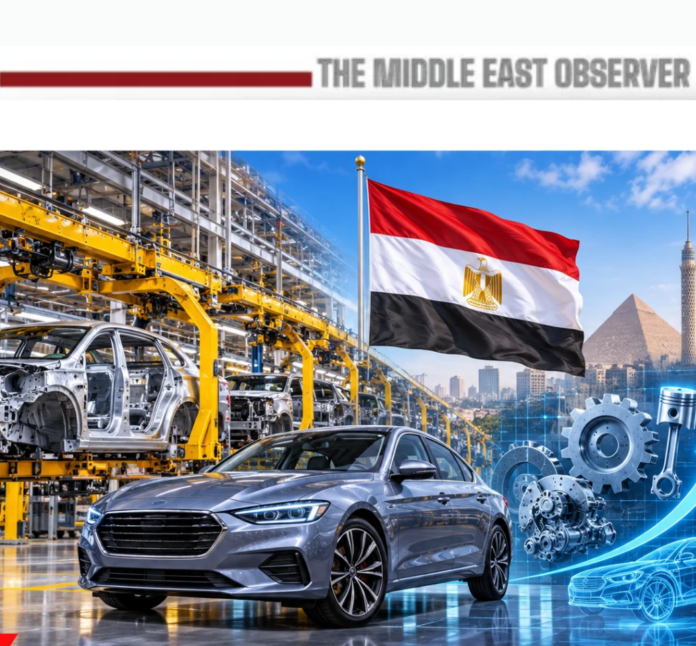
Egypt Creates the Future | Industrial Development, Electric Mobility and Technology Localization
Egypt is seeking to transform its automotive industry from conventional vehicle assembly into an integrated manufacturing sector, following a September 2026 battery technology agreement with China’s CATL and government announcements on November 4 outlining plans for locally produced electric motors and three electric vehicle models from 2027. The proposed vehicle programme targets annual production of 100,000 units by 2032, as Egypt seeks to attract international investment, strengthen domestic suppliers and capture more value from automotive manufacturing.
The initiatives reflect a broader industrial strategy aimed at moving Egypt beyond its traditional role as an assembly market. As electric mobility reshapes global automotive supply chains, the country’s opportunity lies in developing the capacity to manufacture batteries, motors and advanced components rather than relying primarily on imported technologies.
The distinction between investment commitments and industrial achievements remains critical. While some partnerships have been signed and existing facilities are being used for vehicle production, other projects remain under negotiation or have yet to reach commercial operation.
Batteries and Electric Motors: The Foundations of a New Industrial Era
Battery manufacturing is among the most important elements of Egypt’s automotive ambitions. Batteries represent a substantial share of electric vehicle costs, making their production strategically important for industrial competitiveness.
In September 2026, Egyptian manufacturer BME signed a cooperation agreement with China’s Contemporary Amperex Technology Co. Limited (CATL) to establish battery-pack manufacturing capabilities in Egypt.
Under the agreement, CATL will supply battery cells and provide technology licensing, production equipment and technical training. BME, established by Egyptian companies MCV and Auto D, will develop and finance the planned facility.
The first phase targets annual production capacity of one gigawatt-hour, initially serving heavy commercial vehicles. A subsequent expansion could raise capacity to five gigawatt-hours and extend production to passenger vehicle batteries and energy-storage systems.
The project represents a step towards localizing battery technology, although it concerns battery-pack manufacturing rather than domestic production of battery cells. Its industrial value will depend on the manufacturing expertise developed locally and the opportunities created for Egyptian suppliers.
Electric motor production is another priority. During the November government meeting, Industry Minister Khaled Hashem outlined proposed cooperation with an international company to manufacture electric vehicle motors locally in partnership with the Arab Organization for Industrialization (AOI).
Unlike the CATL-related battery agreement, the motor initiative remains at the proposed cooperation stage, with no confirmed production timetable.
Developing these capabilities would allow Egypt to participate in more technologically demanding stages of vehicle manufacturing, including powertrain integration and associated electronic systems.
From Global Partnerships to an Integrated Egyptian Automotive Industry
Attracting international manufacturers is important, but the long-term value of foreign investment depends on its contribution to domestic production, skilled employment and technology transfer.
Egypt’s industrial strategy therefore extends to automotive components and supporting industries.
Government initiatives announced in November included cooperation involving an international company, El Araby Group and AOI to manufacture seven automotive metal components locally, with targeted annual output of approximately eight million units.
Plans also include developing expertise in precision engineering, mould manufacturing and industrial testing. The government has outlined cooperation with Brazilian specialists to establish vocational training in mould and tooling production, alongside efforts to upgrade the Engineering Industries Technology Centre in 10th of Ramadan City.
These capabilities are essential because international automotive manufacturers require suppliers capable of meeting demanding technical and quality standards.
A stronger domestic supplier base could increase the value retained within Egypt, reduce dependence on imported components and improve the competitiveness of locally manufactured vehicles.
Electric Vehicles: An Opportunity to Reshape Egypt’s Industrial Future
Egypt’s existing automotive and engineering industries provide a foundation for expanding electric vehicle manufacturing.
In November, the government announced that a major international manufacturer planned to begin producing three electric vehicle models locally in 2027, targeting annual output of 100,000 vehicles by 2032.
The project aims to increase its local component share from an initial 10% to 27% by 2032. These figures are planned milestones rather than current manufacturing achievements.
The government also reported that China’s Dongfeng had begun electric vehicle manufacturing activities in partnership with SN Automotive and the state-owned El Nasr Automotive Manufacturing Company, using El Nasr’s existing production lines.
Such partnerships could help Egypt expand vehicle production while creating demand for domestic suppliers. However, assembling electric vehicles locally does not automatically establish local manufacturing of their batteries, motors or electronic control systems.
The sector’s development could also create opportunities in charging infrastructure, software, energy management and specialized maintenance services, provided investment in these activities keeps pace with vehicle production.
A National Programme Linking Investment, Production and Exports
Egypt’s National Automotive Industry Development Programme provides the policy framework for expanding manufacturing and increasing domestic value creation.
Its announced objectives include annual production of 100,000 vehicles, local value added of 60% and a domestic industrial component share exceeding 35%.
These programme-wide targets are separate from the production and localization objectives of individual electric vehicle projects.
The programme offers incentives linked to manufacturing output, investment, environmental performance and local content, encouraging companies to expand production and develop domestic supply chains.
For conventional vehicles, the programme sets an initial minimum local industrial component share of 20%, rising towards 35%. Electric vehicles have a separate initial requirement of 10%, subject to periodic review.
The distinction matters because higher vehicle production does not necessarily translate into equivalent growth in domestic manufacturing value.
Egypt’s geographical position and access to African and Arab markets could support automotive exports. Nevertheless, success in international markets will depend on competitive costs, consistent quality, reliable supply chains and compliance with technical standards.
Challenges: Turning Industrial Ambitions into Reality
Despite the opportunities, Egypt faces significant challenges in developing a fully integrated automotive industry.
The immediate priority is implementation. Planned battery facilities must reach commercial production, proposed motor partnerships must secure investment commitments, and vehicle manufacturers must demonstrate progress towards their announced output and localization targets.
Building a reliable network of Egyptian component suppliers will be equally important. Without sufficient domestic manufacturing capabilities, higher vehicle production could leave the industry dependent on imported high-value technologies.
Technical education and specialized training must support this transition. Universities, research institutions and manufacturers will need closer cooperation to develop expertise in engineering, electronics, industrial design and advanced production processes.
Electric mobility also requires investment in charging networks, maintenance services, battery recycling and internationally recognized safety standards.
Progress should be measured through actual production volumes, verified local content, qualified domestic suppliers, export performance and the development of Egyptian technical capabilities.
These indicators would provide a clearer assessment of industrial progress than the number of investment announcements alone.
The Future Begins with Owning the Technology
Egypt’s automotive ambitions represent an opportunity to establish a more competitive manufacturing base as the global industry moves towards electric mobility.
The CATL-related battery agreement, proposed electric motor partnerships and planned vehicle production programmes provide important starting points, but their economic significance will depend on successful implementation.
The central challenge is to ensure that international partnerships develop Egyptian manufacturing expertise and create opportunities for domestic companies across the automotive supply chain.
For Egypt, the ultimate objective should not simply be to assemble more vehicles under international brands, but to increase the technology, engineering capabilities and economic value developed within the country.
Achieving that objective would mark the transition from an automotive assembly market towards a more integrated manufacturing industry capable of competing in regional and international markets.
Related News:
1- Egypt Moves Into EV Battery Manufacturing With CATL
2- El Nasr Launches Dongfeng EV With 45% Local Content
Read Also:
1. Egypt’s Carmakers Gear Up for Export Expansion
2. Bank NXT’s EGP 2.1bn Facility Deepens Ezz Elarab Elsewedy’s Auto Manufacturing Push