

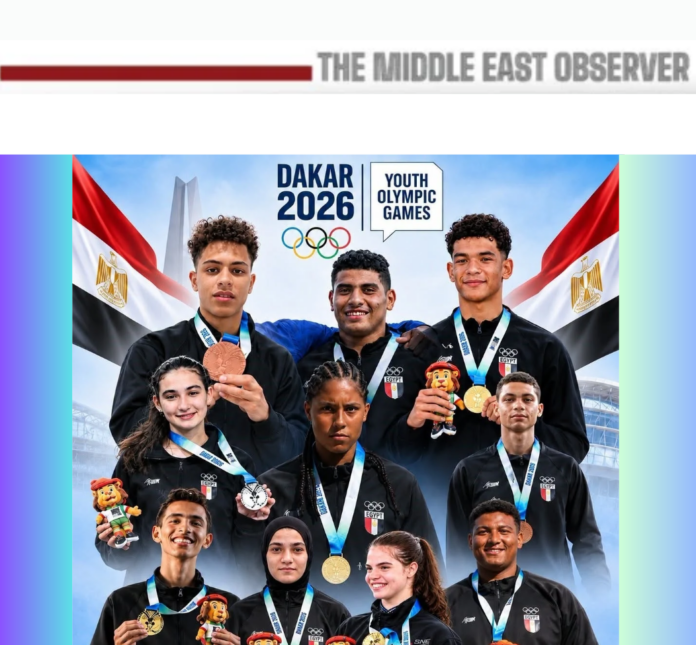
Egypt tops African and Arab medal standings as swimmer Zain Ali claims three titles and discus champion Yahya Sawaby sets an African record, raising expectations for a new generation of Egyptian Olympic athletes.
Egypt finished fourth in the world at the Dakar 2026 Youth Olympic Games, winning six gold, one silver and five bronze medals as the first Olympic sporting event held on African soil concluded on Friday, November 13.
The Games, officially held from October 31 to November 13 across Dakar, Diamniadio and Saly in Senegal, brought together approximately 2,650 athletes aged 14 to 17 from 204 national Olympic committees and a Youth Refugee Olympic Team. Organised under the International Olympic Committee (IOC), the competition featured 25 sports and combined elite youth competition with sporting development, education and cultural exchange.
Egypt’s delegation of 44 athletes, competing in 18 sports according to the Egyptian Olympic Committee’s final figures, secured 12 medals across seven disciplines. Its six golds marked the country’s most successful Summer Youth Olympics by gold-medal count and placed it first among African and Arab nations.
The result was driven by exceptional individual performances, led by Zain Ali’s three swimming titles, Yahya Sawaby’s record-breaking discus victory and historic gold medals in wushu and taekwondo.
Egypt also matched its previous highest total of 12 medals, achieved at Buenos Aires 2018, but doubled its gold-medal count and climbed from 22nd to fourth in the international standings.
The Egyptian delegation said it was the first African or Arab team to win six gold medals at a single Youth Olympics.
Beyond the medals, Dakar offered a measure of Egypt’s emerging sporting potential and renewed attention on whether national investment, specialised coaching and international competition can turn promising juniors into senior Olympic champions.
Egypt Among the World’s Leading Youth Olympic Nations
China topped the final medal standings with 18 gold, eight silver and seven bronze medals, followed by Japan with 11 golds and Russia with eight.
Egypt ranked fourth with six golds, ahead of Ethiopia, which won five golds and finished fifth, and host Senegal, which also claimed five golds and placed sixth.
France finished seventh, Kenya eighth and South Africa ninth, giving Africa five places among the world’s top 10 delegations.
Egypt’s position was particularly notable given the size of its delegation. Host Senegal fielded 136 athletes across 25 sports, compared with Egypt’s 44 competitors in 18.
However, delegation sizes and medal totals are not directly comparable measures of sporting efficiency. Qualification arrangements, athlete quotas, competition opportunities and national sporting priorities all influence the final standings.
The historical comparison also requires perspective.
Dakar featured a substantially smaller competition programme than Buenos Aires 2018, alongside changes in disciplines and participation arrangements. Egypt’s fourth-place finish therefore represents an exceptional achievement within the 2026 competition rather than definitive evidence that its overall sporting system has become the world’s fourth strongest.
Nevertheless, the breadth and quality of several Egyptian performances provide substantial grounds for optimism.
The Champions Behind Egypt’s Six Gold Medals
Egypt’s most outstanding individual performer was 17-year-old swimmer Zain Ali, also identified in Egyptian reporting as Zein Hesham, who completed a clean sweep of the men’s butterfly events.
He began with victory in the 100 metres on November 1, finishing in 52.16 seconds and defeating Serbia’s Aleksej Kalan by 1.87 seconds.
Three days later, Ali won the 50 metres in 24.06 seconds, becoming the first Egyptian swimmer to claim two gold medals at a single Youth Olympic Games.
He completed his treble on November 6, winning the 200 metres in a personal-best 1 minute 57.88 seconds.
World Aquatics described the achievement as a complete sweep of the butterfly programme, establishing Ali as one of the outstanding swimmers of Dakar 2026.
The victories represented the culmination of an established development trajectory rather than an isolated breakthrough. Ali had previously earned international recognition at African swimming competitions and entered Dakar as a multiple Egyptian national champion.
His success also illustrated the considerable demands of elite youth swimming.
Following his first gold medal, Ali described years of preparation and recalled training from as early as 4am.
His three titles accounted for half of Egypt’s gold medals, underscoring both his exceptional contribution and the country’s reliance on a relatively small number of outstanding competitors.
Sawaby Delivers an African Athletics Record
Egypt’s most significant measurable breakthrough in athletics came from Yahya Khaled Sawaby, who won the men’s 1.5kg discus throw on November 9 with a distance of 68.23 metres.
The 17-year-old established an African under-18 record and a Youth Olympic Games record.
According to World Athletics, the performance also placed him seventh on the world under-18 all-time list and made him the leading under-18 thrower globally in 2026 with the 1.5kg implement.
Sawaby opened the final with 67.10 metres before improving to his winning distance in the third round.
Jamaica’s Kamari Kennedy finished second with 66.31 metres, while Chile’s Vittorio Gorziglia took bronze with 56 metres.
The performance distinguished Sawaby from other medal winners because his victory was accompanied by a continental record and a benchmark against the strongest athletes in his age category.
It also highlighted Egypt’s potential in field athletics, where international success depends on specialist coaching, physical development, technical preparation and sustained access to appropriate facilities.
The challenge will be maintaining that progression as Sawaby advances to heavier throwing implements and increasingly competitive senior events.
Historic Gold in Wushu and Taekwondo
Sondos Sonbol secured Egypt’s fourth individual gold-medal contribution through her victory in women’s changquan combined wushu on November 3.
Sonbol accumulated 18.660 points across the combined changquan and gunshu routines, defeating Venezuela’s Valeria Frannerys Dudamel Alvarado, who scored 18.199.
Her achievement was historic because wushu made its debut as an Olympic medal sport at Dakar 2026.
The Chinese martial art combines technically demanding routines involving strength, speed, flexibility and precision. Sonbol’s victory demonstrated Egypt’s ability to challenge internationally in a specialised discipline outside its more established competitive strengths.
The gold also provided an important distinction for Egyptian women’s sport, placing Sonbol among the inaugural champions of an Olympic youth discipline.
Five days later, Youssef Hassan Kamal won the men’s under-48kg taekwondo title, defeating France’s Maxence Botta 2–0 in the final.
Kamal had earlier beaten Moldova’s Dmitrii Balagula in straight rounds to reach the championship contest.
His victory added another gold medal in a combat sport requiring considerable technical and tactical preparation.
Kamal subsequently carried the Egyptian flag during the closing ceremony, providing a symbolic conclusion to the delegation’s campaign.
Silver and Bronze Complete Egypt’s 12-Medal Performance
Egypt’s only silver medal came from Sara Amr Hossny, who reached the women’s individual foil fencing final on November 8.
Hossny advanced undefeated through the earlier stages before losing 15–8 to Russia’s Uliana Belykh.
The result confirmed her standing among the leading young foil fencers internationally, but her achievement carries particular significance for Egypt because she had already competed at the senior Paris 2024 Olympic Games at the age of 14.
Her experience provides evidence of an existing pathway between youth and senior Olympic competition, rather than merely the promise of a future transition.
Egypt’s five bronze medals were distributed across athletics, judo and boxing.
Aly Elramly earned bronze in the men’s under-81kg judo category on November 2, defeating Cyprus’s Vladimiros Charalampous by ippon after establishing an advantage through earlier scoring actions.
Athletics contributed three further bronze medals.
Mohamed Ismail, registered internationally as Mohamed Samir Abdalghany Abdelghani, finished third in the men’s 5kg hammer throw on November 8 with a distance of 69.72 metres.
Ahmed Mohamed Zaki Mohamed claimed men’s high jump bronze on November 9 after clearing 2.09 metres, a personal best.
Alaa Belal completed Egypt’s athletics medal collection on November 10, taking bronze in the women’s 3kg shot put with 15.92 metres.
The delegation’s final bronze came through Menatalla Ibrahim in women’s 60kg boxing.
Ibrahim defeated China’s Jiaen Wang in the quarter-finals before losing her November 11 semi-final 5–0 to Uzbekistan’s Rushanabonu Isoeva, who subsequently won the title.
Ibrahim received bronze when the event concluded on November 12, adding another podium finish for Egyptian women’s combat sports.
In total, Egypt’s 12 medals were won by 10 individual athletes across seven sports. Four female athletes contributed one gold, one silver and two bronze medals.
Athletics produced the largest overall contribution, with four medals, while swimming delivered three golds. Together, the two sports accounted for seven of Egypt’s 12 medals.
The distribution highlights an encouraging spread of talent, but also reveals a considerable concentration of success in particular disciplines and individuals.
What Dakar Reveals About Egypt’s Sporting Development
Egypt’s performance provides evidence that the country possesses young athletes capable of competing at the highest international level in several technically demanding sports.
It does not, on its own, establish that Egypt has developed a uniformly effective national talent system.
There is an important difference between producing exceptional champions and maintaining a sustainable pipeline of internationally competitive athletes.
The first depends partly on outstanding individual ability, personal determination and the quality of specific coaching environments. The second requires coordinated structures for identifying, developing, financing and retaining talent across successive generations.
Egypt’s Dakar medals demonstrate the first achievement convincingly. The extent to which the second has been accomplished remains a longer-term question.
There are nevertheless signs that targeted international support can contribute to progress.
In a November 14 assessment, the IOC confirmed that judo bronze medallist Aly Elramly had benefited from Olympic Solidarity-supported International Judo Federation youth initiatives.
The IOC also reported that fencing silver medallist Sara Amr Hossny had received support to attend an International Fencing Federation training camp and the 2025 Cadet and Junior Foil World Cup.
These examples provide documented links between international development opportunities and successful Egyptian competitors.
They do not establish that external assistance alone produced the medals, but they illustrate the benefits available when national federations and athletes gain access to specialist training and international competition.
Egypt’s Olympic Committee, led by Yasser Idris, worked with national sports federations on preparations for Dakar, with support from the Ministry of Youth and Sports under Minister Gohar Nabil.
The authorities’ contribution should be assessed through athlete development, preparation quality and subsequent results, rather than the medal tally alone.
A durable sporting system would need to track not only podium finishes but also qualification rates, performance improvements, retention of junior athletes and their progression into senior international competition.
Dakar offers Egyptian sports policymakers a valuable opportunity to evaluate which development structures are producing results and where support remains insufficient.
The Investment Challenge: Financing Egypt’s Next Champions
The achievements arrive as Egypt considers new mechanisms to finance elite sporting talent.
In February 2026, Investment and Foreign Trade Minister Mohamed Farid and Youth and Sports Minister Gohar Nabil discussed establishing a specialised sports investment fund intended to provide sustainable financing for promising athletes.
According to an official Ministry of Investment statement, the proposal would use investment-fund structures to help athletes develop their capabilities and prepare for regional and international competitions, with particular attention to individual sports.
The initiative envisages financial mechanisms designed to complement existing sports infrastructure and create more sustainable support for talent development.
The Dakar results strengthen the case for structured athlete financing, particularly in swimming, athletics, fencing and combat sports, where consistent international exposure and technical preparation can involve significant recurring costs.
However, the February announcement concerned a proposal. The publicly verified information reviewed for this report does not establish that the fund has become operational, identify a committed capital amount or demonstrate that it financed any of Egypt’s Dakar medallists.
These distinctions matter.
A credible financing programme would need transparent eligibility criteria, multi-year athlete support, clearly defined performance targets and independent oversight of expenditure.
It would also need to address the costs of specialised coaching, sports medicine, international training camps, travel, equipment and participation in major competitions.
For young athletes, the absence of predictable funding can disrupt the progression from junior promise to senior competitiveness, particularly in individual sports with limited commercial sponsorship.
The investment question is therefore not simply how much Egypt spends on sport, but how effectively resources are allocated, how consistently promising athletes are supported and how results are measured.
The Dakar generation offers a practical test of whether a more structured financing model can convert isolated achievements into sustained Olympic performance.
The Difficult Transition From Youth Medals to Senior Olympic Success
The greatest challenge facing Egypt’s young champions is still ahead.
At Dakar, IOC President Kirsty Coventry said that only about 15% of Youth Olympic participants subsequently compete at the senior Olympic Games.
The figure, reported by Reuters on November 12, provides an important international benchmark.
Youth Olympic success establishes potential, but it does not guarantee senior Olympic qualification, let alone medals.
Athletes must negotiate physical development, changes in competition standards, injuries, educational commitments, financial pressures and the increasingly demanding qualification systems of international federations.
The challenge differs between disciplines.
For Sawaby, progression requires adapting to heavier discus implements and stronger senior competitors. For Ali, it means continuing to reduce swimming times against deeper international fields.
In wushu, Sonbol’s Youth Olympic title provides recognition, but the discipline is not part of the Los Angeles 2028 Olympic medal programme, illustrating how differences between youth and senior programmes can shape athletes’ opportunities.
Egypt nevertheless possesses an important example of successful progression.
Ahmed Elgendy won two modern pentathlon gold medals at Buenos Aires 2018, including the individual title, before earning silver at the Tokyo 2020 Olympic Games and gold at Paris 2024.
At Paris, Elgendy became Olympic champion with a world-record total of 1,555 points.
His career demonstrates how early Olympic success can develop into senior excellence when competitive progression is maintained over several years.
Sara Amr Hossny offers another encouraging example, having participated in Paris 2024 before winning her Dakar silver.
Neither case guarantees similar outcomes for the new generation, but both establish that such transitions are possible for Egyptian athletes.
Los Angeles 2028 represents the nearest senior Olympic opportunity for some Dakar competitors, while Brisbane 2032 offers a longer development horizon.
Egypt’s challenge will be to provide support that follows athletes throughout those years, rather than concentrating resources around major competitions and medal celebrations.
Women’s Sport and the Search for a Broader Talent Base
Dakar also highlighted the international potential of Egyptian female athletes.
The medals won by Sonbol, Hossny, Belal and Ibrahim came across four distinct disciplines: wushu, fencing, athletics and boxing.
Their achievements demonstrate the presence of competitive female talent in sports requiring different technical and physical capabilities.
Yet the results cannot establish whether Egypt is providing equal opportunities across its sporting system.
That assessment would require information on participation rates, the gender composition of national teams, access to facilities, coaching resources and the distribution of financial support.
The wider Dakar programme offered an important reference point.
For the first time in Summer Youth Olympic history, athlete quotas and competition opportunities were designed to achieve full gender balance across sports, disciplines and events.
For Egypt, the objective should extend beyond the number of medals won by women.
Sustained progress would require broader access to competitive sport, particularly through schools, clubs and regional training centres, together with pathways that enable talented female athletes to advance into international competition.
The same principle applies geographically.
The success of individual athletes should not automatically be interpreted as evidence that talent-development opportunities are evenly distributed throughout Egypt.
Without verified data on the geographic origins of athletes, access to training facilities and regional funding allocations, it is not possible to determine whether the current system adequately reaches promising competitors outside established sporting centres.
Expanding that reach could help Egypt build a deeper national talent pool and reduce dependence on a relatively small number of exceptional individuals.
Dakar’s African Legacy Extends Beyond the Medal Table
Egypt’s achievement took place against the backdrop of a historic moment for African sport.
Senegal became the first African country to host an Olympic sporting event, staging the fourth Summer Youth Olympic Games across three host areas.
The event brought together young athletes from around the world while seeking to establish a lasting sporting, educational and organisational legacy for Senegal and the wider continent.
The IOC reported that more than one million Senegalese school children participated in Olympic values and education programmes linked to Dakar 2026.
More than 300 young professionals, including participants from 21 African national Olympic committees, received training through the Dakar 2026 Learning Academy.
Organisers also invested in upgrading sporting facilities, while the Youth Olympic Village at Amadou Mahtar Mbow University was designed to return to student use following the Games.
These initiatives demonstrate how the value of hosting a major sporting event can extend beyond competition, provided facilities, skills and programmes remain effective after the closing ceremony.
The African medal performances added a competitive dimension to that achievement.
Egypt, Ethiopia, Senegal, Kenya and South Africa all finished among the top 10 delegations, establishing a prominent continental presence in the international standings.
For Egypt, the Games reinforced the potential benefits of closer African sporting cooperation, including regional competition, coaching exchanges, federation partnerships and shared athlete-development programmes.
Africa’s first Olympic hosting experience also demonstrated the continent’s ability to organise a complex international sporting event, although the long-term economic and social returns will depend on the continued use of infrastructure and development programmes.
The IOC has meanwhile paused the process of selecting a host for the 2030 Youth Olympic Games while reviewing the event’s future, including its format and contribution to youth development.
That uncertainty further underlines why success should be measured by sustained athlete progression and sporting participation, not medals alone.
Egypt’s Olympic Future: From a Historic Result to a Sustainable Legacy
Dakar 2026 brings Egypt’s cumulative Summer Youth Olympic record to 38 medals: 13 gold, six silver and 19 bronze.
Its fourth-place finish represents the country’s highest international ranking at the event, while six gold medals establish a new national benchmark.
The achievement is substantial. Egypt defeated established sporting nations in the medal standings, produced an African athletics record and demonstrated competitive strength across seven disciplines.
But the results also expose the central challenge facing its sporting institutions.
Three of the six gold medals came from one swimmer. Seven of the 12 medals were produced by swimming and athletics. The success of these athletes deserves recognition, but future performance cannot depend on a handful of exceptional individuals.
The next phase requires continuity in coaching, regular exposure to international competition, appropriate medical and technical support, transparent financing and credible systems for identifying new talent.
For the Egyptian Olympic Committee, the Ministry of Youth and Sports and national federations, the most meaningful measure will be how many members of this generation advance into senior national teams, qualify for world championships and remain competitive through Los Angeles 2028 and Brisbane 2032.
The Games have also created an opportunity to broaden public recognition of Egyptian sporting achievement beyond football and encourage more young people to participate in individual Olympic disciplines.
Such benefits are possible, but they will depend on sustained action rather than the immediate impact of medal celebrations.
Egypt leaves Senegal as Africa’s leading Youth Olympic delegation, with its most successful gold-medal performance and several athletes whose achievements meet exceptional international standards.
Dakar has established the promise of a new Egyptian sporting generation. Whether it becomes a lasting Olympic legacy will depend on what Egypt builds around those athletes after the medals have been awarded.
Related news:
Egypt Sweeps African Table Tennis Team Titles in Morocco
Egypt Sweeps Qatar Classic as Orfi Sets World Record
Read also:
Egypt Targets 30 Factory Takeovers as Industrial Revival Fund Eyes First December Deal
El Organi’s $500mn Acquisition Plan Faces Egyptian SPAC Deadline
