
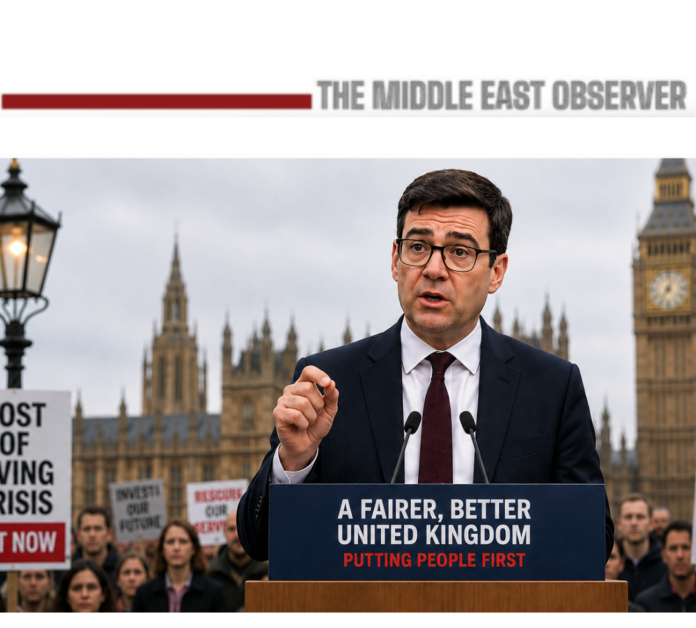
The former Greater Manchester mayor has launched his premiership with rapid action on household costs while signalling a more interventionist economic strategy and a firmer diplomatic tone on Gaza, setting the direction for a government that must balance political ambition with tight fiscal constraints.
LONDON — Britain’s new Prime Minister Andy Burnham has moved swiftly to define his government, unveiling a series of measures aimed at easing pressure on households while outlining an economic philosophy centred on regional development, public investment and a more active role for the state.
Within days of entering 10 Downing Street, Burnham announced the abolition of the 5% value-added tax (VAT) on domestic electricity bills from 1 October, pledged to restore the £2 cap on most bus fares in England, and launched a national initiative to tackle long-term homelessness. Collectively, the measures establish the priorities of a government focused on living standards, regional inequality and public service reform.
For investors, however, the early challenge is less about the popularity of these initiatives than whether they can be financed without undermining Britain’s fiscal credibility at a time of weak economic growth, elevated borrowing costs and continuing geopolitical uncertainty.
From Manchester to Downing Street
Burnham, 56, became Prime Minister on 20 July after succeeding Sir Keir Starmer as Labour leader, completing an unexpected return to frontline national politics following almost a decade as Mayor of Greater Manchester.
First elected to Parliament in 2001, Burnham served in Gordon Brown’s government as Chief Secretary to the Treasury, Culture Secretary and Health Secretary before later becoming one of Labour’s most prominent opposition figures. His political reputation was subsequently rebuilt during two terms leading Greater Manchester, where he championed regional devolution, integrated public transport and stronger links between housing, health and local economic development.
His flagship achievement was the creation of Greater Manchester’s Bee Network, which returned bus services to public control while integrating transport planning across the city region. Supporters argue that the experience demonstrated how devolved government can deliver more responsive public services when equipped with sufficient powers and resources.
That record forms the foundation of what has become known as “Manchesterism” — Burnham’s belief that stronger regional government, strategic public investment and partnership with private enterprise can drive economic renewal outside London. Rather than advocating widespread nationalisation, Burnham has consistently argued for greater public oversight of essential services where markets alone have failed to deliver affordability or long-term investment.
In his first address as Prime Minister, he pledged to “rewire” Britain by devolving power from Westminster, rebuilding industrial capacity and reducing long-standing regional disparities through a 10-year programme of economic renewal.
Cost of living comes first
Burnham’s first major policy decision was the removal of VAT from domestic electricity bills.
The government estimates the measure will save the average household around £45 annually while costing the Treasury approximately £850 million during the current financial year. Although the direct financial benefit is relatively modest, the policy carries considerable political significance, targeting one of the most visible pressures on household budgets following several years of elevated energy costs.
Ministers said the measure would initially be financed through cancelling the previous government’s proposed digital identity programme. Opposition politicians have questioned whether those savings fully offset the tax reduction, meaning Burnham’s first Budget will be closely scrutinised for its longer-term funding arrangements.
The electricity measure is complemented by plans to restore the £2 national bus-fare cap from January 2027 and an additional £340 million programme aimed at reducing long-term rough sleeping. Together, the initiatives illustrate Burnham’s preference for policies capable of delivering immediate and visible benefits while longer-term structural reforms are prepared.
Economists broadly view these measures as targeted relief rather than comprehensive economic reform. Their longer-term impact will depend on wider policies covering housing, infrastructure, energy investment and productivity growth.
Investors focus on the broader economic strategy
Financial markets reacted cautiously to Burnham’s arrival, reflecting greater interest in the government’s medium-term fiscal strategy than its initial policy announcements.
The appointment of John Healey as Chancellor provided reassurance that Labour intends to retain existing fiscal rules despite adopting a more interventionist economic agenda. Healey’s experience in previous Treasury roles has been widely interpreted as a signal that spending commitments will continue to operate within established budgetary frameworks.
Britain nevertheless faces significant structural challenges. Public debt remains above 95% of gross domestic product, productivity growth has remained subdued for more than a decade, and higher defence expenditure, healthcare costs and demographic pressures continue to constrain public finances.
Burnham argues that stronger regional investment, modern infrastructure, industrial policy and greater devolution will stimulate private-sector investment and improve productivity. His government is expected to publish a detailed 10-year economic strategy later this year covering manufacturing, housing, transport, skills and regional development.
Business leaders will look for faster planning decisions, greater policy certainty and clear incentives for investment. Markets, meanwhile, will judge whether Burnham can reconcile increased public investment with sustainable borrowing and stable public finances.
A measured but firmer Middle East stance
Burnham has also indicated that Britain’s diplomatic approach to the Middle East could evolve, particularly regarding the conflict in Gaza.
During Labour’s leadership contest, he acknowledged that the party had been too slow in responding to the humanitarian consequences of the war following the Hamas attacks of 7 October 2023, stating publicly that Labour “didn’t get it right” in its initial position. He has since called for stronger international pressure to secure a lasting ceasefire, expanded humanitarian access and renewed efforts towards a two-state solution.
Burnham has also expressed support for examining additional sanctions against individuals linked to extremist settler violence and has suggested that restrictions on trade involving goods produced in Israeli settlements should be considered. These positions reflect statements made during the leadership campaign rather than formal government policy, and ministers have yet to publish any revised framework governing UK-Israel relations.
At the same time, Burnham has maintained Britain’s longstanding commitment to Israel’s security, international law and close cooperation with European and American allies. His emerging approach therefore appears aimed at combining stronger diplomatic pressure over humanitarian concerns with continued support for regional stability.
For Middle Eastern governments, investors and businesses, any adjustments in British policy will be monitored closely, particularly regarding sanctions, trade measures and London’s broader role in supporting diplomatic efforts towards a negotiated settlement.
Gulf stability remains an economic priority
While Burnham has signalled a firmer tone on Gaza, his wider security position suggests broad continuity regarding Britain’s strategic interests in the Gulf.
The Prime Minister has repeatedly stressed the importance of safeguarding international shipping routes and maintaining stability around the Strait of Hormuz, recognising that prolonged disruption would directly affect global energy supplies, inflation and economic growth.
The United Kingdom maintains deep commercial, defence and investment partnerships across the Gulf Cooperation Council, making regional stability a significant economic as well as strategic interest. Higher oil and gas prices resulting from regional tensions would increase energy costs for British households and businesses, potentially offsetting some of the government’s cost-of-living measures.
Although Burnham has advocated rebuilding Britain’s defence capabilities in response to a more uncertain international environment, his government has also indicated that diplomacy and close coordination with allies will remain central to UK policy in the region.
The defining challenge
Burnham’s opening week has demonstrated a governing style characterised by speed, visible intervention and a determination to reconnect government with everyday economic concerns.
Yet the success of his premiership will ultimately be measured not by the popularity of its first announcements but by its ability to deliver stronger productivity, higher private investment and sustained economic growth while preserving fiscal stability.
For businesses, financial markets and Britain’s international partners—including governments and investors across the Middle East—the government’s first Budget and forthcoming long-term economic strategy will provide the clearest indication of whether Burnham can translate the political success of Greater Manchester into a credible national model for economic renewal.
His first decisions have established the direction of travel. The more demanding task now begins: converting political momentum into durable economic performance in an increasingly uncertain global environment.
Related news:
Joint Satellite Project Strengthens Saudi-Egyptian Push into Space Economy
How Digital Money Can Strengthen Monetary Policy Across the MENA Region
Read also:
Aswan Dances to the Rhythm of the World at the 13th International Festival of Culture and Arts