

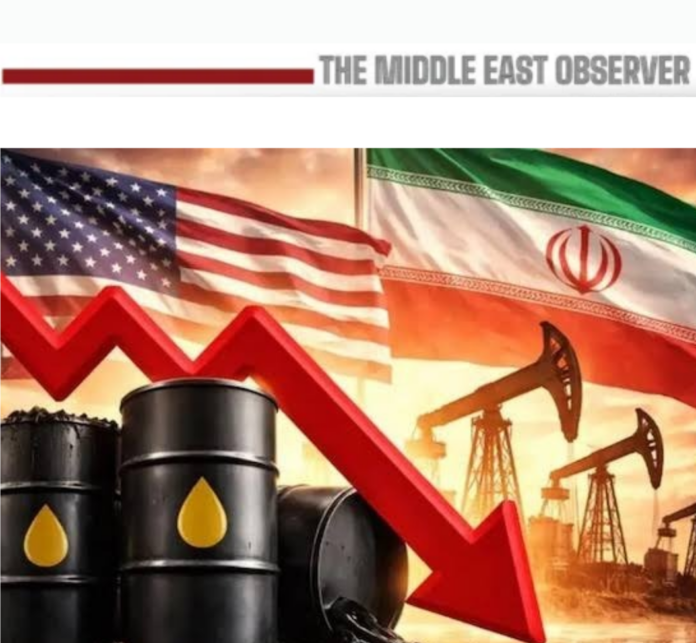
Oil prices fell below $90 a barrel for the first time since August on Tuesday, November 10, extending their sharpest weekly decline since 2020 as US President Donald Trump’s decision to hold off on further strikes against Iran raised hopes of easing Middle East supply disruptions, despite continued attacks and uncertainty over a peace agreement.
Brent crude futures briefly slipped below $90 before trading at $90.18 a barrel by 09:30 GMT, down 2.58% from Monday’s settlement. US West Texas Intermediate (WTI) fell 2.43% to $84.74 a barrel, extending losses from the previous session.
The decline followed a steep sell-off on Monday, when Brent settled 5.85% lower at $92.57 a barrel and WTI dropped 4.38% to $86.85. Brent had already lost 16% the previous week, its biggest weekly decline since the start of the COVID-19 pandemic in 2020.
The latest retreat reflects growing expectations that Washington could avoid further military escalation against Iran. Trump said on Monday that additional US strikes were unnecessary for the time being following appeals from regional governments, including Qatar, whose prime minister met the president at the White House.
The shift in Washington’s position followed the Democrats’ victory in the US midterm elections, which increased expectations of political pressure to bring the conflict to an end. However, Trump indicated that the US naval blockade affecting Iranian oil exports would remain in place.
The prospects for a diplomatic breakthrough remain uncertain. Senior US and Gulf officials have questioned whether an agreement is imminent, while Iranian officials have insisted that Washington must meet Tehran’s conditions before negotiations can advance.
Security risks also persist around the Strait of Hormuz, a critical route for global oil shipments. Maritime authorities have reported attacks on commercial vessels in the region, underscoring the possibility of renewed disruption even as oil prices decline.
Meanwhile, recovering oil flows through the Strait of Hormuz and rising production among members of the Organization of the Petroleum Exporting Countries (OPEC) have added downward pressure on prices.
A Reuters survey showed that OPEC’s crude production increased by 1.38 million barrels per day in October to 22.87 million barrels per day, led by higher output from Saudi Arabia, Kuwait and Iraq, despite continuing export constraints.
Signs of weaker physical oil market conditions have also weighed on futures. JPMorgan estimated that global oil supply exceeded demand by approximately 1.4 million barrels per day in October, suggesting that the market faces potential oversupply alongside easing concerns about military escalation.
Oil shipping costs have declined from recent peaks, improving the economics of long-distance crude deliveries. Baltic Exchange data showed that chartering a supertanker to transport two million barrels from the US Gulf Coast to Asia cost approximately $45 million on Monday, compared with $79.6 million a month earlier.
The combination of diplomatic optimism, recovering regional supplies and weaker physical market conditions has reduced the geopolitical risk premium in crude prices. Nevertheless, the continuing US blockade and threats to commercial shipping leave the market exposed to renewed volatility.
Traders are also monitoring this week’s oil market reports from the US Energy Information Administration, OPEC and the International Energy Agency for updated assessments of global supply and demand.
Further progress towards an agreement between Washington and Tehran could ease supply concerns and maintain downward pressure on prices, while renewed attacks on shipping or energy infrastructure could reverse the decline.
Related News:
1. Middle East Crude Nears Pre-War Levels, but Energy Crisis Shifts Downstream
2. The New Middle East Energy Premium: Iran War Reprices Oil, Gas and Shipping
Read Also:
1. Fitch Sees Brent at $70 as Hormuz Reopening Reshapes Oil Outlook
2. Hormuz Traffic Slumps as Gulf Oil Turns to Costly Transfers
