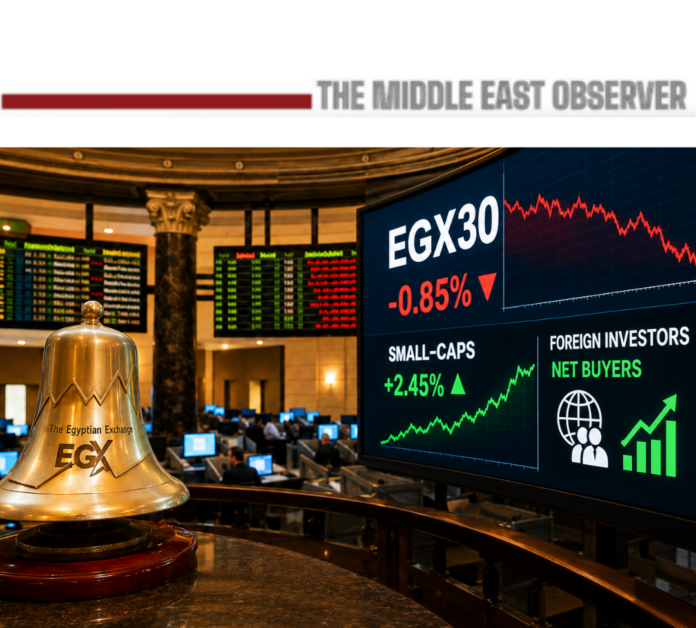
Foreign investors remained net buyers of Egyptian equities on Sunday, but selling pressure in heavyweight blue-chip stocks pushed Egypt’s benchmark index lower even as small- and mid-cap shares extended their strongest rally in weeks. The contrasting performance highlighted an increasingly selective market in which investors are favouring company-specific earnings prospects and relative valuations over benchmark exposure, while remaining cautious towards large-cap stocks after recent gains.
The benchmark EGX30 declined 0.70% to close at 52,560.10 points, weighed down primarily by a 1.3% fall in Commercial International Bank (CIB), Egypt’s largest listed lender. In contrast, the EGX70 Equal Weight Index climbed 1.25% to a record 17,263.26 points, extending a three-week advance, while the EGX100 Equal Weight Index rose 0.85% to 23,081.76 points. The EGX35-LV edged 0.15% higher to 6,268.34 points, whereas the EGX33 Shariah Index slipped 0.66% to 5,910.65 points.
Market capitalisation eased marginally to EGP3.886 trillion, indicating that gains across a broad range of listed companies largely offset weakness among heavyweight constituents.
Small-Caps Continue to Lead the Market
Sunday’s session reinforced one of the defining characteristics of the Egyptian Exchange in recent weeks: a widening divergence between the benchmark index and the broader market.
While blue-chip stocks came under selling pressure, particularly within the banking sector, investors continued rotating into small- and mid-cap companies perceived to offer stronger earnings momentum, restructuring opportunities and more attractive valuations.
The EGX70 has extended its strongest rally of the year over the past three weeks, underlining sustained investor appetite for smaller companies despite periodic consolidation in large-cap shares. The continued outperformance of the equal-weighted indices suggests the rally is broadening rather than becoming concentrated in a handful of benchmark constituents.
Trading activity remained robust, with equity turnover reaching approximately EGP10.1 billion, reflecting healthy investor participation despite the mixed performance across the market.
Foreign Investors Remain Net Buyers
Official Egyptian Exchange statistics showed foreign investors as net buyers of approximately EGP770.1 million, while Egyptian investors recorded net sales of EGP196.2 million and Arab investors sold a net EGP573.8 million.
The figures indicate that foreign investors continued selectively increasing exposure to Egyptian equities despite ongoing regional uncertainty. However, selling in several heavyweight stocks outweighed foreign demand, preventing the benchmark index from extending last week’s gains.
The session also demonstrated that foreign buying alone does not necessarily determine overall market direction. Concentrated weakness in a small number of large-cap constituents can offset broader investor demand when benchmark indices remain heavily weighted towards a limited number of companies.
Healthcare and Food Producers Lead the Winners
Among the session’s strongest performers, GlaxoSmithKline Egypt, Middle Egypt Flour Mills and North Cairo Flour Mills each gained the daily maximum of 20%. Healthcare and food producers featured prominently among the session’s strongest gainers, reflecting continued investor interest in companies with resilient operating profiles.
On the downside, Golden Textiles & Clothes Wool declined 5.98%, followed by Egyptian for Tourism Resorts, which fell 4.67%, and Egyptian Real Estate Group, down 3.85%.
The diversity of the day’s leading gainers and losers suggests investors remain focused on individual corporate fundamentals rather than broad sector rotation.
Equity and Debt Markets Continue to Diverge
The divergence between Egypt’s equity and fixed-income markets remains one of the most significant developments for portfolio investors.
According to Egyptian Exchange data, Arab and foreign investors recorded approximately US$1.46 billion in net sales in the secondary market for Egyptian government securities during the previous week. The outflows followed US$8.76 billion of net purchases during June, while cumulative portfolio inflows into government debt reached approximately US$11.66 billion during the second quarter of 2026.
Rather than signalling a broad retreat from Egyptian assets, the contrasting flows suggest that international investors are becoming increasingly selective. Local-currency government securities remain more sensitive to exchange-rate expectations, interest-rate policy and regional geopolitical developments, whereas equity investors can target companies with stronger earnings visibility, foreign-currency revenues and defensive business models.
Stable Monetary Policy Supports Market Visibility
Investors are also assessing Egypt’s macroeconomic outlook following the Central Bank of Egypt’s decision on 9 July to leave its monetary policy unchanged. The central bank maintained the overnight deposit rate at 19.0%, the overnight lending rate at 20.0%, and both the main operation and discount rates at 19.5%.
The decision reinforces policymakers’ commitment to consolidating the recent moderation in inflation while maintaining positive real interest rates. Stable monetary policy provides greater visibility over financing costs and corporate earnings, even as investors continue to assess the timing of any future policy easing.
Capital-Market Reforms Gather Momentum
Alongside daily trading activity, regulators continued implementing reforms aimed at broadening Egypt’s capital markets and attracting a wider range of investors.
The Financial Regulatory Authority (FRA) recently approved a one-year exemption from selected clearing and settlement fees for derivatives trading to encourage participation during the market’s launch phase, while permanently waiving fees for opening client accounts, cash deposits and cash withdrawals.
The Authority also established a permanent joint coordination committee with the Egyptian Exchange and the Egyptian Tax Authority to improve regulatory coordination, clarify the tax treatment of capital-market transactions and strengthen electronic integration between the three institutions.
Separately, through its Financial Services Institute, the FRA is launching an IPO-readiness programme to prepare executives of state-owned companies identified for future public offerings. The initiative is intended to strengthen corporate governance, disclosure standards and investor-relations practices, supporting the government’s broader programme to deepen capital markets and expand private-sector participation.
Although Egypt’s derivatives market remains at an early stage with relatively modest trading volumes, these initiatives are intended to enhance market depth, broaden investment products and strengthen the long-term competitiveness of the Egyptian capital market.
Weekly Perspective
Despite Sunday’s decline, the broader tone of the Egyptian market remains constructive.
Three themes continue to shape trading.
First, leadership has shifted decisively towards small- and mid-cap companies, with the EGX70 continuing to outperform the benchmark for a third consecutive week.
Second, foreign investors continue to distinguish between Egyptian asset classes. While local-currency government debt has experienced renewed selling amid regional uncertainty, selective buying of Egyptian equities points to continued confidence in companies with resilient earnings prospects and attractive valuations.
Third, regulators are accelerating structural reforms through the expansion of derivatives trading, preparations for future government listings and enhanced coordination between financial authorities, laying the foundations for a broader and more diversified capital market.
Outlook
Attention is now shifting towards second-quarter corporate earnings, which are expected to determine whether the current divergence between blue chips and smaller companies persists during the second half of the year.
Investors are now looking ahead to second-quarter earnings from banks, real estate developers and industrial companies, which are expected to determine whether the recent outperformance of small- and mid-cap shares can be sustained. They will also assess earnings quality, balance-sheet resilience and management guidance alongside inflation trends, monetary policy expectations and the direction of foreign portfolio flows.
Continued implementation of capital-market reforms—including the expansion of derivatives trading and preparations for future state-owned enterprise listings—is intended to broaden investment opportunities and strengthen the long-term depth of Egypt’s capital market.
Sunday’s trading demonstrated that Egypt’s equity rally is becoming increasingly selective rather than broad-based. While weakness in heavyweight constituents pushed the benchmark index lower, sustained gains across the broader market indicate that investors continue to favour companies offering stronger earnings growth, resilient business models and attractive relative valuations. As the reporting season gathers pace, corporate fundamentals are likely to play an increasingly important role in shaping market performance, reinforcing a gradual shift away from index-driven investing towards selective stock picking.
Read also:
Can Digital Banking Help Expand Financial Inclusion in Egypt?
Can Digital Banking Help Expand Financial Inclusion in Egypt?