

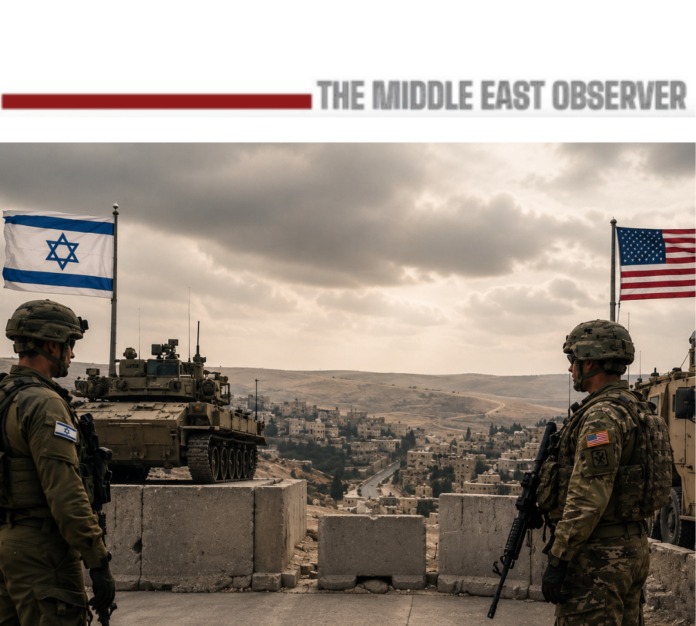
The systematic and widespread attacks launched by settlers and Israeli Border Police over the past week on villages and towns in the West Bank- from Tel and Al-Mughayyir and Jalud to Hawara and Nablus- were not merely a transient security breach. Rather, they revealed an integrated strategy of “military settlement,” in which the occupation army’s role intertwines with armed settler militias to impose a new geographic and demographic reality. This bloody field escalation, backed by a clear political decision from the far-right government, has reframed the age-old debate about the limits of American influence on Israeli security doctrine, and whether Israel is merely an “American state” or whether Israeli strikes are “American strikes carried out by Israeli hands”. This is not just a theoretical claim. It is a subject of serious academic and political debate, supported by strong structural and political evidence, while simultaneously contested by other views that affirm the persistence of relative Israeli autonomy.
Numerous facts indicate that the relationship between the two countries is not one of equals, but rather contains clear elements of dominance and dependency:
1. Israel receives approximately $3.8 billion in annual U.S. military aid, making it the largest recipient of American assistance, with a U.S. legal commitment to maintaining Israel’s “qualitative military edge” in the region. This systematic support ties Israel to an American supply chain and makes its defense decisions closely linked to Washington.
2. The United States consistently uses its veto power in the UN Security Council to protect Israel from critical international resolutions, providing it with a crucial diplomatic shield.
3. Numerous reports indicate that the U.S. administration (the Biden administration) has directly intervened to direct or restrict Israeli military operations. Trump claimed that he “stopped” Netanyahu from continuing to occupy Gaza, and issued orders to turn back Israeli warplanes heading to strike Iranian targets. According to sources, he explicitly stated: “Israel will no longer bomb Lebanon… that is prohibited by the United States”.
4. In a poll conducted by Israel’s Channel 12, 67% of Israelis considered their country to be a “vassal state” of the United States, and that Washington is the real decision-maker behind the military campaign in Gaza.
These facts make the idea that Israel acts as a U.S. “proxy”, an American state or a semi-dependent territory of the United States seem convincing to many, as the U.S. provides financial, military, and diplomatic support, while Israel implements policies that ultimately serve American strategic objectives in the region, such as weakening Iranian influence and protecting oil interests.
Conversely, defenders of the U.S.-Israel relationship offer a different view of Israeli autonomy, based on:
1. Netanyahu’s recent public rejection of Trump’s demand to withdraw from Gaza, Syria, and Lebanon is used as evidence that Israel retains the right to make its own sovereign decisions, especially regarding its national security. This refusal is considered an example of exercising autonomy even in the face of a direct American request.
2. Describing the situation as a strategic partnership rather than subservience, as some analysts see the relationship not as one of command and the other is obedience, but as a complex strategic partnership. Israel, as much as it benefits from U.S. support, is also a strategic asset for Washington. The existence of an independent and effective military force in a turbulent region is an advantage serving U.S. interests. This was evident during the recent war with Iran, where the U.S. and Israel acted as complementary partners. Israel carried out direct strikes while the U.S. provided air cover and missile defense, reflecting a level of coordination between the two militaries.
However, the test of “autonomy” is most clearly manifested today in the West Bank. While the Biden administration, through verbal pressure and symbolic sanctions on a handful of settlers, tried to preserve what remains of the two-state solution as a necessity for its regional strategy, now, facing Trump administration, Netanyahu’s government disregards these warnings. Arming settlers with American M4 rifles and providing them with military cover as they burn Palestinian homes, farms, and vehicles represents the pinnacle of Israeli “operational autonomy”—exploiting structural U.S. support to implement a settlement agenda that ostensibly contradicts the stated American desire for “calm,” thereby putting Washington’s credibility on the line.
Two Sides of the Same Coin
Here, observers might perceive some contradiction between U.S. “verbal condemnation” on one hand and “practical support” for Israeli actions- whether economic American aid, military aid , or political cover in international forums- on the other. Yet this contradiction reveals two sides of the same coin in a complex relationship. The U.S. provides economic aid, strategic support, weapons (such as the M4 rifles used by settlers), and political cover, while Israel retains maneuvering room to achieve its objectives, as long as they do not conflict with major U.S. interests or drag Washington into an all-out war. At moments of fundamental disagreement, Israel proves its autonomy, but within the overall framework of dependency.
Perhaps this simply means that this is American bombardment carried out by Israeli hands to achieve American interests. Israel acts as a “cheap American shield” in the region, carrying out military operations that serve U.S. goals such as weakening Iran and its proxies and securing maritime navigation routes. Perhaps the most accurate description of the situation is that the visible project in the Middle East is a “two-headed joint project”- an American head that approves as long as the political cost is low, and an Israeli head that pushes toward maximum achievement of its goals, aware of the game’s limits.
With growing divisions within the United States over support for Israel and shifting geopolitical orientations, this dynamic is being put to the test. The question is no longer: “Is Israel an American territory?” but rather: “Will this balance between dependency and autonomy change in the future?”.