

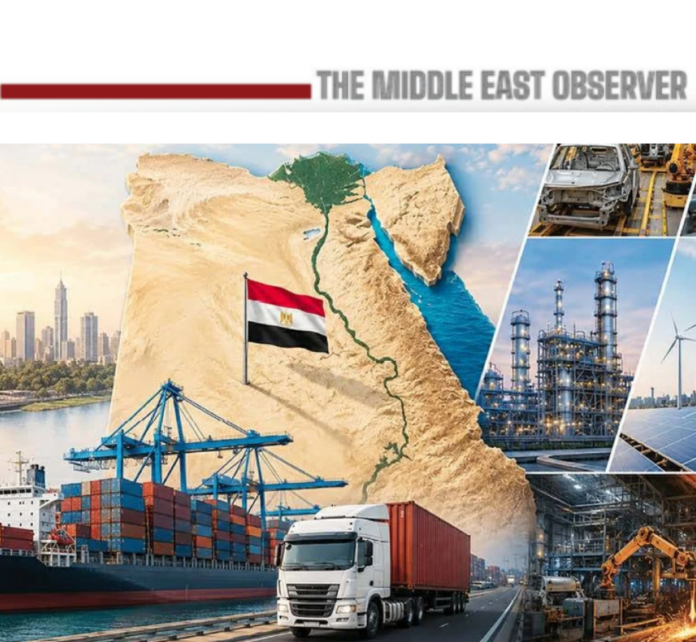
Non-oil exports climbed 17% in 2025, but Egypt’s next growth phase will depend on whether its infrastructure investments can support competitive manufacturing, stronger local supply chains and higher-value exports.
CAIRO, October 25, 2026 — Egypt’s non-oil exports reached $48.57 billion in 2025, up 17% from the previous year, highlighting a critical question for the country’s economic future: can years of investment in roads, ports and industrial zones translate into stronger manufacturing, higher domestic value added and sustainable employment?
According to the Ministry of Investment and Foreign Trade, imports increased to $83.01 billion, while the merchandise trade deficit narrowed by 9% to $34.45 billion.
The improvement signals stronger export performance, but it also reveals the scale of Egypt’s continued dependence on foreign goods. Expanding exports is essential; ensuring that more of their value is generated domestically is an equally important challenge.
From Export Growth to Industrial Value
Egypt’s leading non-oil export sectors in 2025 included building materials, chemicals and fertilisers, food products, and engineering and electronic goods.
Together, these industries provide a foundation for expanding manufacturing and strengthening Egypt’s position in regional supply chains.
However, higher export revenues do not necessarily mean an equivalent increase in domestic industrial value. Manufacturers relying heavily on imported components may generate substantial foreign sales while retaining a smaller share of the proceeds within the Egyptian economy.
Developing competitive local suppliers could help reduce that dependence, create opportunities for smaller businesses and increase the economic benefits of industrial expansion.
An example emerged in September 2025, when the Suez Canal Economic Zone signed an agreement with Chinese garment manufacturer ShuanFeng to establish an $8 million factory in Qantara West.
The planned facility targets annual production of 16.5 million garments, entirely for export, and approximately 2,000 direct jobs.
These are announced targets rather than confirmed operating results. Nevertheless, the project illustrates how industrial land, logistics access and foreign investment can support export-oriented manufacturing.
Electronics Manufacturing: The Technology Challenge
Egypt’s electronics industry offers a more advanced test of its industrial ambitions.
In October 2025, Chinese technology company OPPO opened a smartphone manufacturing facility in Tenth of Ramadan City under a $50 million investment plan.
According to Egypt’s Information Technology Industry Development Agency, the facility opened with 17 production lines and approximately 2,000 Egyptian employees. Government figures reported monthly production of around 400,000 devices and a local value-added component of 42% at the time.
Unlike projects still awaiting implementation, the OPPO facility provides evidence of operating manufacturing capacity.
Yet producing international products locally is only one stage of technological development. Greater economic value can emerge when domestic businesses participate in component manufacturing, product design, engineering, testing and research.
For Egypt, the opportunity extends beyond attracting global manufacturers. It involves developing Egyptian suppliers and technical expertise capable of competing within international production networks.
Infrastructure Must Generate Economic Returns
Egypt’s geographical position, the Suez Canal and its expanding transport infrastructure provide important advantages for industrial investors.
But location alone does not guarantee competitiveness.
Factories require reliable utilities, efficient customs procedures, predictable regulations and affordable transport. Delays and high operating costs can undermine the benefits of proximity to international markets.
The Suez Canal Economic Zone therefore represents a broader economic test: whether infrastructure, industrial facilities and logistics services can function as an integrated commercial system.
Its success should ultimately be measured through operating factories, cargo efficiency, investment returns and the ability of businesses to expand production and exports.
Similar principles apply to tourism and rural development. Cultural infrastructure can support local services when visitor spending reaches businesses, while improved rural roads and utilities can help agricultural producers and smaller enterprises access markets.
In each case, infrastructure creates the conditions for growth. Productive activity determines its economic return.
Private Investment Holds the Key
Egypt’s investment structure is also changing.
According to the General Authority for Investment and Free Zones, private investment reached approximately EGP 1.2 trillion in fiscal year 2024/25, compared with EGP 700.4 billion in the preceding year. Its reported share of implemented investment rose to 56.5% in current-price figures.
Separate Ministry of Planning data, calculated at constant prices, placed the private-sector share at approximately 47.5%.
Both measures point to a growing private-sector role, although they use different statistical bases and should not be treated as directly interchangeable.
For investors, the decisive considerations remain financing costs, regulatory stability, competition, skilled labour and access to reliable suppliers.
Small and medium-sized Egyptian businesses face additional challenges in meeting international manufacturers’ quality, financing and delivery requirements.
Strengthening supplier development, vocational training and access to capital could allow more domestic firms to benefit from foreign investment and participate in export-oriented production.
Measuring the Next Phase of Growth
Egypt Vision 2030 sets out ambitions for diversification, innovation and improved living standards. Achieving those objectives will require more than increasing the number of completed projects or announced investments.
Export performance must be assessed alongside domestic value added. Industrial capacity needs to translate into actual production, while infrastructure investment should deliver measurable improvements in business efficiency.
Reliable information on local sourcing, factory utilisation, employment, logistics costs and investment returns would help identify where economic development is producing lasting benefits.
Egypt has established substantial physical foundations for future growth. Its next challenge is to ensure that those assets support competitive businesses, stronger domestic supply chains and sustainable sources of income.
The ultimate measure of Egypt’s economic transformation will not be how much infrastructure it builds, but how much additional production, exports and economic value that infrastructure makes possible.
Related News :
SCZone Nears 400-Factory Milestone as Egypt Deepens Suez Manufacturing
Beyond More Factories: Egypt’s Investment Challenge Shifts From Quantity to Quality
Read Also:
Private Investment Takes the Lead in Egypt’s Economic Shift
The Maintenance Economy: The Industry Egypt’s Infrastructure Boom Is Creating
