

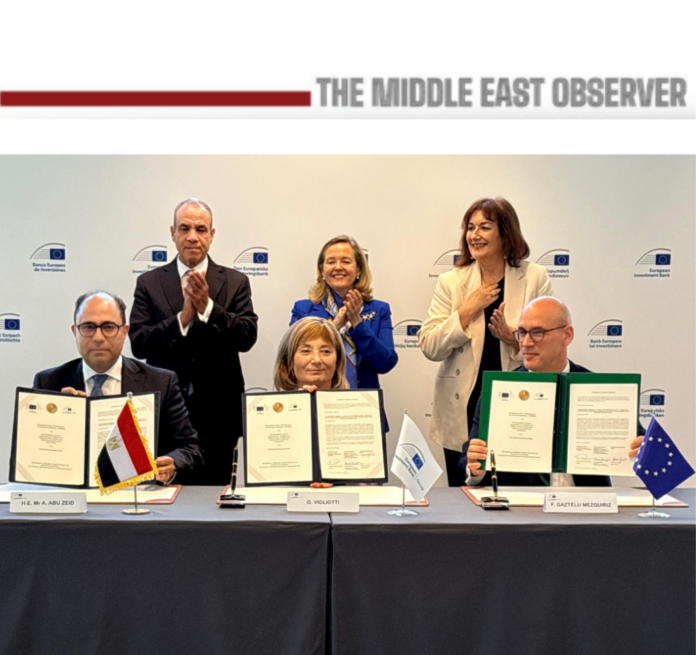
The EU-backed programme will strengthen Egypt’s electricity transmission network to integrate 22GW of renewable capacity, while the separate GREGY interconnector aims to create a future export route into Greece and the wider European power market.
The European Union has committed up to €690 million to modernise Egypt’s electricity transmission network, backing one of the country’s most significant energy infrastructure projects as Cairo seeks to transform itself into a regional renewable-energy and electricity-trading hub.
The investment is designed to integrate up to 22GW of renewable capacity by 2030, strengthening the domestic grid needed to support Egypt’s expanding solar and wind sector while laying the infrastructure required for potential electricity exports to Europe.
Crucially, the financing does not cover the proposed GREGY subsea interconnector between Egypt and Greece. Instead, it supports the domestic component of a broader Mediterranean energy strategy in which Egypt is reinforcing its national transmission network while separately pursuing cross-border electricity links with European markets.
Together, the two initiatives illustrate a shift in Egypt’s energy policy—from rapidly expanding renewable generation towards building the transmission and market infrastructure needed to transport, trade and eventually export clean electricity.
Domestic grid comes first
The financing package, announced by the European Investment Bank (EIB) and the European Commission in June 2026, consists of a €600 million loan from EIB Global and up to €90 million in EU grants, with the Egyptian Electricity Transmission Company (EETC) expected to fund the remaining share of the wider investment programme.
Implementation is scheduled between 2027 and 2030.
Rather than financing new renewable-power plants, the programme focuses on expanding Egypt’s transmission network through new high-voltage lines, substations and associated infrastructure needed to transport electricity from the country’s principal wind and solar corridors—including the Gulf of Suez, the Red Sea coast and Upper Egypt—to major consumption centres.
The investment addresses one of the biggest constraints facing Egypt’s energy transition. While renewable generation has expanded rapidly, transmission capacity has not always kept pace, increasing the risk of congestion, delayed grid connections and renewable-energy curtailment.
By reinforcing the national network, the programme aims to improve grid reliability, reduce transmission losses and provide the flexibility required to integrate intermittent solar and wind generation.
European officials estimate the upgraded system will be capable of integrating renewable electricity equivalent to the annual consumption of around 10 million households, although the figure represents generation capacity rather than new customer connections.
The project also marks an important policy shift. Egypt is moving beyond expanding electricity generation towards strengthening the infrastructure that enables renewable energy to reach consumers, industrial users and, eventually, export markets.
A broader EU-Egypt energy partnership
The investment forms part of the EU-Egypt Strategic and Comprehensive Partnership, launched in March 2024, which elevated energy co-operation to one of the central pillars of bilateral relations.
It also falls under the EU’s Global Gateway investment strategy and the Trans-Mediterranean Renewable Energy and Clean-Tech Cooperation Initiative (T-MED), which seeks to strengthen renewable-energy infrastructure and industrial integration across the Mediterranean.
For Egypt, the partnership provides access to long-term development financing and grants that reduce the cost of strategic infrastructure.
For Europe, the programme reflects a broader effort to diversify energy supplies and strengthen electricity links with neighbouring regions following the restructuring of European energy markets after Russia’s invasion of Ukraine.
Egypt’s expanding renewable sector, strategic location and one of North Africa’s largest and most interconnected electricity systems position it as a natural partner in the EU’s long-term clean-energy strategy.
The €690 million package should therefore be viewed primarily as a domestic infrastructure investment with wider regional significance. A stronger transmission network will allow renewable electricity generated across Egypt to be transported efficiently throughout the country and, where commercially viable, supplied to future international interconnections.
GREGY provides the export route
The international component of that strategy is the proposed GREGY interconnector, a separate project being developed by Elica Interconnector, part of Greece’s Copelouzos Group.
If completed, GREGY would become one of Europe’s first large-scale electricity corridors importing renewable power directly from North Africa. The high-voltage direct-current cable would connect Egypt and Greece across roughly 1,000 kilometres of the Mediterranean with a planned transmission capacity of 3GW.
According to the developer, electricity exported through the cable would originate from renewable-energy projects in Egypt, supplying Greek industry, supporting green-hydrogen production and potentially entering wider European electricity markets.
The project has received political backing from Egypt, Greece and the European Union and has been designated a Project of Common (Mutual) Interest by the EU.
In January 2026, the European Commission approved €9.56 million to finance additional engineering studies, marine surveys and seabed investigations required before construction can proceed.
Construction itself, however, remains unfunded.
Current developer estimates place the project’s value at around €4.2 billion, meaning GREGY must still complete technical and environmental assessments, secure regulatory approvals, raise project financing and conclude long-term commercial agreements before reaching a final investment decision.
Two investments, one strategic objective
Although the domestic transmission programme and GREGY are legally, financially and operationally separate, they form successive stages of the same energy strategy.
Renewable electricity generated in Egypt must first move through the national transmission network before it can reach any future export terminal.
The sequence is straightforward: renewable plants generate electricity, EETC’s domestic network transports and balances it, and GREGY would provide the international connection into Greece and the wider European electricity market.
The €690 million package therefore does not finance electricity exports directly. Instead, it strengthens the domestic infrastructure required to make future cross-border electricity trade technically possible.
Nor should the projects be interpreted as guaranteeing future exports. Most of the renewable electricity integrated into Egypt’s network will continue serving domestic demand, while any electricity transmitted through GREGY would depend on dedicated generation capacity and commercially negotiated export contracts.
Commercial execution remains the key test
While political support for closer EU-Egypt energy integration has strengthened, commercial execution remains the decisive challenge.
For the domestic programme, successful implementation will depend on timely delivery of transmission infrastructure and continued private investment in renewable generation.
For GREGY, the challenge is considerably broader. Developers must demonstrate that electricity exports can compete economically with renewable generation already available within Europe while securing long-term power-purchase agreements, regulatory approvals, transmission arrangements and financing for a multi-billion-euro infrastructure project.
Infrastructure investors will closely watch whether Egypt’s expanding renewable capacity, improving transmission network and geographic proximity to Europe can together produce a commercially bankable export model.
The broader opportunity extends beyond electricity trading. A stronger transmission system could accelerate investment in renewable generation, support green-hydrogen production, improve industrial decarbonisation and strengthen Egypt’s position within emerging Mediterranean clean-energy supply chains.
Execution will define Egypt’s energy ambitions
The EU-backed grid programme represents an important milestone in Egypt’s energy transition, shifting the focus from building renewable generation towards developing the infrastructure needed to transport and commercialise it.
GREGY represents the second stage of that vision by seeking to connect Egyptian renewable resources with European demand.
Whether Egypt ultimately becomes a significant exporter of renewable electricity will depend less on the scale of its solar and wind resources than on successful execution. Completing domestic transmission upgrades, securing commercially viable export contracts and financing cross-border infrastructure will determine whether today’s strategic vision evolves into a functioning Mediterranean electricity corridor linking North Africa with Europe.
Related news:
Egypt Restarts Power Exports to Libya After Grid Collapse
Egypt Advances Clean Energy Push Through Solar, Storage and Grid Investments
Read also:
Qatar Enters Global Diamond Trade with New Exchange
Military Settlement Between Israeli Autonomy and American Interventions