
Record Fire Season Exposes Europe’s Climate, Economic and Infrastructure Vulnerabilities as Experts Call for a Strategic Shift from Suppression to Prevention
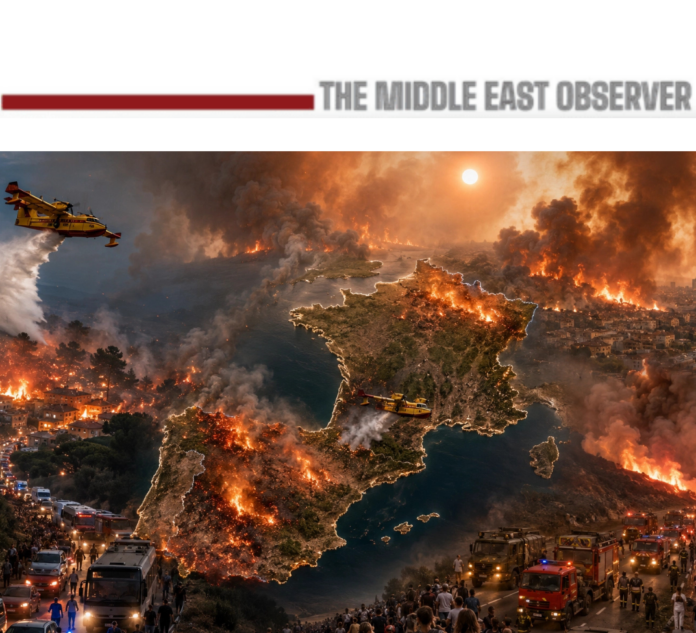
Europe is confronting one of its most destructive wildfire seasons in modern history, with fires having already scorched more than 254,000 hectares—an area roughly equivalent to the entire territory of Luxembourg—well before the traditional peak of the summer fire season. Although 2026 has not yet exceeded the record pace recorded during the same period in 2025, it is already significantly above the long-term average and is widely expected to rank among the continent’s most severe wildfire years unless weather conditions improve markedly.
What was once regarded as a seasonal environmental hazard has evolved into a strategic economic challenge. Beyond the immediate destruction of forests, the crisis is disrupting tourism, agriculture, infrastructure, insurance markets and public finances, while increasing pressure on governments to accelerate climate adaptation and disaster resilience. Increasingly, policymakers view wildfires not as isolated natural disasters but as recurring systemic risks capable of affecting economic growth, investment confidence and regional development.
From Seasonal Hazard to Structural Challenge
Wildfires have long formed part of the Mediterranean ecosystem, with Spain, Portugal, Greece, Italy and southern France historically experiencing seasonal fires during hot, dry summers. However, the scale, intensity and duration of recent fire seasons reflect the convergence of long-term climatic shifts and changing land-use patterns.
Over the past two decades, rising temperatures, prolonged heat waves, persistent drought, declining soil moisture, rural depopulation, agricultural land abandonment, expanding urban development along forest boundaries and stronger wind events have collectively transformed Europe’s wildfire profile. Forests that once experienced periodic fires are now exposed to longer fire seasons and increasingly extreme fire behaviour.
According to the European Forest Fire Information System (EFFIS), Europe’s wildfire season has gradually expanded beyond its traditional summer window, with heightened risks beginning earlier in spring and increasingly extending into autumn. Many fire scientists now describe southern Europe as entering an era of near year-round wildfire preparedness.
2026: One of Europe’s Most Severe Fire Seasons
As of late July, data from the European Commission’s Copernicus Emergency Management Service indicate:
- More than 254,000 hectares burned across the European Union.
- More than 1,250 significant wildfires, exceeding twice the long-term annual average.
- Approximately 8.31 million tonnes of carbon dioxide released into the atmosphere.
Spain remains the hardest-hit EU member, with more than 200,000 hectares burned and several fires ranking among the country’s largest in recent decades. Tens of thousands of residents have been evacuated around Madrid and Ávila as emergency services continue to battle rapidly spreading fires under extreme weather conditions.
France has experienced one of its most destructive wildfire seasons on record, particularly in the Gironde region surrounding Bordeaux, where hundreds of thousands of residents and visitors have been displaced while military units, international firefighting aircraft and thousands of firefighters were mobilised.
Portugal has maintained maximum wildfire alerts across much of the country, while Italy, Greece, Cyprus and parts of the western Balkans continue to face elevated wildfire danger as successive heatwaves persist across the Mediterranean basin.
The Economic Impact Extends Far Beyond Burned Forests
The direct destruction of forests represents only a fraction of the overall economic cost.
Tourism
Southern Europe’s tourism industry—one of the region’s largest employers and sources of foreign currency earnings—has experienced growing disruption through destination closures, transport interruptions, deteriorating air quality and cancellations during the peak holiday season.
Hotels, rural tourism operators, vineyards, national parks and coastal destinations have all reported operational challenges, highlighting the increasing vulnerability of one of Europe’s most valuable economic sectors to climate-related risks.
Agriculture
Agricultural losses continue to expand through damage to vineyards, olive groves, orchards, grazing land and irrigation systems. Repeated fires also accelerate soil degradation, erosion and water contamination, reducing long-term agricultural productivity and increasing future rehabilitation costs.
Forestry
Europe’s forestry sector faces the destruction of commercial timber assets accumulated over several decades. Reforestation program often require 30 to 60 years before forests recover their ecological and commercial value, significantly extending the economic consequences beyond the immediate disaster.
Infrastructure
Wildfires increasingly threaten electricity transmission networks, telecommunications systems, highways, railway corridors, reservoirs and industrial facilities. The protection of strategic infrastructure has therefore become an essential component of national resilience planning.
Insurance and Financial Markets
The growing frequency and severity of climate-related disasters are reshaping Europe’s insurance landscape. Reinsurers continue to reassess exposure across wildfire-prone regions, while higher premiums and tighter underwriting standards are expected to influence residential development, commercial investment and infrastructure financing in vulnerable areas.
Beyond insured losses, governments face mounting expenditure through emergency response operations, aerial firefighting fleets, military deployments, infrastructure reconstruction, environmental restoration, healthcare costs associated with smoke pollution and financial assistance for displaced communities.
Pressure on Europe’s Emergency Response System
The European Union’s Civil Protection Mechanism and the rescEU aerial firefighting fleet have become increasingly important as multiple member states simultaneously request assistance during major wildfire outbreaks.
However, successive large-scale fires have also highlighted the operational limitations of shared European firefighting resources. As wildfire seasons increasingly overlap with those in North America and other fire-prone regions, competition for specialised aircraft, helicopters and experienced firefighting personnel is expected to intensify, reinforcing calls for expanded pre-positioned response capabilities and greater investment in prevention.
Environmental Consequences
The environmental impact extends well beyond burned vegetation.
Copernicus estimates that the 2026 wildfire season has already released approximately 8.31 million tonnes of carbon dioxide, temporarily offsetting part of Europe’s emissions reduction efforts. Smoke plumes have travelled hundreds of kilometres, degrading air quality across national borders and affecting millions of residents.
Repeated high-intensity fires also threaten biodiversity, destroy wildlife habitats, increase soil erosion and heighten future flood risks by removing vegetation that stabilises vulnerable landscapes.
Weather Outlook Suggests Continued Risk
Meteorological forecasts provide little immediate relief.
Copernicus projections continue to indicate above-average temperatures and below-average rainfall across large parts of western and southern Europe, particularly from France through the Alps into the Balkans.
The highest wildfire danger remains concentrated across Portugal, northern and central Spain, southwestern France and parts of the western Mediterranean, while elevated risks are expected to persist across southeastern Europe should prolonged dry conditions continue.
Although temporary weather systems may reduce fire intensity in isolated areas, specialists caution that the underlying climatic conditions remain highly favourable for further large-scale wildfire outbreaks during the remainder of the summer.
Prevention Becoming as Important as Suppression
Across Europe, wildfire specialists increasingly argue that expanding firefighting capacity alone will not be sufficient to address the growing scale of the challenge.
Long-term resilience will require sustained investment in forest management, satellite monitoring, artificial intelligence for early fire detection, ecological restoration, prescribed burning where environmentally appropriate, improved emergency access corridors and stronger cross-border coordination.
Growing attention is also being given to reducing fuel continuity within forests through scientifically designed landscape management capable of slowing wind-driven fire propagation while preserving ecological integrity.
MEO Research Team Analysis
The MEO Research Team notes that Europe’s repeated wildfire emergencies in successive years suggest that prevention strategies should increasingly focus on areas demonstrating recurring vulnerability rather than attempting immediate continent-wide intervention.
Based on the pattern of major fires recorded during both the 2025 and 2026 wildfire seasons, the team believes that landscapes affected in consecutive years should be designated as Priority Wildfire Resilience Corridors for accelerated preventive management during the 2026–2027 winter maintenance season, when climatic conditions are most favourable for large-scale forestry operations.
Drawing upon the broad consensus among forestry, ecology and wildfire management specialists, priority measures should include the development of scientifically planned fuel-break and ecological buffer networks, selective vegetation thinning, prescribed burning where environmentally appropriate, improved emergency access routes and expanded satellite- and AI-assisted monitoring. Rather than relying solely on conventional firebreaks, modern wildfire management increasingly favours a landscape mosaic approach integrating lower-density vegetation, naturally fire-resistant species, managed woodland and agricultural corridors to interrupt fuel continuity and substantially reduce the risk of wind-driven fire propagation.
The research team considers the 2026–2027 winter season to represent a critical implementation window. Concentrating investment within landscapes repeatedly affected over the past two fire seasons would enable governments to direct limited resources toward areas where historical evidence indicates the highest probability of recurring wildfire activity, strengthening long-term landscape resilience while delivering greater economic efficiency than relying predominantly on increasingly costly emergency response operations.
Outlook
Europe’s wildfire emergency has evolved into far more than an environmental crisis. It has become a test of the continent’s economic resilience, infrastructure security, climate adaptation policies and long-term land management strategy.
As insurers reprice climate risk, governments increase adaptation spending and infrastructure planners redesign critical assets, wildfire resilience is becoming an increasingly important component of economic policy. The cost of prevention is no longer measured solely against annual forestry budgets but against the far greater financial burden of repeated reconstruction, disrupted economic activity, escalating insurance costs and declining investor confidence in climate-exposed regions.
Even if 2026 ultimately remains marginally below the record pace established in 2025, the season has reinforced a broader conclusion shared by climate scientists, economists, insurers and policymakers alike: extreme wildfire seasons are becoming an increasingly recurrent feature of Europe’s changing climate.
The challenge facing Europe is therefore no longer confined to responding more effectively once fires ignite. It is increasingly about reshaping vulnerable landscapes before the next fire season begins—making wildfire resilience a permanent pillar of environmental policy, economic planning and civil protection.
Related news:
Aquaculture: Balancing the Benefits and Risks of Fish Farming
Read also:
District Cooling Gains Ground as Singapore Seeks Climate Resilience