

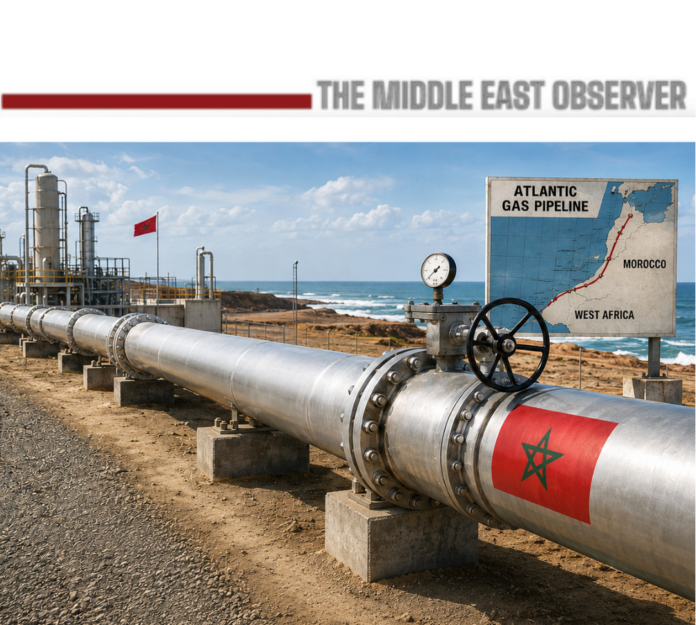
Morocco is seeking international financing for the estimated $26 billion African Atlantic Gas Pipeline (AAGP), arguing that heightened geopolitical tensions and Europe’s search for more resilient energy supplies have strengthened the investment case for one of Africa’s largest planned infrastructure projects.
Speaking in Washington on Wednesday, Morocco’s Ambassador to the United States, Youssef Amrani, said recent instability in the Middle East had reinforced the need to diversify global gas supply routes. He described the pipeline as a strategic project for African economic integration and European energy security but declined to provide details of ongoing financing discussions.
A spokesperson for the Export-Import Bank of the United States (EXIM) confirmed the agency has held preliminary discussions regarding potential support for the project, while the World Bank declined to comment.
The financing initiative follows a key political milestone after heads of state from the Economic Community of West African States (ECOWAS) signed an Intergovernmental Agreement (IGA) on 19 July, establishing the legal and governance framework for the proposed pipeline.
Designed to extend approximately 6,800 kilometres (4,225 miles) along Africa’s Atlantic coast, the pipeline would transport Nigerian natural gas through more than a dozen West African countries before connecting with Morocco’s gas network and the Maghreb-Europe Gas Pipeline, providing access to Spain and wider European markets.
Jointly developed by Nigeria National Petroleum Company (NNPC) Ltd. and Morocco’s National Office of Hydrocarbons and Mines (ONHYM), the project is expected to transport around 30 billion cubic metres (bcm) of natural gas annually while supplying both regional and European markets.
The project also reflects Europe’s changing energy landscape. While governments continue seeking alternatives to Russian gas and greater supply security, the International Energy Agency (IEA) expects European gas demand to decline by around 8% between 2024 and 2030, alongside the addition of roughly 300 bcm per year of new global LNG export capacity. The combination suggests the pipeline’s long-term success will depend on securing competitive transportation costs and long-term purchase agreements rather than geopolitical demand alone.
Financing remains the decisive hurdle
At an estimated $26 billion, the African Atlantic Gas Pipeline would require one of the largest infrastructure financing packages assembled in Africa.
Although EXIM has acknowledged preliminary discussions, no institution has announced a financing commitment. The project is expected to rely on a combination of sponsor equity, sovereign support, multilateral development-bank lending, export-credit guarantees and commercial debt.
Potential participants could include the African Development Bank, African Export-Import Bank (Afreximbank), the Islamic Development Bank, the ECOWAS Bank for Investment and Development, Gulf development funds, export-credit agencies and private infrastructure investors, although none has publicly confirmed involvement.
Before reaching financial close, lenders are expected to require long-term gas-supply agreements, transportation contracts, environmental approvals, transit arrangements and revenue guarantees capable of supporting a project of this scale.
Competing export routes
The Atlantic pipeline is also competing with Algeria’s proposed Trans-Saharan Gas Pipeline (TSGP) for investment and future export markets.
Both projects target transport capacity of about 30 bcm annually, but the Trans-Saharan route would cover roughly 4,100 kilometres and is generally estimated to cost $10 billion-$13 billion, substantially less than the Atlantic corridor. However, Morocco’s proposal would connect multiple West African economies before linking to Europe, whereas Algeria’s project would rely on its existing Mediterranean export infrastructure.
Beyond exports, growing domestic demand for natural gas across West Africa is expected to support new power generation and industrial development, providing an additional commercial rationale for the pipeline.
Political backing but no investment decision
Although the ECOWAS agreement represents a major political step, the project has not yet reached a Final Investment Decision (FID).
Engineering and feasibility studies have progressed, while environmental assessments, project structuring and regulatory work continue. Developers must still conclude commercial agreements with gas suppliers and buyers, secure financing, reach financial close and award engineering and construction contracts before work can begin.
First launched by Morocco and Nigeria in 2016, the initiative has evolved steadily into a multinational infrastructure programme, but execution risks remain significant given its scale, financing requirements and coordination across participating countries.
Market outlook
If completed, the African Atlantic Gas Pipeline would become one of the world’s longest offshore and coastal gas transmission systems, strengthening West African energy integration while creating a new export corridor to Europe.
Its success, however, will depend less on political endorsements than on commercial execution. Securing long-term gas supply and offtake agreements, assembling a bankable financing package and delivering the project on schedule will determine whether it can compete with lower-cost LNG supplies and rival pipeline routes. Those commercial milestones—not geopolitical ambition alone—are likely to determine when, and whether, the project reaches a final investment decision.
Related news:
Morocco Overtakes South Africa in Industrial Competitiveness Ranking
Egypt Tenders EGP4.5bn Link for Dabaa Nuclear Power Plant
Read also:
Saudi–Qatar High-Speed Rail Reinforces Momentum Behind GCC Railway Vision
Egypt and Syria Deepen Cooperation on Gas and Infrastructure