CAIRO — Egypt’s equity market remained divided on Wednesday as profit-taking in heavyweight banking, real estate and industrial shares pulled the benchmark index modestly lower, while sustained demand for small- and mid-cap companies extended one of the strongest secondary-market rallies of recent weeks. The session reinforced a broader weekly trend in which investors continued to favour domestically focused growth stocks despite consolidation among blue-chip companies ahead of key macroeconomic developments.
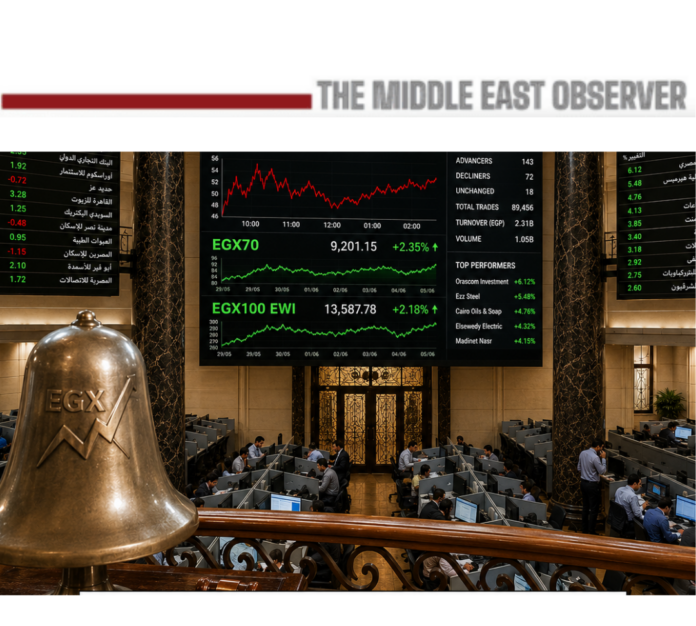
The EGX30 slipped 0.19% to close at 53,627.32 points, while the EGX70 Equal Weight Index advanced 0.67% to 18,422.68 points, extending its weekly outperformance. The broader EGX100 Equal Weight Index gained 0.51% to 24,255.77 points, the EGX35-LV rose 0.12% to 6,369.41 points, and the EGX33 Shariah Index remained broadly unchanged at 6,057.08 points. Total market capitalization stood at approximately EGP3.959 trillion.
Selling pressure was concentrated in several heavyweight constituents, including banking, property and building materials shares. Declines in stocks such as Talaat Moustafa Group, together with weakness across selected cement producers and other large-cap counters, outweighed gains elsewhere, limiting the benchmark’s performance despite continued strength in the broader market. The divergence reflects a period of consolidation following the EGX30’s strong rally earlier in July rather than a deterioration in overall market sentiment.
Trading activity remained resilient, with turnover of approximately EGP11 billion across nearly 225,000 transactions. However, market breadth remained negative, with 145 shares declining, compared with 84 advancing and 23 unchanged, indicating that buying interest remained concentrated in selected sectors rather than extending across the market.
Domestic Liquidity Continues to Anchor the Market
Official trading statistics showed Egyptian investors remained modest net buyers during regular trading, joined by Arab investors, while non-Arab foreign investors recorded slight net selling. Retail investors accounted for nearly four-fifths of total market activity, underlining the continuing importance of domestic participation in supporting trading volumes as international investors maintained a more selective approach.
The session broadly reflected themes identified in recent research by EFG Hermes, which highlighted improving domestic macroeconomic conditions and stronger earnings prospects in consumer-oriented and domestically driven companies, while suggesting that some sectors experiencing strong gains earlier in the year may enter a period of valuation consolidation.
Healthcare and Select Industrials Drive Gains
Healthcare shares again attracted significant investor demand. GlaxoSmithKline Egypt surged 20% to EGP 199.80, making it the session’s strongest performer, while Alexandria Flour Mills climbed 18.73%. Heliopolis Housing also posted gains, reflecting continued investor appetite for selected domestically focused companies.
Conversely, profit-taking weighed on several heavily weighted constituents, including Talaat Moustafa Group, Misr Cement–Qena, Commercial International Bank and other construction-related stocks, preventing the benchmark index from matching the broader market’s performance.
Capital-Market Reforms Gather Momentum
Beyond daily trading, investors continued to monitor structural reforms designed to deepen Egypt’s capital markets.
The Financial Regulatory Authority (FRA) reviewed the final regulatory and operational framework governing securities borrowing and short selling ahead of the mechanism’s expected launch. The new framework defines the responsibilities of brokerage firms, the Egyptian Exchange and Misr for Central Clearing, while strengthening settlement efficiency, transparency and operational safeguards for market participants.
Separately, the FRA approved a seven-working-day extension of the voluntary tender offer submitted by the New Construction Chemical–Ascom consortium to acquire up to 48.41 million shares, representing approximately 13.4% of Spinalex, at EGP15 per share. The extension until 13 August provides additional time to complete regulatory requirements, including the independent financial adviser’s assessment.
Markets Await IMF Executive Board Review
Attention also remained focused on the International Monetary Fund Executive Board, which was scheduled to consider Egypt’s seventh review under the Extended Fund Facility and the second review under the Resilience and Sustainability Facility on Thursday. While IMF staff reached a staff-level agreement with the Egyptian authorities in late June, investors awaited the Board’s formal decision before assessing its implications for investor confidence and Egypt’s reform programme.
Meanwhile, the Egyptian pound remained broadly stable, with the Central Bank of Egypt’s average exchange rate standing at approximately EGP50.66 per US dollar for buying and EGP50.76 for selling, providing a relatively predictable macroeconomic backdrop for financial assets.
Weekly Perspective
By Wednesday’s close, the divergence between blue-chip and broader market performance had become increasingly pronounced. The EGX30 had eased modestly during the week as investors locked in profits following July’s rally, while the EGX70 continued to outperform, gaining roughly 4% over the same period. The widening performance gap suggests that capital is being deployed more selectively, favouring companies with stronger domestic earnings potential, improving operational performance and attractive valuations rather than tracking benchmark constituents indiscriminately.
Outlook
Looking ahead, investors are expected to focus on three principal catalysts: the release of second-quarter corporate earnings, implementation of the FRA’s securities borrowing and short-selling framework, and continued progress in Egypt’s state-owned enterprise listing programme. Together with the outcome of the IMF Executive Board’s review, these developments are likely to determine whether liquidity broadens beyond small- and mid-cap shares or whether the current divergence between benchmark and broader indices persists through the coming weeks.
Although Wednesday’s benchmark decline reflected continued profit-taking among large-cap stocks, the resilience of broader indices, steady domestic participation and ongoing regulatory reforms suggest that investor confidence in Egypt’s equity market remains fundamentally intact, even as participants become increasingly selective in allocating capital.
Related news:Foreign Buying Absorbs EGX Profit-Taking Amid Reform Momentum
Egypt’s Liquidity Boom Tests Financial Infrastructure Capacity
Read also:
Profit-Taking Erases $2.6bn from Nigerian Exchange as Rally Faces Valuation Test
Small-Caps Lead Weekly Rally as Blue-Chip Profit-Taking Caps EGX30