Secretary-General says rising military budgets are widening the gap between defense spending and sustainable development financing
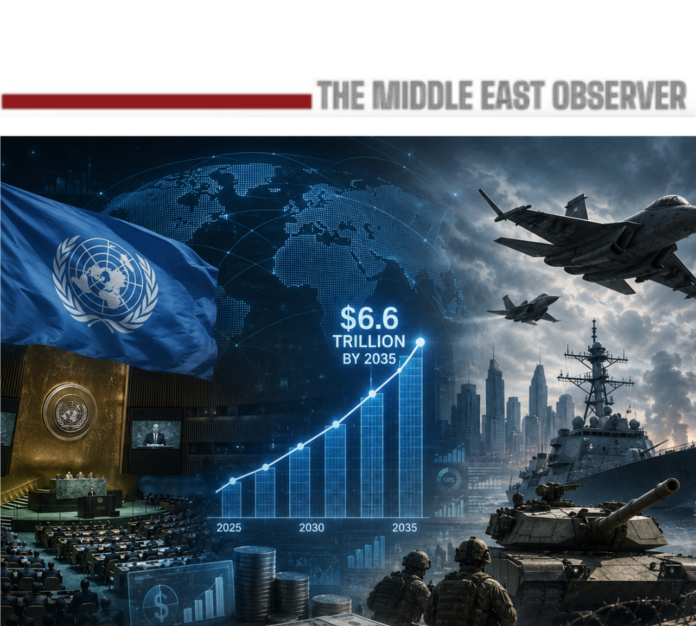
Global defense spending could more than double to as much as $6.6 trillion annually by 2035 if governments maintain current military spending trajectories, the United Nations has warned, highlighting the growing fiscal trade-off between national security and investment in sustainable economic development.
The projection is contained in UN Secretary-General António Guterres‘ report, The Security We Need: Rebalancing Military Spending for a Sustainable and Peaceful Future, which examines the implications of accelerating military expenditure for global development and long-term economic resilience. The report comes at a time when governments worldwide are expanding defence budgets in response to a rapidly evolving security environment.
The report reflects a profound shift in global security priorities. Since Russia’s full-scale invasion of Ukraine in 2022, defence budgets have expanded across Europe, while strategic rivalry between the United States and China, persistent instability across the Middle East, and growing concerns over cyber warfare, artificial intelligence and space security have accelerated military modernisation worldwide. NATO members have also committed to raising defence expenditure, reinforcing a broader global rearmament trend.
“The world is over-armed while peace is underfunded,” Guterres argues in the report, calling on governments to pursue a more balanced approach between military preparedness and investment in sustainable development.
Military spending reaches historic highs
Using the latest internationally comparable dataset available when the report was prepared, the UN cites figures from the Stockholm International Peace Research Institute (SIPRI) showing that global military expenditure reached approximately $2.7 trillion in 2024, the highest level ever recorded and the tenth consecutive annual increase.
More than 100 countries increased defense spending, while the world’s ten largest military spenders accounted for nearly three-quarters of total global military expenditure. Military spending represented roughly 2.5% of global gross domestic product, underscoring the growing share of public resources being directed towards defence amid an increasingly uncertain geopolitical environment.
If current spending patterns continue, annual global defence expenditure is projected to reach around $3.5 trillion by 2030 before rising to between $4.7 trillion and $6.6 trillion by 2035, depending on the pace of military expansion. According to the report, such growth would represent one of the largest long-term reallocations of public resources in modern history.
Security challenges reshape fiscal priorities
The report recognizes that governments face increasingly complex security threats and retain the primary responsibility for protecting national sovereignty. Many countries argue that higher defense spending has become essential to deter aggression, modernise armed forces and strengthen strategic resilience in an era of heightened geopolitical uncertainty.
Defense analysts similarly note that the international security landscape has changed fundamentally over the past decade. Russia’s war in Ukraine, China’s expanding military capabilities, instability across parts of the Middle East, and renewed great-power competition have prompted many governments to accelerate military investment despite mounting fiscal pressures.
At the same time, defense spending has become an increasingly important component of industrial policy. Governments are directing investment towards domestic defense manufacturing, aerospace, semiconductors, artificial intelligence, cybersecurity and advanced engineering, viewing these industries as critical to both economic competitiveness and strategic autonomy.
Development funding under pressure
The Secretary-General contends, however, that sustained increases in military expenditure also carry significant opportunity costs.
According to the report, the $2.7 trillion spent globally on defence during 2024 exceeded the combined economic output of Africa and amounted to approximately $334 per person worldwide. Global military expenditure also far exceeded official development assistance and was hundreds of times larger than the UN’s regular operating budget.
The report argues that the world’s fiscal challenge is increasingly about how governments prioritise competing spending commitments as defense absorbs a growing share of public expenditure. It estimates that redirecting even a modest share of annual military spending could substantially narrow financing gaps for the Sustainable Development Goals (SDGs), including programmes targeting hunger, healthcare, education and climate resilience.
Rather than advocating reductions in legitimate national defence capabilities or unilateral disarmament, the report calls for a more balanced approach to public spending. It recommends strengthening diplomacy, conflict prevention, transparency in military expenditure, regional confidence-building measures and multilateral cooperation while integrating sustainable development more closely into national security strategies.
Outlook
The United Nations concludes that geopolitical tensions are likely to keep global defense spending on an upward trajectory throughout the coming decade. Whether annual expenditure ultimately reaches the report’s upper projection of $6.6 trillion by 2035 will depend largely on how geopolitical rivalries, regional conflicts and technological competition evolve.
Yet the report argues that the defining policy challenge extends beyond military preparedness itself. As governments confront rising security demands alongside ageing populations, climate adaptation, infrastructure investment and mounting public debt, balancing defence expenditure with long-term economic resilience is likely to become one of the defining fiscal debates of the 2030s. The central question, the report suggests, is no longer whether nations invest in security, but how they allocate increasingly constrained public resources between military preparedness and the broader foundations of sustainable prosperity.
Related news:
Economic Security Reshapes the EU–South Korea Alliance
Strait of Hormuz Tensions Reshape Global Energy Markets
Read also:
Egypt, France Launch Strategic Dialogue to Advance Economic and Political Cooperation
Brent Falls to $72.5 as Iraq Exposes OPEC to a New Challenge