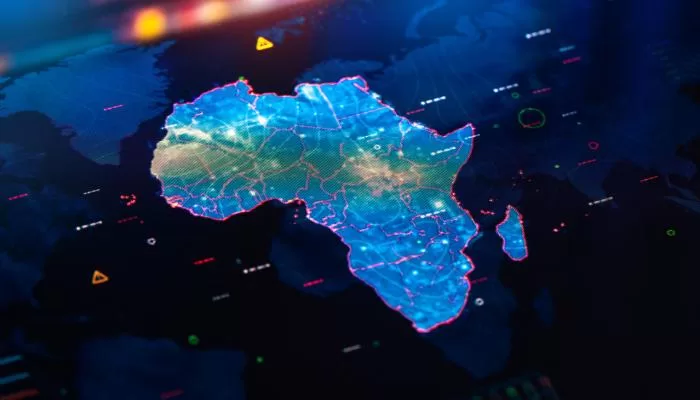
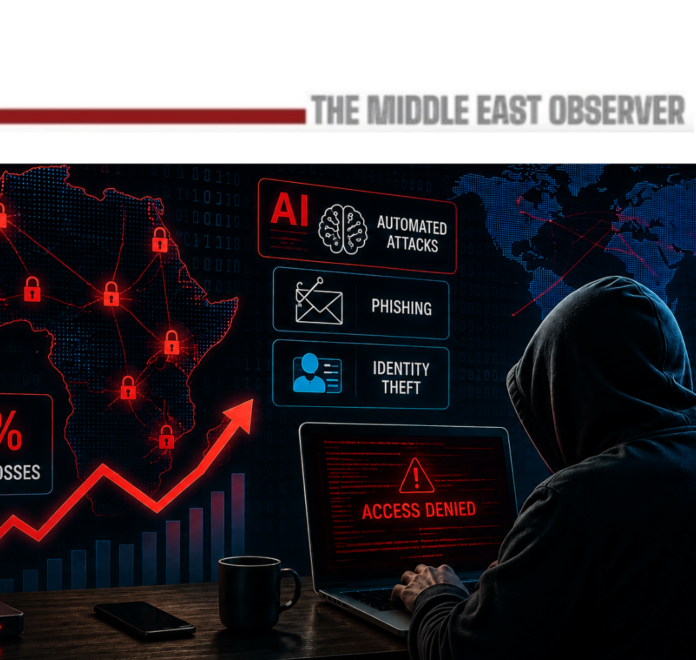
INTERPOL’s African Cyberthreat Assessment Report 2026 says artificial intelligence is industrialising cybercrime across the continent, exposing growing vulnerabilities as Africa’s digital economy continues to expand.
Reported cybercrime losses across Africa have climbed by approximately 152% in just two years as artificial intelligence enables organised criminal networks to industrialise online fraud, according to INTERPOL’s African Cyberthreat Assessment Report 2026. The assessment estimates that reported financial losses linked to cybercrime increased from US$192 million in 2024 to US$484 million, underscoring the widening gap between the continent’s accelerating digital transformation and its cybersecurity capacity.
The findings highlight one of the principal risks accompanying Africa’s digital expansion. As mobile banking, fintech platforms, e-commerce and digital public services continue to broaden financial inclusion, cybersecurity has struggled to keep pace with increasingly sophisticated criminal activity. With more than 1.1 billion mobile subscriptions recorded across the continent, the economic opportunities created by greater connectivity are increasingly matched by a rapidly expanding cyber attack surface.
The report also reflects a broader global trend in which generative artificial intelligence is lowering barriers to cybercrime while increasing the speed, scale and sophistication of financial fraud. As governments and businesses worldwide accelerate AI adoption, cybersecurity agencies are increasingly warning that the same technologies driving innovation are also reshaping organised cybercriminal activity.
According to INTERPOL, more than half of reported cybercrime incidents across Africa now involve AI-assisted techniques, illustrating how rapidly emerging technologies are changing the threat landscape. Criminal groups increasingly employ artificial intelligence to automate phishing campaigns, produce convincing social engineering content, harvest credentials at scale and generate synthetic identities capable of bypassing traditional verification systems. Generative AI has significantly reduced the technical expertise and resources required to conduct sophisticated cyberattacks, enabling organised criminal networks to expand operations with unprecedented speed and efficiency.
Rather than isolated criminal activity, INTERPOL argues that cybercrime has evolved into a professionalised, cross-border industry in which specialised criminal groups collaborate across jurisdictions using business-like structures and scalable operating models. Increasingly, these networks are targeting financial institutions, businesses, government agencies and critical digital infrastructure through highly coordinated campaigns designed to maximise financial returns while exploiting regulatory and jurisdictional gaps.
Online scams remain Africa’s most commonly reported cybercrime, followed by mobile money fraud, business email compromise (BEC), romance scams, digital sextortion and credential theft. Criminals are also increasingly combining authentic personal information with AI-generated identities and fabricated documentation to open bank accounts, obtain digital loans and register SIM cards under false identities, illustrating the growing sophistication of identity-based financial fraud.
The report identifies distinct regional threat patterns. East Africa has emerged as a hotspot for mobile money fraud and ransomware attacks targeting digital infrastructure, while West and Central Africa continue to experience elevated levels of business email compromise and online financial fraud. Southern Africa’s comparatively advanced digital infrastructure has increasingly attracted sophisticated international ransomware groups seeking high-value targets capable of causing widespread operational disruption.
Beyond the attacks themselves, INTERPOL warns that structural weaknesses continue to undermine Africa’s cyber resilience. Fragmented cybercrime legislation, uneven regulatory frameworks, limited digital forensic capabilities and low levels of AI preparedness among many law enforcement agencies continue to constrain effective enforcement. The absence of real-time intelligence sharing between banks, telecommunications providers and investigative authorities further hampers efforts to detect and disrupt cross-border criminal networks, while differences in national legal frameworks continue to complicate investigations and prosecutions.
Although 17 African countries enacted or strengthened cybercrime legislation during 2025, INTERPOL suggests that institutional reforms continue to lag behind the pace at which AI-enabled criminal techniques are evolving. Nevertheless, expanding regional operational cooperation, intelligence-sharing initiatives and cybersecurity capacity-building programmes are laying important foundations for a more coordinated continental response.
The organisation recommends greater harmonisation of cybercrime legislation, stronger digital forensic capabilities, enhanced cross-border intelligence sharing and increased investment in AI training for law enforcement agencies. It also calls for deeper public-private cooperation involving governments, financial institutions, telecommunications providers and cybersecurity companies to strengthen prevention, detection and incident response capabilities.
For investors and policymakers alike, the findings suggest cyber resilience is becoming an increasingly important component of economic competitiveness, operational risk management and financial stability. As African economies continue investing in artificial intelligence, digital public services, cashless payments and financial inclusion, the ability to safeguard digital infrastructure will become an increasingly important determinant of long-term investment confidence.
The report therefore frames cybersecurity not simply as a policing challenge, but as a strategic economic imperative. Strengthening cyber governance, regulatory coordination and institutional capacity will be essential to sustaining Africa’s digital growth, attracting long-term investment and ensuring that technological innovation is matched by resilient and trusted digital ecosystems.
Related news:
Egypt Signs Deal to Launch Dedicated East Africa Shipping Line
East African States Advance Joint Regional Satellite Initiative
Read also:
Egypt Looks to Tanzania to Deepen East African Trade Links
Tabby Becomes Licensed Consumer and SME Lender in Saudi Arabia