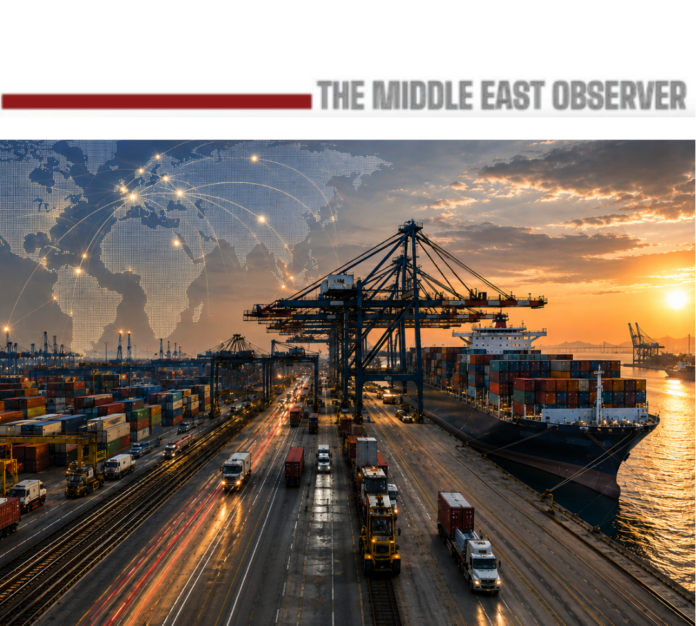
China’s tighter control over strategic minerals, Washington’s push to secure supply chains, Africa’s demand for local processing and Europe’s tougher carbon and trade rules are fragmenting the industrial system that underpinned globalisation. The Iran war has exposed another vulnerability: the trade routes on which MENA’s geographic importance has long depended. The opportunity now is to turn transit geography into industrial leverage.
The shift is already visible. The world’s largest supplier still accounted for about 85 percent of rare-earth refining in 2025, according to the International Energy Agency. In August, the US announced more than $2bn of critical-mining projects and over $180mn for mining education, underscoring Washington’s increasingly interventionist approach to supply security.
Africa is simultaneously pushing for greater domestic processing, while Europe is raising the cost and complexity of industrial market access through carbon requirements, trade remedies and traceability rules. Egypt’s hot-rolled steel, for example, faces an 11.7 per cent EU anti-dumping duty.
The Iran war has added urgency by demonstrating how quickly disruption around the Strait of Hormuz can turn a geographic advantage into an industrial and trading liability.
The implications extend beyond shipping. Energy, minerals, manufacturing, logistics and trade policy are becoming parts of the same industrial-security equation.
For MENA, the choice is therefore larger than diversification from hydrocarbons. The region can remain principally a supplier of commodities and transport services, or use its energy, capital, manufacturing base and proximity to Africa to occupy more of the value chains connecting competing economic blocs.
From Transit to Transformation
The clearest opportunity lies between extraction and final manufacture.
Copper illustrates the difference. Exporting ore or cathodes captures only part of its value. Converting copper into wire rod, cables, transformers, motors and grid equipment creates deeper industrial capacity and products less exposed to competition on price alone.
The principle extends across strategic industries:
iron ore → DRI → steel → engineered products
bauxite → aluminium → conductors and components
phosphate and gas → fertilisers → speciality chemicals
battery minerals → processed materials → storage systems
rare earths → separation → metals → magnets and motors
The relevant measure of industrial progress is therefore not simply tonnes produced, but how many commercially competitive stages of the value chain can be retained within the region.
That favours greater emphasis on downstream metals, chemicals, engineering products and electrical equipment. Expanding grids, renewables and data centres will require transformers, cables, switchgear, motors, storage systems and power electronics — sectors in which MENA can combine existing strengths in energy, metals and engineering.
Energy as the Industrial Foundation
MENA’s energy advantage remains central, but it needs to underpin manufacturing rather than operate as a separate export strategy.
Natural gas remains important for reliable electricity, fertilisers, petrochemicals, refining and direct-reduced iron. Solar and wind can progressively reduce industrial carbon intensity and, where economics permit, power costs, supported by storage and stronger grids.
The more plausible model combines conventional energy for reliability and feedstock with renewables for increasingly lower-carbon production.
Hydrogen fits where identifiable industrial demand already exists, particularly in steel, ammonia and refining, rather than principally against uncertain future export demand.
The commercial test is whether projects can combine competitive power, reliable feedstock, long-term offtake, affordable finance and export access without permanent state support.
Africa as a Production Partner
Africa’s push for greater mineral beneficiation changes the proposition for MENA investors.
Rather than relying on the traditional extraction model, Gulf and North African capital can participate in mines, infrastructure and first-stage processing within producing countries, with higher-value refining and manufacturing distributed across specialised African and MENA hubs.
The chain becomes:
African resources + local beneficiation + MENA capital and energy + regional manufacturing + global markets.
This would allow African economies to retain more value while giving MENA industries access to inputs needed for electrification and advanced manufacturing.
The harder commercial question is whether projects can reconcile African demands for domestic value addition with investors’ need for scale, reliable infrastructure and predictable returns. Both will be necessary for durable integration.
Specialisation Before Self-Sufficiency
The greater regional risk is duplication.
If every government subsidises its own battery complex, hydrogen industry, steel expansion and EV programme, MENA could create excess capacity rather than an integrated production system.
Regional economics instead favour specialised clusters connected by supply chains.
The Gulf brings capital, energy-intensive processing, metals, petrochemicals and logistics. North Africa offers broader manufacturing bases, engineering capabilities and proximity to European and African markets. Oman adds strategically valuable maritime access outside Hormuz.
Saudi Arabia has scope to deepen mining and mineral processing; Egypt can build on steel, fertilisers, electrical equipment and engineering; Morocco has established automotive and phosphate industries while expanding into battery-related production. The UAE combines aluminium, logistics, trading and investment capabilities.
These are not fixed national assignments. Investment should follow energy, skills, infrastructure, resources, scale and market access, rather than the political attraction of replicating every strategic industry domestically.
Build Corridors That Carry Industrial Value
MENA already possesses major ports and trade routes. Their next role should be to connect production systems rather than simply move commodities.
Ports can anchor processing plants, manufacturing zones, storage and power infrastructure, while industrial corridors connect African resources and markets with North African, Red Sea, Gulf, Arabian Sea and Atlantic production centres.
Trade compliance must develop alongside that infrastructure.
Carbon intensity, rules of origin and supply-chain traceability increasingly affect market access, landed cost and operating margins. Manufacturers unable to document input origin or embedded carbon may face higher costs or exclusion from premium markets.
A regional industrial passport for selected strategic products could therefore become commercially useful, documenting raw-material origin, energy source, processing location and carbon intensity.
But traceability cannot compensate for poor economics. Financing costs, productivity, logistics and energy efficiency will ultimately determine whether MENA manufacturers can compete with established industrial clusters in China, India, Turkey, Southeast Asia and Mexico.
The intended transformation is straightforward:
Resources → Energy → Processing → Materials → Components → Equipment → Finished Products → Global Markets
instead of:
Resources → Port → Export.
Execution Will Decide the Outcome
MENA’s location gives it an opportunity, not an entitlement.
The region does not yet possess the supplier density, engineering depth or manufacturing productivity found in parts of East Asia. Several economies also face expensive finance, water scarcity, skills shortages, fragmented customs regimes and uneven infrastructure.
Comparative advantage does not automatically create industrial capability.
The likely winners are industries with structural advantages in energy, resources, engineering, logistics or market access. Those dependent primarily on cheap subsidised power, protection or political ambition risk becoming expensive stranded capacity.
Industrial policy therefore requires selectivity and commercial discipline.
A credible transition could proceed in three stages:
To 2029 — resilience: secure industrial energy and critical inputs, strengthen grids and storage, protect export access and improve logistics, carbon accounting and trade-defence capacity.
2029–2035 — industrial depth: expand mineral processing, downstream metals, speciality chemicals, electrical equipment, renewable-energy components and selected battery value chains.
Beyond 2035 — integration: connect MENA and African production through industrial corridors, power interconnections, regional finance and increasingly compatible standards.
Europe wants diversified and lower-carbon supply; Washington increasingly values secure industrial chains; China continues to seek international markets and manufacturing partnerships; and Africa wants a greater share of the value generated from its resources.
MENA’s strongest position is therefore not exclusive alignment with one bloc, but industrial relevance to several.
That would shift the region’s strategic value from primarily where it sits on the map to increasingly what it can process, manufacture and supply.
The opportunity is not merely to remain the corridor through which competing blocs trade. It is to sustainably become the industrial platform that connects them.
Related news:
Arab League Advances AI Integration Through Strategic Training Programme
Read also:
Africa’s $29.5 Trillion Mineral Wealth Sets the Stage for Long-Term Industrial Transformation