EGX70 gains 2.6% as market value reaches EGP 4.16tn, widening the gap with blue chips while Egypt considers a more commercial structure for its stock exchange
CAIRO — Egyptian equities delivered another divided session on Monday, with weakness in heavyweight shares pulling the benchmark back below 55,000 while small- and mid-cap stocks extended the rally that has increasingly defined the market’s August performance.
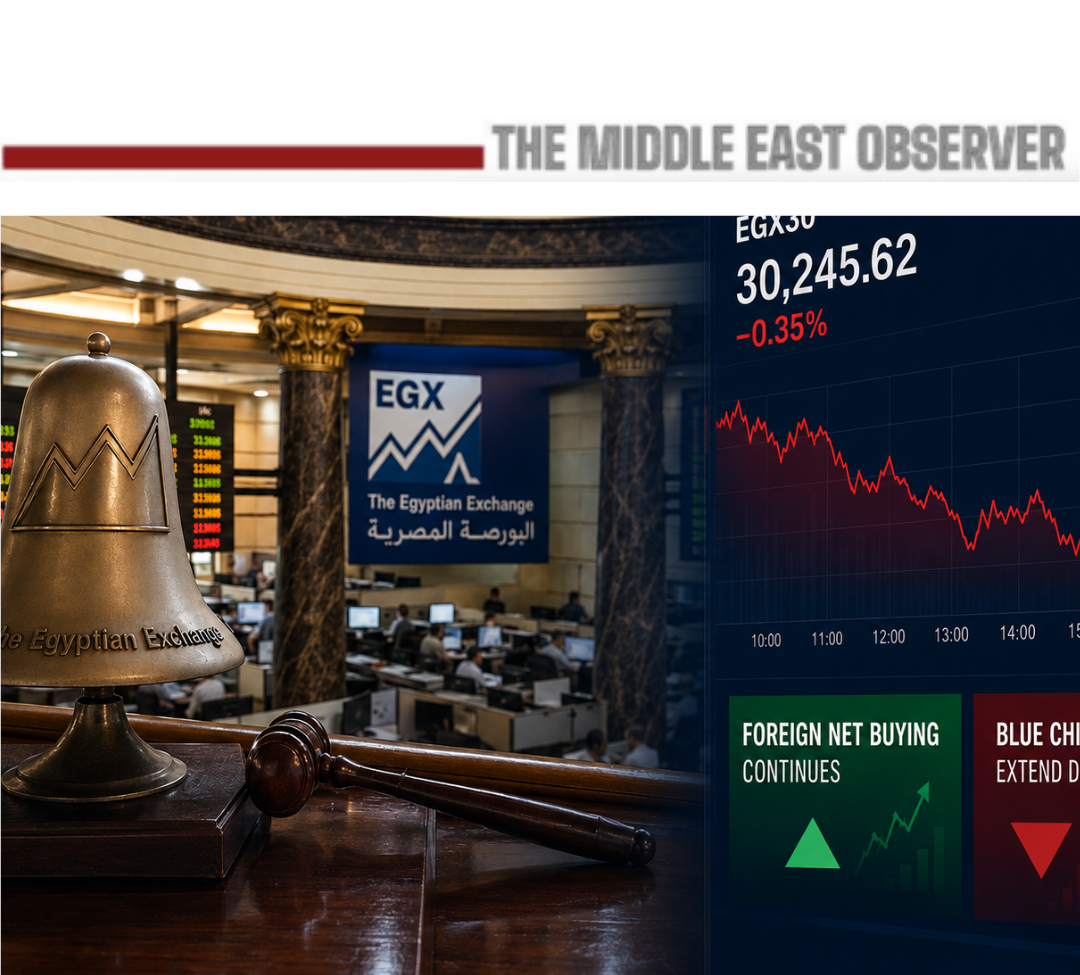
The EGX30 fell 0.45% to 54,876 points, giving back part of Sunday’s advance above 55,000. The EGX33 Shariah Index declined 0.22% to 6,411.87, while the lower-volatility EGX35-LV gained 0.52% to 6,805.14.
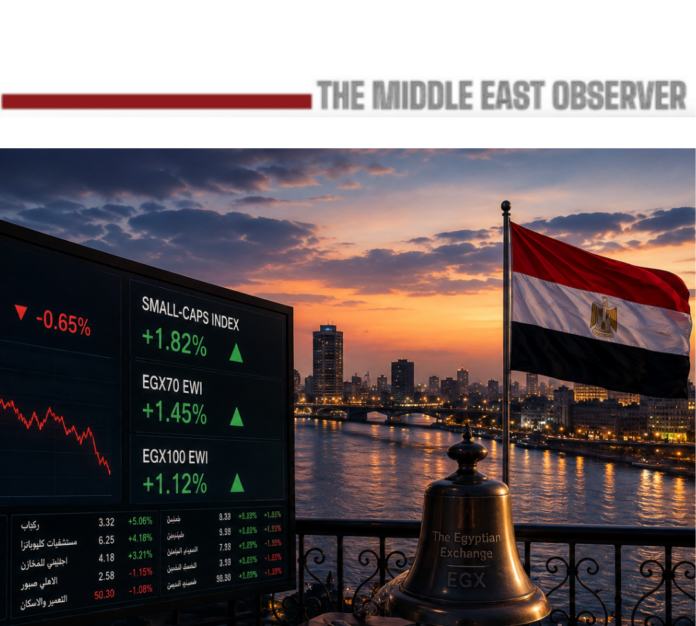
The broader market moved firmly higher. The EGX70 Equal Weight Index climbed 2.60% to 21,339.79 points, while the EGX100 Equal Weight Index advanced 2.00% to 27,521.83.
Market capitalization increased by about EGP6bn to roughly EGP4.16tn, despite the EGX30’s decline. Trading in listed shares rose to about EGP15bn, from approximately EGP12.2bn on Sunday, indicating that the divergence occurred alongside stronger trading activity rather than a retreat in overall liquidity.
The session reinforced an increasingly important feature of the current rally: the EGX30 is no longer providing a complete picture of market performance. Smaller companies are appreciating much faster than the largest constituents, allowing overall market value to rise even when the benchmark retreats.
Small-Caps Extend Their Lead
The gap has widened rapidly.
Since Thursday August 6, the EGX30 has gained only about 0.4%, while the EGX70 has advanced roughly 6.7% and the EGX100 about 5.4%. Market capitalisation has increased by approximately EGP60bn over the same period.
The divergence extends a broader rotation towards smaller companies after an earlier rally in large-cap shares. Equal-weighted indices reduce the influence of the exchange’s biggest constituents, making their recent outperformance a useful indication of where the strongest price appreciation is occurring.
Monday nevertheless demonstrated that strong index gains should not be confused with uniform buying across the exchange. Large advances in selected smaller companies can have a substantial effect on equal-weighted indices even when market breadth is more balanced.
That makes corporate results increasingly important. As earnings emerge, investors will have greater evidence to distinguish between companies where price gains are supported by stronger profits and cash generation and those where share prices have moved substantially faster than disclosed fundamentals.
Domestic Liquidity Remains Central
Domestic investors remained important to Monday’s market.
Excluding deals, Egyptian investors were net buyers of about EGP229mn, while non-Arab foreign investors recorded net sales of approximately EGP141mn and Arab investors sold roughly EGP88mn.
Egyptians accounted for about 92% of trading on the same basis, illustrating the continuing importance of local participation to the current advance.
The figures should not be interpreted as evidence of a broader foreign withdrawal. International portfolio investors can allocate between Egyptian equities and the country’s high-yielding government securities, meaning foreign appetite for Egyptian assets does not necessarily translate directly into stock-market purchases.
The more important test will be whether sustained institutional equity participation develops alongside the domestic liquidity that has supported much of the recent rally.
EGP4tn Market Value Raises the Stakes for Reform
The increase in listed market capitalisation above EGP4tn marks a significant expansion in the nominal size of Egypt’s equity market.
But a larger market is not necessarily a deeper one.
Market depth depends on the number and free float of sizable companies, sustained turnover, institutional participation and the availability of instruments that allow investors to manage risk and deploy capital efficiently.
That distinction is increasingly relevant because market value has risen quickly. From about EGP 4.104 tn on August 6, listed equity capitalisation has increased by roughly EGP60bn in two sessions even though the EGX30 has advanced only marginally.
Egypt also retains substantial potential to broaden its listed universe. GAFI said in June that around 61,000 joint-stock companies were potentially eligible for listing, compared with only about 260 companies listed on the exchange.
The challenge is therefore shifting from increasing headline market value towards building a broader institutional market with larger free floats, more issuers and a wider range of investable instruments.
Egypt Considers Corporatising the Exchange
Against that backdrop, Egypt is examining whether the Egyptian Exchange itself should be converted into a joint-stock company, potentially paving the way for an eventual public offering.
The proposal remains under consideration and should not be treated as an approved flotation.
Corporatisation could give the exchange a clearer commercial mandate, strengthen financial accountability and provide greater flexibility to invest in technology, market data, new products and partnerships.
For investors, any eventual flotation would also require clarity over the exchange operator’s revenue model — including trading and listing fees, market-data income and the commercial potential of derivatives and other new products.
But changing the EGX’s legal or ownership structure would not by itself deepen Egypt’s capital market.
That will depend principally on increasing the supply and free float of sizable listed companies, strengthening institutional participation and developing instruments including bonds, derivatives, securities lending and short selling.
Any restructuring would also require a clear separation between the exchange’s commercial objectives and the Financial Regulatory Authority’s independent supervisory responsibilities.
The appropriate measure of success would therefore not simply be whether the EGX itself can eventually be listed, but whether corporatisation helps the exchange attract issuers, increase liquidity, diversify revenues and broaden its investor base.
Earnings Become the Next Test
Monday’s session illustrated both the strength and the imbalance of the current advance.
The EGX30 retreated below 55,000, but the EGX70 added another 2.6%, the EGX100 gained 2%, turnover increased and overall market capitalization continued to rise. Recent value creation has therefore been considerably stronger outside the benchmark’s largest constituents.
Corporate earnings now provide the immediate test. Rapid appreciation among smaller companies will increasingly need to be accompanied by growth in profits and cash generation if recent prices are to prove sustainable.
The structural test is broader. Egypt is simultaneously seeking more listings, deeper institutional participation, new investment instruments and potentially a more commercially oriented structure for the exchange itself.
The EGX’s rise above EGP4tn demonstrates that the market is getting larger. The test for investors is whether earnings, new listings and institutional capital can make it deeper — and whether that depth can justify the speed at which smaller shares are being repriced.