Domestic institutions support the benchmark as the EGX70 pauses after three sessions of sharp gains and market capitalisation rises to EGP 4.093 tn
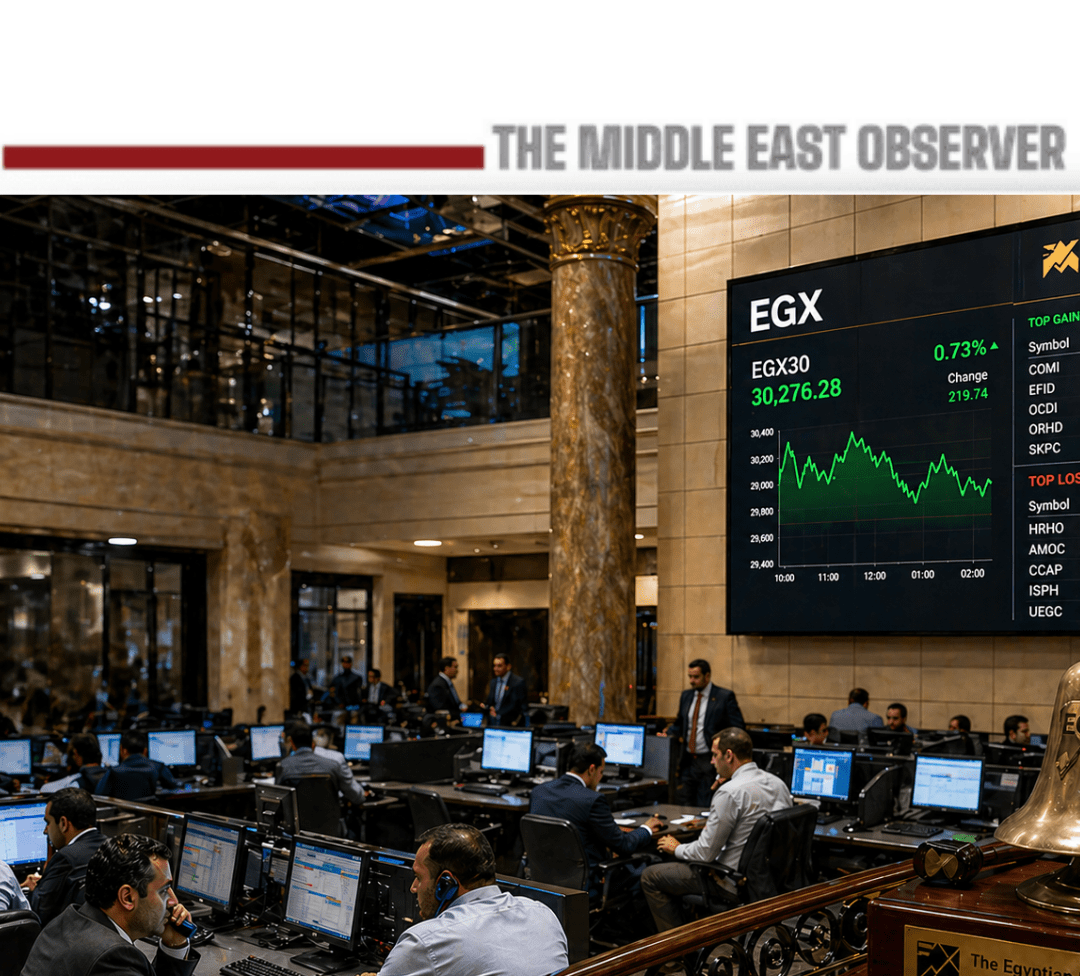
CAIRO — Egyptian equities ended mostly higher on Wednesday as buying shifted towards larger and lower-volatility companies, while small-cap shares paused after leading the market’s sharp advance during the opening sessions of August.
The benchmark EGX30 gained 0.29% to close at 54,659.57 points, while the EGX33 Shariah Index rose 1.05% to 6,326.53 points and the lower-volatility EGX35-LV advanced 1.01% to 6,690.43 points.
The broader market was more restrained. The EGX70 Equal Weight Index slipped 0.16% to 19,765.34 points, ending three consecutive sessions of sharp gains, while the EGX100 Equal Weight Index edged 0.15% higher to 25,862.74 points. Market capitalization increased by approximately EGP18.3bn to EGP4.093tn.
Wednesday’s divergence suggested a change in market leadership rather than a deterioration in the broader trend. Larger and more liquid shares advanced, while investors took profits in parts of the smaller-company universe after several sessions of exceptional gains.
Turnover Moderates as Breadth Remains Positive
Listed-equity turnover reached approximately EGP12.93bn, down from more than EGP15bn in each of the previous two sessions but still above the market’s recent daily norm.
Market breadth remained positive, with 135 stocks advancing, 65 declining and 22 unchanged. The figures confirm that the EGX70’s modest retreat did not represent a broad small-cap sell-off.
Instead, the session pointed to more selective positioning. Larger or more liquid shares continued to attract capital, while profit-taking emerged in some stocks that had recorded repeated daily-limit gains.
Local Institutions Offset Foreign Selling
Regular-session data showed Egyptian investors as net buyers of approximately EGP304.9mn, while non-Arab foreign investors recorded net sales of about EGP242.2mn and Arab investors sold a net EGP62.7mn.
Egyptian investors accounted for roughly 90.7% of listed-equity activity after excluding negotiated transactions. Institutions represented about one-fifth of trading, with local institutional purchases helping support the benchmark.
These figures differ from the much larger nationality totals carried by some market reports, which showed more than EGP13bn in foreign and Arab buying offset by Egyptian selling. Those amounts appear to include negotiated or block transactions and should not be used to describe ordinary secondary-market sentiment.
Wednesday was therefore not driven by a broad foreign inflow into listed shares. Domestic investors—particularly local institutions—absorbed selling from international and regional participants.
Separate fixed-income data showed foreign and Arab investors as net buyers in Egypt’s secondary government-debt market, illustrating how overseas investors can reduce equity exposure while increasing holdings of high-yielding sovereign securities.
Small-Caps Retain a Strong Weekly Lead
Despite Wednesday’s pause, small- and mid-cap indices remained far ahead for the week.
Compared with the previous Thursday’s close, the EGX30 was up approximately 2.3%, while the EGX70 had gained about 8.4% and the EGX100 approximately 7.6%. The EGX33 was around 5.2% higher, and the EGX35-LV had risen almost 5.9%. Market capitalisation increased by close to EGP156bn over the same period.
The divergence remains the week’s central market theme. Smaller companies delivered gains several times larger than the benchmark, supported by domestic liquidity and elevated risk appetite.
Wednesday’s shift towards large-cap and lower-volatility shares may prove constructive if it broadens the rally rather than ending it. A market advance supported by a wider group of liquid companies is generally more sustainable than one concentrated in less-liquid shares repeatedly reaching their daily trading limits.
Glaxo Reversal Highlights Momentum Risk
The most striking stock-level move was the reversal in GlaxoSmithKline Egypt.
The pharmaceutical company fell by the daily limit of 20% to EGP 331.44 after a sequence of limit-up sessions had lifted its share price sharply. The decline showed how quickly short-term momentum can reverse once investors begin taking profits.
The strongest percentage gainers included Lotus for Agricultural Investments and Development, up 19.9%, Mohandes Insurance, which gained 15.13%, and Alexandria Flour Mills, which rose 10.58%.
Among more liquid companies, Oriental Weavers advanced 9.1%, Emaar Misr gained 5.3%, and Orascom Investment Holding rose 4%. E-finance, Kima and Ibnsina Pharma were among the more actively traded decliners.
The varied performance indicates that investors are becoming more selective. Pharmaceuticals, property companies and smaller shares are no longer moving as uniform sector trades; liquidity, company-specific developments and recent price performance are exerting greater influence.
Property and Healthcare Lead Trading Activity
Property led sector turnover at approximately EGP2.68bn, followed by healthcare and pharmaceuticals at about EGP1.77bn.
At company level, EIPICO recorded the highest trading value at roughly EGP679.6mn, while Commercial International Bank, Oriental Weavers, Palm Hills Developments and EFG Holding were also among the most actively traded shares.
The figures reinforce the shift towards selective, company-specific positioning rather than uniform sector buying. CIB’s presence among the most actively traded companies also supports the view that liquidity was returning to heavyweight shares after several sessions dominated by smaller stocks.
Tax Reform Removes One Source of Uncertainty
The market’s strong August performance has coincided with the operational introduction of Egypt’s revised securities-tax framework, under which the proposed capital-gains tax was replaced by a proportional stamp duty.
The new structure is simpler to administer because the levy is collected automatically at transaction level rather than requiring investors to calculate taxable gains. Some market participants have argued that clearer tax treatment, settlement improvements and better access to foreign currency could support foreign participation over time.
The tax changes should not, however, be treated as the sole explanation for the market’s recent advance. Domestic liquidity, stronger risk appetite, currency stability and expectations surrounding earnings and new listings have also influenced sentiment.
The most relevant early signal is that listed-equity turnover has remained above EGP10bn after the stamp duty entered operational collection. Several weeks of data will be needed to assess its effect on retail and higher-frequency trading.
Foreign Interest Improves on a Monthly Basis
Non-Arab foreign investors were net buyers of approximately EGP1.4bn in July, reversing part of the selling recorded during the second quarter.
The monthly figure offers a more useful indication of overseas appetite than one day’s flows. However, foreign investors accounted for only 6.3% of regular trading on Wednesday, and one month of net buying does not establish a durable trend.
Sustained foreign re-engagement will require reliable access to foreign currency, stable settlement, stronger macroeconomic visibility and a wider selection of liquid listed companies.
Reforms Gain Importance as Rally Matures
The change in market leadership increases the relevance of the Egyptian Exchange’s development agenda.
Officials are preparing a revised securities-lending and short-selling framework, seeking larger state and private-sector offerings and working to broaden the range of fixed-income and equity products available to investors.
Short selling could improve price discovery and provide hedging tools after the sharp momentum moves seen in pharmaceuticals and smaller companies. Its practical effect will depend on the availability of lendable shares, brokerage readiness and the number of eligible securities.
The reforms are structural rather than immediate drivers of Wednesday’s session. Their importance lies in whether elevated turnover can be converted into deeper institutional participation and a larger investable market.
Outlook
Wednesday’s session suggested that the rally is evolving rather than reversing. Large-cap and lower-volatility indices advanced, breadth remained positive and market capitalisation rose, while the EGX70 paused after gaining more than 8% in less than a week.
Second-quarter earnings will test whether recent gains are supported by corporate fundamentals. Progress on listings, securities lending and short selling will also determine whether elevated turnover develops into deeper institutional participation.
For now, the move from indiscriminate small-cap buying towards more selective company-level trading points to a more measured—and potentially healthier—phase of the advance.
Related news:
EGX Ends Higher as Foreign Equity Demand Offsets Debt-Market Pressure
Foreign Buying Persists Despite Tax and Classification Uncertainty
Read also:
Egypt Moves to Boost Property Exports with Title Deed Insurance Framework
District Cooling Gains Ground as Singapore Seeks Climate Resilience