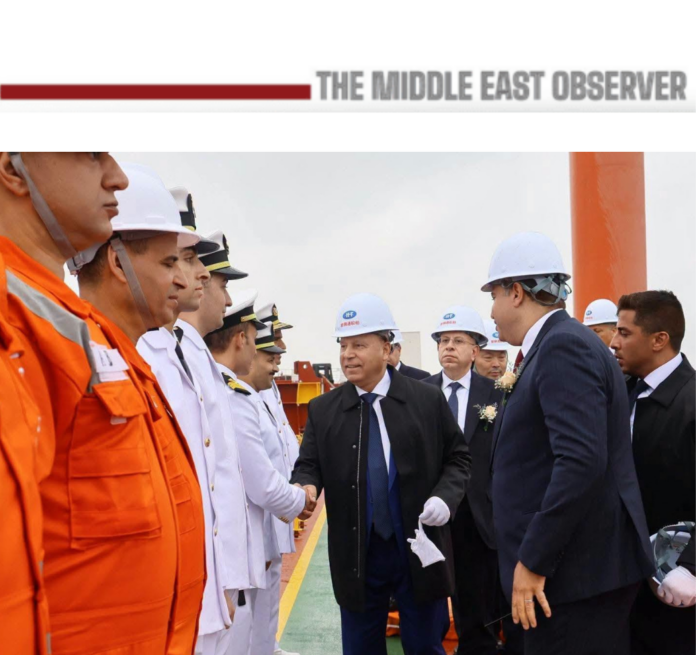
Egypt has taken delivery of two 82,000-dwt dry-bulk carriers from China and is seeking Chinese cooperation on a commercial ship-repair yard and four container vessels, broadening a fleet-renewal programme aimed at strengthening the country’s position in regional shipping and logistics.
The Wadi El Nil and Wadi El Qamar, built by New Hantong Ship Heavy Industry for the National Navigation Company (NNC), are Kamsarmax carriers designed to transport large-volume commodities including grain, ores and fertiliser feedstocks. Their delivery raises NNC’s fleet to 16 vessels.
Two further 82,000-dwt Kamsarmax vessels — Wadi El-Natrun and Wadi El-Alaki — are already contracted. Transport Minister Kamel El-Wazir has asked New Hantong to bring their delivery forward to the end of 2027 from the end of 2028.
The additions form part of a four-year renewal programme expected to modernise about 54 percent of NNC’s owned fleet, according to the Transport Ministry. The programme is being financed from the company’s own resources, reducing the need for direct external financing for the fleet expansion.
The expansion also has an increasingly commercial dimension. NNC said the private sector’s share of cargo shipments increased to 80 per cent in 2025 from 20 per cent in 2021, highlighting the changing profile of a company that also transports strategic commodities.
The wider government programme aims to expand the commercial fleet owned by Transport Ministry-affiliated companies to 40 vessels by 2030, with capacity to transport about 30mn tonnes of diversified cargo annually. Greater Egyptian-controlled capacity is intended to increase the share of the country’s foreign trade carried by its own vessels and could reduce reliance on chartered foreign tonnage during periods of freight-market disruption.
From fleet renewal to maritime industry
Egypt is also seeking to extend its cooperation with New Hantong beyond dry-bulk vessels.
El-Wazir proposed establishing a specialised commercial ship-repair yard in Egypt modelled on New Hantong’s Chinese facility, which would add capacity to the country’s existing shipbuilding and repair industry. He also called for work to be accelerated on four container ships of different capacities.
The distinction is important: the repair yard and four container vessels are proposals or requested projects rather than completed additions to the fleet. If implemented, however, they would broaden the programme from dry-bulk fleet renewal towards container shipping and greater localisation of maritime services.
A larger Egyptian-controlled fleet, combined with additional repair capacity and expanding ports, could support demand for ship maintenance, bunkering, marine engineering and freight-management services, allowing more of the economic value generated by Egypt’s maritime trade to remain within the domestic economy.
The test will be whether this investment translates into a larger Egyptian share of the freight, handling and logistics revenues generated by trade passing through the country.
Related news:
President El-Sisi and Alstom CEO Discuss key transport projects
Egypt Advances Integrated Ports and High-Speed Rail Strategy to Strengthen Regional Trade
Read also:
Can Self-Healing Concrete Cut the Middle East’s Infrastructure Bill?