
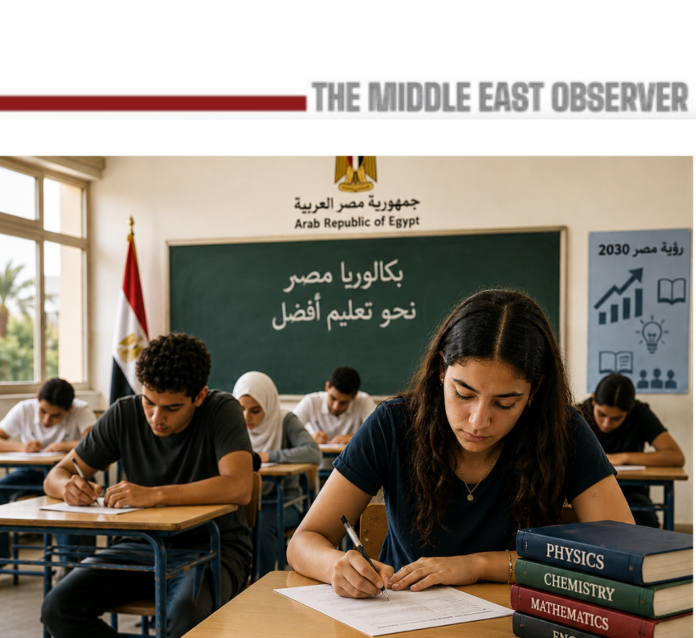
Egypt is preparing to roll out the next stage of its new Baccalaureate system in the 2026/27 academic year, adding financial literacy, programming and artificial intelligence as the government seeks to turn the replacement of the traditional Thanaweya Amma model into a broader overhaul of how students learn — and ultimately enter university and the workforce.
Education Minister Mohamed Abdel Latif said the ministry would shortly announce the regulatory mechanisms governing the Egyptian Baccalaureate and had completed its second-year curricula. The ministry says the educational frameworks have been reviewed and approved by the International Baccalaureate Organization (IBO), with which Egypt signed a cooperation agreement covering curriculum development, technical support, capacity building and teacher training.
The changes move the reform beyond examination mechanics. Financial literacy will be offered as a second-year activity, introducing students to concepts including stock markets, shares and start-ups, while programming and AI are intended to develop problem-solving and digital capabilities. Together, they point towards an attempt to connect secondary education more closely with skills demanded by a changing economy.
From one-shot exams to continuous assessment
The Baccalaureate is intended to dismantle the high-stakes “one-shot exam” culture associated with Thanaweya Amma. Rather than allowing a single examination cycle to dominate a student’s prospects, the emerging framework provides multiple assessment opportunities and combines core academic requirements with broader skills and activities.
Its effectiveness, however, will depend as much on implementation as curriculum design.
The 2026/27 calendar provides for 183 actual school days, compared with 172 in 2025/26. Abdel Latif has contrasted the new calendar with 116 days in earlier years, presenting longer classroom time as part of an effort to give teachers sufficient hours to complete curricula without excessive compression.
The academic year starts on September 12 for public, official-language and distinguished official-language schools, while international schools begin on September 6. At a meeting with about 4,500 school principals and education officials from 21 governorates, Abdel Latif stressed adherence to the timetable, textbook availability and operational readiness from the first day.
Classroom capacity remains another test. The minister said classes should not exceed 50 students, alongside efforts to address teacher shortages and strengthen principals’ ability to resolve operational problems.
Basic learning outcomes are equally important. Abdel Latif said assessments conducted in three stages showed the share of students classified as weak in reading and writing falling from about 45% in the first assessment to 13% in the third. These are ministry-reported results and, without published methodological detail, should not be interpreted as an independently verified measure of nationwide literacy improvement.
More sophisticated curricula in AI, programming or finance will have limited impact if students progress through the system without strong foundational skills.
The university bottleneck
The harder structural challenge begins when students leave school.
Admission to Egypt’s public universities remains dominated by aggregate examination scores and intense competition for subsidised places, particularly in medicine, dentistry, pharmacy and engineering. The system can therefore turn fractions of a percentage point into decisions that significantly alter a student’s academic pathway.
The contrast with non-public institutions illustrates the capacity divide. For 2025/26, minimum application thresholds for medicine at private and national universities ranged from 74% at selected institutions to 81% at others, substantially below the scores generally required for highly competitive public medical faculties.
The comparison is imperfect: minimum application thresholds are not final admission scores, while institutions differ in capacity, pricing and selection mechanisms. But the divergence exposes a structural reality. Public seats are constrained by scarcity, while access to alternative capacity is more closely linked to a family’s ability to finance it.
That is the central contradiction confronting the Baccalaureate. Egypt can reduce high-stakes examination pressure in secondary education, but if university entry remains overwhelmingly determined by marginal differences in aggregate scores, much of the competitive pressure may simply migrate downstream.
The challenge therefore extends beyond replacing Thanaweya Amma. It is ensuring university admissions, teaching capacity and pathways between school and higher education evolve quickly enough to accommodate the type of student the new system is intended to produce.
Skills, employment and a new education market
Higher education is also diversifying through international partnerships, dual-degree programmes and closer engagement with industry, potentially widening access to different curricula, research networks and teaching models. But the larger test lies beyond university: whether qualifications and newly acquired skills translate into productive employment.
The labour-market arithmetic makes that transition urgent. The World Bank estimates that about 1.3mn young Egyptians enter the labour market each year, while only around 500,000 jobs are created. It estimates that achieving full youth employment could increase Egypt’s GDP by 36%, underscoring the economic cost of failing to convert education into productive employment.
Skills are part of that equation. International Labour Organization analysis of online vacancies in Egypt, Jordan and the UAE — an imperfect proxy for the wider labour market, particularly where recruitment remains informal — points to growing demand for combinations of digital, cognitive and interpersonal capabilities. Yet AI and machine-learning skills accounted for only about 1% of skills requested in the vacancies analysed, suggesting that teaching AI is partly a forward-looking investment while broader problem-solving, communication and complementary digital capabilities remain critical.
Egypt has begun addressing the transition at university level. The second phase of the “Be Ready – 1 Million” initiative aims to equip one million university students and recent graduates with skills required by a changing labour market. Its pilot, launched in 2023, reached more than 18,000 students across 20 public universities, while the expanded programme includes a digital platform covering training, career readiness and job matching.
The reforms are also creating a potentially significant education market. A curriculum incorporating AI, programming, financial literacy and repeated assessment increases demand for digital learning platforms, specialised content, assessment technologies and teacher development. Universities face parallel demand for foundation programmes, career services, international partnerships and stronger links with employers.
For education providers and investors, the opportunity lies less in simply adding school or university seats than in addressing the gaps between stages of the system: preparing teachers for new curricula, measuring skills rather than memorisation, helping students bridge secondary and tertiary education, and connecting graduates with sectors capable of creating employment.
Greater private provision, however, cannot substitute for institutional reform. Without credible quality assurance and broader access, expanding fee-paying capacity could deepen rather than resolve the divide between students competing for subsidised public places and those able to purchase alternatives.
The test beyond the classroom
Egypt’s Baccalaureate is therefore best understood as the beginning of a larger transition rather than simply a new secondary-school certificate. The question is whether reforms across schools, universities and employment can converge while tertiary admission remains heavily shaped by numerical ranking and capacity constraints.
If secondary reform is accompanied by stronger foundational learning, more flexible university pathways, credible expansion of tertiary capacity and employer-led skills development, the Baccalaureate could become the entry point to a genuine education-to-employment pipeline.
If those downstream reforms lag, Egypt risks changing the architecture of Thanaweya Amma without fully escaping its underlying logic.
Replacing the old examination is the visible reform. Building a system in which what students can do matters more than the fraction of a percentage point separating their examination scores is the considerably larger one.
Related news:
Cairo Experiments Again: Inside the 33rd Cairo International Festival for Experimental Theatre
Can Egypt’s ‘Productive Villages’ Plan Reshape Rural Employment?
Read also:
El-Sisi Advances Human Capital Strategy Through Health, Education, Research and Innovation