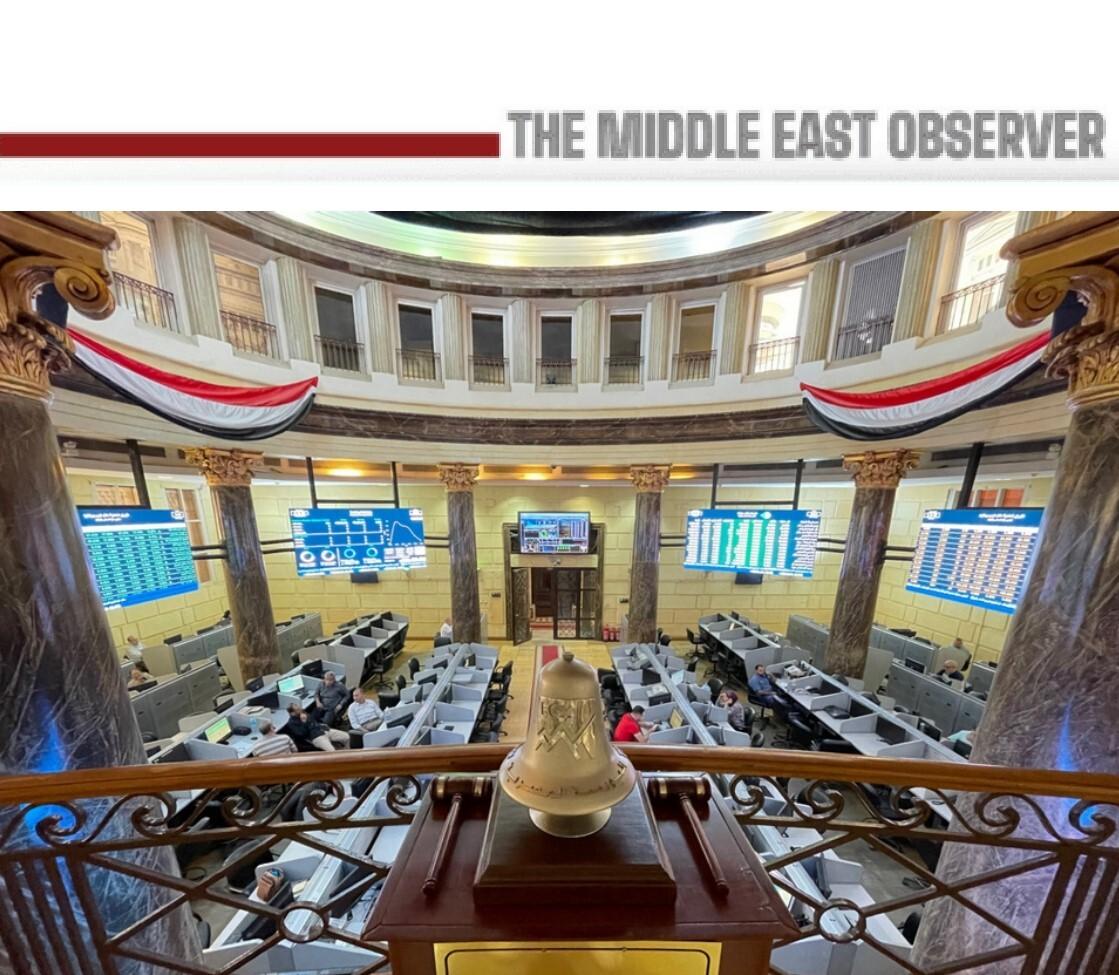
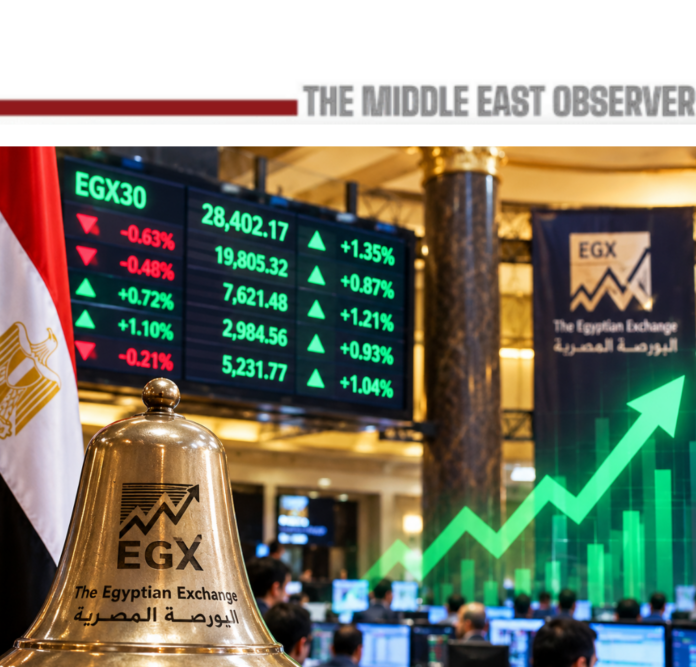
Egyptian equities steadied on Tuesday after Monday’s broad sell-off, with losses narrowing sharply and market breadth repairing. The stronger signal came outside stocks: foreign and Arab investors returned aggressively to Egyptian government debt, while the pound strengthened — suggesting cross-asset stress eased even as foreign institutions remained sellers of listed equities.
The EGX30 slipped just 0.12% to 54,930.89 points, while EGX70 eased 0.10% to 20,460.44 and EGX100 fell only 0.02% to 26,994.70. Market capitalisation nevertheless rose by about EGP5.6bn to EGP 4.343 tn, while turnover fell to EGP 9.74bn from EGP13.51bn on Monday.
Breadth improved dramatically: 99 stocks advanced against 107 decliners, compared with Monday’s 20 gainers against 189 fallers.
The session was therefore stabilisation rather than recovery.
Monday’s Breadth Shock Begins to Repair
The first three sessions of the week still leave the wider market materially weaker.
From last Thursday’s close, EGX30 is down about 1.0%, EGX70 roughly 2.9% and EGX100 about 2.5%, with almost EGP54bn erased from market capitalisation.
But Tuesday changed the internal structure of the correction.
Small and mid caps stopped materially underperforming, the advancer-decliner gap almost disappeared and market capitalisation rose despite marginal index losses.
That is not yet a recovery, but it is the clearest evidence so far that Monday’s breadth deterioration is no longer accelerating.
Foreigners Sell Stocks but Return to Sovereign Carry
Investor flows require strict asset-class separation.
In listed equities, Egyptians bought a net EGP402.7mn, while foreigners sold approximately EGP377mn and Arab investors EGP 25.7mn. Foreign institutions accounted for almost all of the international equity selling.
The much larger reported nationality figures — roughly EGP20bn of Arab buying, EGP19.6bn of foreign buying and EGP39.7bn of Egyptian selling — relate to government-debt transactions and should not be treated as stock-market flows.
In sovereign debt, foreign and Arab investors recorded roughly $775mn of net buying on Tuesday, sharply reversing Monday’s $38.2mn net outflow.
The contrast is clear:
international capital sold listed shares while moving heavily back into Egyptian sovereign carry.
That reverses last week’s pattern, when foreign investors were net buyers of equities while international and regional investors reduced sovereign exposure.
Pound Strength Confirms the Shift
The currency moved in the same direction as Tuesday’s sovereign inflow.
The CBE’s average dollar rate fell to about EGP 51.53 for buying and EGP 51.67 for selling, from EGP 51.87/51.97 on Monday — a roughly 0.6% appreciation of the pound in one session.
One day does not establish causality or a durable FX trend. But Tuesday produced a more coherent cross-asset combination than several recent sessions: strong sovereign inflows alongside a firmer pound.
That is marginally constructive for equities because it reduces immediate currency-translation risk, even though foreign investors remained net sellers of stocks.
Deutsche Bank Expects CBE to Hold
The next test comes from the Central Bank of Egypt on September 24.
Deutsche Bank expects the MPC to keep the overnight deposit and lending rates unchanged at 19% and 20%, extending the pause in the easing cycle to a fifth consecutive meeting after cumulative cuts of 825 basis points between April 2025 and February 2026.
The case for holding rests on two opposing forces. Inflation has remained softer than previously expected, with urban headline inflation at 14.5% in August, but higher global energy prices, renewed regional uncertainty and recent FX volatility argue for caution.
For markets, the trade-off is straightforward:
a hold would preserve Egypt’s sovereign yield advantage while keeping the discount-rate hurdle high for equities.
High real and nominal yields can continue attracting Treasury-bill demand even as stocks require stronger earnings growth to justify further re-rating.
Stabilisation, but Not Yet Confirmation
Tuesday was materially better than Monday.
Breadth normalised, market capitalisation recovered modestly, sovereign inflows returned strongly and the pound firmed.
But the benchmark still fell, turnover weakened and foreign institutions continued reducing equity exposure.
The EGX therefore remains in correction, although the character of that correction has become less severe.
Related news:
The Painkiller Paradox: When Relief Becomes Risk
Airbus Targets Egypt’s Emerging Civil Helicopter Market Through Air Ambulance Plan
Read also: