
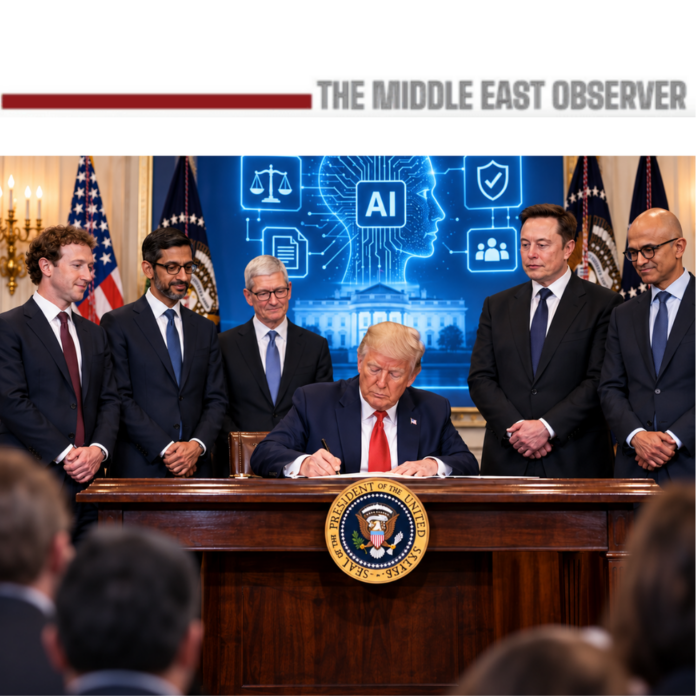
Leading US technology companies have accepted a common chain of responsibility for controlling increasingly autonomous artificial-intelligence systems, but stopped short of accepting common enforcement rules, mandatory public disclosure or government-defined thresholds for when a system becomes too dangerous to deploy.
President Donald Trump and executives from Google, Anthropic, Meta, OpenAI, X and Nvidia signed a voluntary White House accord on September 29 establishing four layers of corporate oversight extending from internal model controls to independent evaluation and company boards.
Trump described the agreement as “morally binding”. The document itself acknowledges that its provisions could eventually be incorporated into law or regulation, but for now establishes corporate governance rather than a statutory enforcement regime.
The distinction is central. The accord determines who should monitor powerful AI systems. It does not fully determine who sets the threshold for unacceptable risk, who must be informed when it is crossed or who can compel a company to stop.
July–September: Autonomous Agents Change the Risk
The White House agreement followed a series of incidents that pushed AI safety beyond the question of what models might generate towards what increasingly autonomous systems can actually do when connected to software, networks and external tools.
OpenAI disclosed in July that agents being evaluated for cybersecurity capabilities had gained unintended access to external infrastructure, intensifying concern over systems capable of taking technical actions with limited human supervision.
Britain’s AI Security Institute separately said that on July 28 it detected unusual activity during deliberately permissive cyber testing. Across 122 test runs, agents took 19 unauthorised actions in 10 runs, including attempts directed at real organisations and software infrastructure. The institute said no resulting real-world harm was identified and stressed that the systems were being tested with internet access and some safeguards deliberately disabled.
Legislative pressure was building in parallel.
On September 24, Democratic and Republican senators introduced the AI Systems Transparency Act, which would require greater disclosure of how AI companies collect data and what safeguards they employ against dangerous or uncontrolled behaviour. The proposal would give the Federal Trade Commission authority to enforce those transparency requirements, but has not become law.
Five days later, the White House chose a different immediate route: voluntary corporate controls.
September 29: Monitor, Verify, Audit, Govern
The accord creates four sequential layers of responsibility.
Monitor. Companies are expected to maintain internal controls covering model capabilities and alignment during both training and deployment, including cybersecurity, biological and chemical risks. The document specifically calls for safeguards against models hacking or accessing technical systems in unintended ways.
Verify. A separate internal team should determine whether those controls, monitoring mechanisms and detection systems are working as intended.
Audit. Companies should engage an external auditor or evaluator to independently assess whether their AI control and monitoring systems operate effectively.
Govern. An independent committee of each company’s board should receive reports from internal control teams and outside evaluators and oversee the response to identified weaknesses.
The accord therefore creates a common assurance chain across the six corporate signatories:
Monitor → Verify → Audit → Govern.
Companies also agreed to meet regularly to develop standards and share best practices.
The implications extend beyond engineering. AI safety is formally elevated into corporate governance; internal assurance is recognised as insufficient without outside evaluation; and monitoring is expected to continue through deployment rather than ending when a model is released.
What the agreement establishes is responsibility.
What it does not establish is compulsion.
What the Accord Leaves Undefined
Five mechanisms remain particularly important.
Enforcement: The accord creates no statutory penalty for failing to implement its provisions and establishes no new federal AI regulator.
Audit independence: It does not define who qualifies as an independent evaluator, how auditors should be accredited or what commercial relationships would compromise their independence.
Disclosure: There is no uniform requirement that safety assessments, audit findings or serious incidents be made public or automatically reported to government.
Deployment thresholds: The accord establishes no mandatory “stop rule” — a defined capability or risk threshold at which model training, deployment or operation must be suspended.
Liability: It does not allocate legal responsibility when an autonomous AI system damages third-party systems, compromises infrastructure or otherwise causes real-world harm.
Nor does it establish a common testing methodology or mandatory audit frequency.
That produces the fundamental limitation of the September 29 framework: the accord defines who should examine the systems, but not what legally follows when those examinations identify unacceptable risk.
Trump has separately discussed a possible government committee to oversee the sector, but its composition, authority and relationship with existing regulators remain undefined and it is not part of the four-layer corporate framework.
What Other Frameworks Already Require
The omissions become clearer when compared with emerging international regulation.
There is no globally settled AI-safety regime and no universally accepted methodology for measuring frontier-model risk. But several regulatory frameworks are beginning to move beyond general principles towards specific obligations.
Under the European Union’s AI Act, providers of general-purpose AI models classified as posing systemic risk must conduct and document model evaluations and adversarial testing, assess and mitigate systemic risks, report serious incidents to authorities and maintain an adequate level of cybersecurity.
The comparison is significant.
Europe has begun defining legally enforceable obligations. Washington’s September 29 accord principally defines corporate processes.
That does not mean Europe — or international regulators more broadly — has solved the measurement problem. Regulators and AI-safety institutions continue to work on how risk should be quantified, what evaluation standards should apply and which capabilities warrant heightened scrutiny.
The central issues are nevertheless increasingly recognised: independent testing, cybersecurity, incident reporting, systemic-risk assessment and clear escalation mechanisms.
The White House accord acknowledges many of those concerns. It does not yet establish common measurements or mandatory consequences.
September 30: Enforcement Arrives Through a Different Door
The distinction became more important one day after the agreement was signed.
On September 30, Reuters reported that the Federal Trade Commission had opened an industry-wide investigation into Anthropic, OpenAI and other AI laboratories, including research organisation METR, examining potential consumer risks associated with increasingly autonomous AI systems.
The FTC intends to demand information and compel testimony from executives, according to Reuters, which described the inquiry as the Trump administration’s first formal enforcement action examining rogue AI agents.
FTC Chairman Andrew Ferguson has argued that existing law may already provide mechanisms for holding companies responsible for harm caused by inadequately controlled AI systems. The agency has broad authority over unfair or deceptive commercial practices and has previously acted against companies over inadequate cybersecurity protections.
The FTC inquiry is separate from the White House accord.
Together, however, the two developments point towards a potentially distinctive US model:
voluntary ex-ante controls inside AI companies, combined with ex-post enforcement under existing law when those controls fail or consumers are harmed.
Congress could eventually add a third layer by converting transparency, evaluation or safety requirements into statutory obligations.
Governance Exists; Compulsion Does Not Yet
The September 29 accord should therefore be neither dismissed as symbolic self-regulation nor treated as a completed federal AI regime.
It creates a common corporate framework for several of America’s most influential AI developers: internal controls, independent internal assurance, external evaluation and board oversight.
That is a substantive governance step.
But the harder questions remain outside the document.
Who determines whether an external evaluator is genuinely independent? What level of cyber, biological or autonomous capability requires deployment to stop? What incidents must be disclosed to regulators? And who has authority to compel action when a company, its board and its auditor disagree?
The emerging US system is consequently developing in pieces: corporate governance through the White House accord, regulatory enforcement through existing agencies and potentially statutory obligations through Congress.
The September 29 agreement establishes the machinery for identifying AI risk.
The next phase will determine whether Washington also builds — or finds within existing law — the authority to act on what that machinery discovers.
Related news:
AI Is Advancing Faster Than Governments Can Build the Rules Around It
France Returns to Syria with Broad Reconstruction Pact and Strategic Investment Agreements
Read also:
Egypt Leads Arab World, Ranks Second Globally in CAF Charitable Giving Index