NEW ALAMEIN — The closing phase of Egypt’s Alamein African meetings shifted the agenda from investment promotion toward the political, financial and logistical conditions required to make African integration work, producing a new four-country regional consultation mechanism while placing payment systems, transport corridors, capital mobilisation and project risk at the centre of the continent’s implementation agenda.
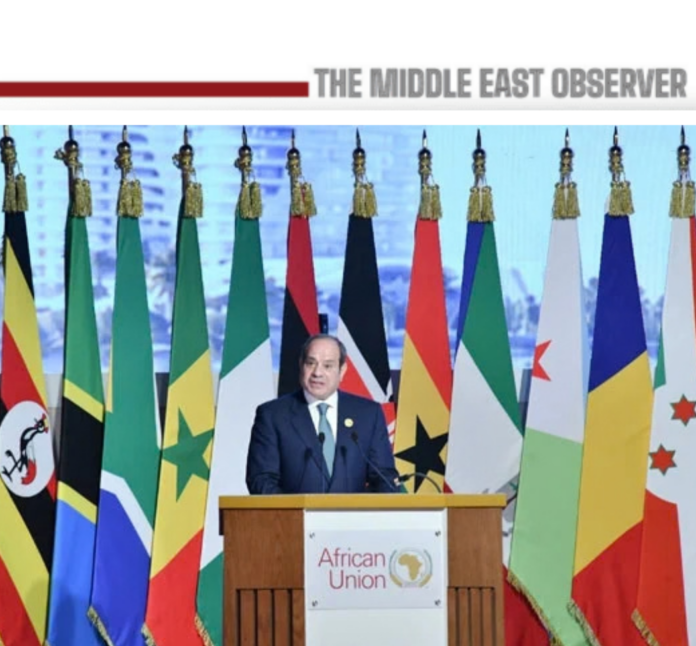
The developments unfolded on October 4, during the African Union’s eighth Mid-Year Coordination Meeting and a parallel summit bringing together Egypt, Somalia, Sudan and Eritrea, before moving on October 5 into follow-up discussions between the African Union Commission and African Development Bank over financing and risk-sharing.
The result was less a new wave of commercial deals than an effort to construct the political and financial architecture within which future deals could operate.
Four States Establish a Regional Consultation Mechanism
The most significant new political outcome came from a meeting between Egyptian President Abdel Fattah El-Sisi, Eritrean President Isaias Afwerki, Somali President Hassan Sheikh Mohamud and Sudan’s Transitional Sovereignty Council chairman Abdel Fattah Al-Burhan.
The four leaders issued an El Alamein Joint Declaration and agreed to establish a follow-up mechanism for implementing its conclusions, while committing to hold further four-way consultations periodically and when regional circumstances require them.
The declaration combined political-security positions with commitments to deepen economic and trade cooperation.
On Sudan, the four governments backed the country’s sovereignty, territorial integrity and national institutions, rejected parallel political structures and called for a Sudanese-owned political process.
On Somalia, they reaffirmed the country’s sovereignty and territorial integrity, rejected recognition of Somaliland and supported efforts to strengthen Somali security institutions and combat terrorism. They also called for adequate and predictable financing for the African Union Support and Stabilization Mission in Somalia.
The declaration also addressed two of the region’s most strategically sensitive issues.
It stated that governance of the Red Sea should remain the responsibility of its littoral states, while affirming freedom of navigation. On transboundary rivers, including the Nile, the four governments called for adherence to international law, prior notification, consultation and the principle of avoiding significant harm.
The African Union Commission separately clarified on October 4 that an earlier statement concerning regional tensions was not intended to assign responsibility to Egypt, Eritrea or any neighbouring state, reiterating its preference for sovereignty, non-interference and political solutions.
The four-state mechanism should therefore be read as an attempt to institutionalise consultation among governments sharing overlapping Red Sea, Horn of Africa and Nile security concerns, rather than as a declared military or political bloc.
AU Turns to the Barriers Behind AfCFTA
The wider African Union Mid-Year Coordination Meeting moved from broad integration objectives toward the obstacles preventing the African Continental Free Trade Area from functioning commercially.
The AU called for the removal of unjustified non-tariff barriers, improved trade facilitation and expanded cross-border payment systems, while pressing for faster development of transport corridors, regional infrastructure and digital connectivity.
It also called for implementation of the Single African Air Transport Market and stronger regional value chains.
The implications are practical.
Lower tariffs alone cannot create an integrated continental market if businesses face expensive payment conversions, weak transport connections, customs delays, fragmented aviation links or insufficient energy and digital infrastructure.
The closing discussions therefore placed increasing emphasis on the physical and financial systems needed to make African trade commercially viable.
The AU also urged member states to advance the legal architecture for proposed African financial institutions and called for clearer allocation of responsibilities between the African Union, regional economic communities and national governments before the next coordination meeting.
El-Sisi added a post-conflict dimension, calling for stronger financing for the African Union Centre for Post-Conflict Reconstruction and Development, linking economic integration more directly with institutional recovery in states emerging from conflict.
Egypt Pushes a Bigger African Capital Agenda
The strongest financial-policy intervention came from Central Bank of Egypt Governor Hassan Abdalla, who argued that Africa must retain more of its own liquidity and international reserves for investment within the continent.
Abdalla proposed directing 10% of African banking liquidity toward African investment and allocating 5% of international reserves to investments on the continent.
These figures are proposals, not adopted African Union targets or binding commitments.
Their significance lies instead in the problem they identify: African savings and liquidity frequently leave the continent before returning through external financing channels at a higher cost.
Abdalla also called for greater use of local currencies in intra-African transactions, deeper capital markets, stronger credit-assessment mechanisms and an African credit-rating agency.
That agenda converges with the AU’s parallel focus on cross-border payment infrastructure.
Egypt’s participation in the Pan-African Payment and Settlement System, PAPSS, already provides one potential mechanism for reducing dependence on intermediary hard currencies in African trade.
Abdalla said Egypt has signed around 15 MoUs with African central banks covering training, governance and technical cooperation. Official accounts indicate these agreements are cumulative and should not be treated as having all been concluded at Alamein.
Trade Rises, but Imports Drive the Increase
Fresh CAPMAS figures released around the closing meetings gave a wider picture of Egypt’s commercial position across Africa.
Egypt’s trade with African Union countries reached about $6.1bn in the first seven months of 2026, compared with $5.5bn during the same period a year earlier, an increase of 11.8%.
Egyptian exports rose more modestly, by 3.4% to $4.5bn, while imports climbed 45.5% to $1.6bn.
The increase in total trade was therefore heavily import-led.
Libya remained Egypt’s largest African export market, followed by Sudan, Algeria and Morocco, while the Democratic Republic of Congo and Sudan were among the largest African suppliers to the Egyptian market.
The trade composition is also relevant to the industrial argument running through the Alamein meetings. African imports into Egypt include significant volumes of copper and other raw materials, alongside fuels and agricultural products, while Egyptian exports include manufactured goods such as electrical equipment, plastics and iron and steel products.
That provides a potential foundation for deeper continental value chains if African raw materials can increasingly feed African manufacturing rather than moving through external intermediaries before returning as higher-value finished products.
Capital flows already show a more developed two-way relationship. Egyptian investment in African Union economies reached about $756mn in FY 2024/25, while investment from AU countries into Egypt stood at roughly $343mn.
The figures remain modest relative to Africa’s economic scale, but they reinforce the Alamein argument that trade integration will increasingly depend on cross-border investment and production, rather than trade policy alone.
Egypt Links African Ambitions to Its Domestic Reform Story
Prime Minister Mostafa Madbouly used the closing weekend to place Egypt’s African investment agenda alongside the government’s domestic economic narrative.
He cited GDP growth of 5.1% in FY 2025/26, compared with 4.4% a year earlier, and said the government is targeting growth of 5.4% in the current fiscal year.
Madbouly also said Egypt does not expect to seek a new IMF programme once the current arrangement concludes, arguing that the country is moving toward a nationally driven reform framework.
The comments are relevant to Alamein principally because Egypt’s ability to position itself as a base for African trade, investment and manufacturing will depend partly on the credibility of its own macroeconomic stabilisation, access to foreign currency and investment environment.
They do not signify an end to Egypt’s relationship with the IMF, whose surveillance and policy engagement can continue independently of a lending programme.
The final stage produced a regional political declaration, continuing consultation mechanisms, financial-policy proposals, integration priorities and institutional follow-up.
Those are meaningful outcomes, but they are not equivalent to committed private capital.
The commercial test remains whether these mechanisms can reduce financing costs, move projects through preparation and financial close, and make cross-border investment materially easier.
October 5: Implementation Moves Toward the AfDB
The first significant post-Alamein follow-up came on October 5, when African Union Commission chair Mahmoud Ali Youssouf met African Development Bank President Sidi Ould Tah.
Their discussion focused on financing priority African projects and, more specifically, on guarantees, risk-sharing and mechanisms capable of reducing the cost of capital.
No new financing value or facility was announced.
But the subject of the meeting is important because it goes directly to one of the constraints identified repeatedly during Alamein: African projects frequently struggle not because the underlying need is absent, but because project preparation, perceived risk and financing costs prevent them from becoming bankable at commercially acceptable terms.
That moves the discussion from political aspiration toward financial engineering.
The Closing Balance
Alamein’s closing phase broadened the original investment discussion into a more complete picture of what continental integration actually requires.
The Egypt-Somalia-Sudan-Eritrea declaration adds a continuing mechanism for addressing regional security, Red sea navigation security and sovereignty questions.
The AU coordination meeting pushed attention toward payments, transport, aviation, infrastructure and the removal of practical trade barriers.
The Central Bank of Egypt raised the more ambitious question of how much African liquidity and reserve capital could be retained and invested inside the continent.
And the immediate AU-AfDB follow-up shifted attention toward guarantees, risk-sharing and the cost of financing projects.
Africa is increasingly defining the mechanisms it believes are required to integrate its markets, retain more capital, build regional value chains and reduce reliance on external financing.
The next measure will be substantially harder: whether those mechanisms begin producing financial closes, operating projects and cross-border investment at scale.
Related news:
Egypt Approves Fujairah-Alamein Oil Storage and Trading Free Zone
Egypt to Offer Management of New Alamein Downtown Towers to Local and Global Consortia
Read also:
Qatari Diar Revives Long-Delayed Red Sea Development
Cairo Consolidates Africa Aviation Lead as Egypt Builds for 70mn-Passenger Hub