
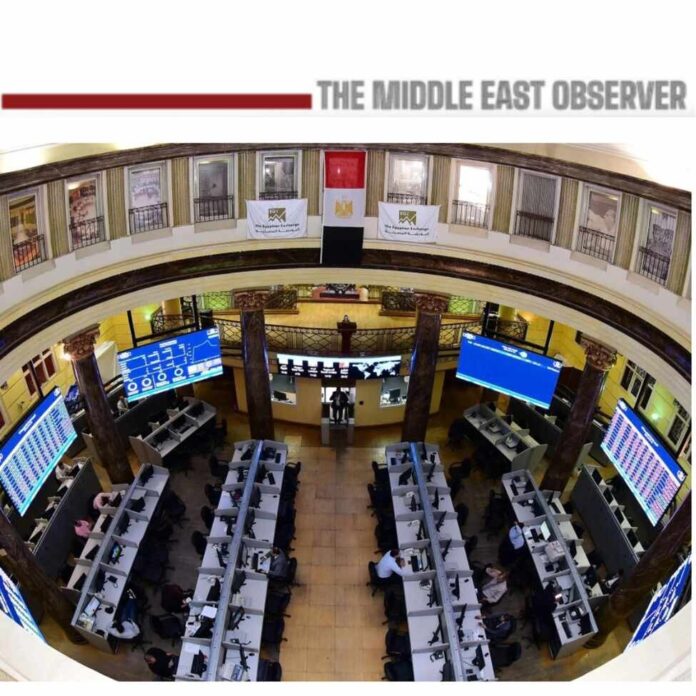
CAIRO — The Egyptian Exchange’s two-session recovery paused on Monday, Oct. 5, with the EGX30 falling 0.66% to 53,553.41, the EGX70 EWI declining 0.89% to 19,776.31 and the EGX100 EWI losing 0.89% to 26,132.88.
Market capitalisation fell approximately EGP24bn to EGP 4.239 tn, erasing only about 12% of the roughly EGP207bn recovered over the preceding two sessions. Equity trading value remained relatively firm at EGP9.458bn, although it was 17.6% below its 90-day average.
EGX30 Fails at 54,000 Again
EGX30 climbed as high as 54,112.78 before falling to 53,213.17 and recovering more than 340 points from its intraday low by the close.
The benchmark has therefore moved above 54,000 in two consecutive sessions without sustaining the level, reinforcing 54,000–54,500 as the recovery’s immediate resistance zone.
Breadth delivered the clearer warning. Only 61 stocks advanced against 151 decliners, with 10 unchanged, reversing Sunday’s overwhelmingly positive participation.
The recovery retained price support on Monday, but not its broad-market participation.
Local Institutions Buy Into Weakness
Egyptian investors were the sole nationality group of net equity buyers, purchasing approximately EGP581.7mn, while foreigners sold EGP521.4mn and Arabs EGP60.3mn.
More importantly, Egyptian institutions bought approximately EGP158mn, up from about EGP94mn on Sunday, while Egyptian individuals added EGP423.7mn. Foreign institutions, by contrast, sold roughly EGP526.1mn, with Arab institutions selling EGP102.9mn.
Egyptian institutional net buying therefore increased by roughly 68% from Sunday even as share prices declined.
That is a stronger signal than institutions simply joining a rising market: local institutions moved from participating in the rebound to absorbing its first pullback.
Their support should not be overstated, however. EGP158mn of Egyptian institutional buying remained well below the scale of foreign institutional selling.
Offshore Flows Split Between Stocks and Debt
The most revealing signal came from comparing asset classes.
While Arab and foreign investors were net equity sellers, the two groups collectively recorded approximately $10.3mn of net buying in Egypt’s secondary government-debt market, according to reported EGX data. Secondary-market debt activity remained limited, but the direction of flows is significant.
The figures do not establish that the same portfolios moved directly from equities into bonds. They do, however, indicate that offshore flows diverged across Egyptian asset classes, consistent with selective preference for high-yield sovereign exposure over equity risk.
That preference is understandable. With the CBE overnight deposit rate at 19% and recent Treasury-bill yields above 25%, Egyptian sovereign debt continues to set an unusually high hurdle for equity allocations.
Currency movements reinforced the defensive picture. The dollar rose about 14 piastres, with the CBE’s average client rate reaching EGP52.3624 buying and EGP52.5006 selling on Monday.
The combination — a weaker pound, heavy foreign institutional equity selling and simultaneous offshore demand for government debt — suggests Egyptian risk itself was not being rejected. Capital was becoming more selective about where it took that risk.
Recovery Survives, but Its Limits Emerge
Monday did not break the recovery, but it exposed its limits.
EGX30 held above 53,000 and recovered substantially from its intraday low, while Egyptian institutions increased their buying. Yet breadth reversed sharply, foreign institutions continued to sell heavily and the benchmark again failed to hold above 54,000.
The sequence since late September therefore remains constructive: indiscriminate liquidation gave way to absorption, reversal, follow-through and now the recovery’s first controlled pullback.
But the next phase requires stronger confirmation.
A sustained equity advance will depend on EGX30 holding around 53,000 before decisively clearing 54,000–54,500, accompanied by recovering breadth and moderation in foreign institutional selling. Until then, high-yield government debt remains a formidable competitor for capital even as domestic institutions increasingly defend the equity recovery.
Related news:
EGX Recovery Broadens as Small Caps Lead
EGX Pullback Tests Record Rally as Institutional Selling Broadens
Read also:
EGX Ends Higher as Foreign Equity Demand Offsets Debt-Market Pressure
EGX Rises as Foreign Capital Returns Across Debt and Equities