

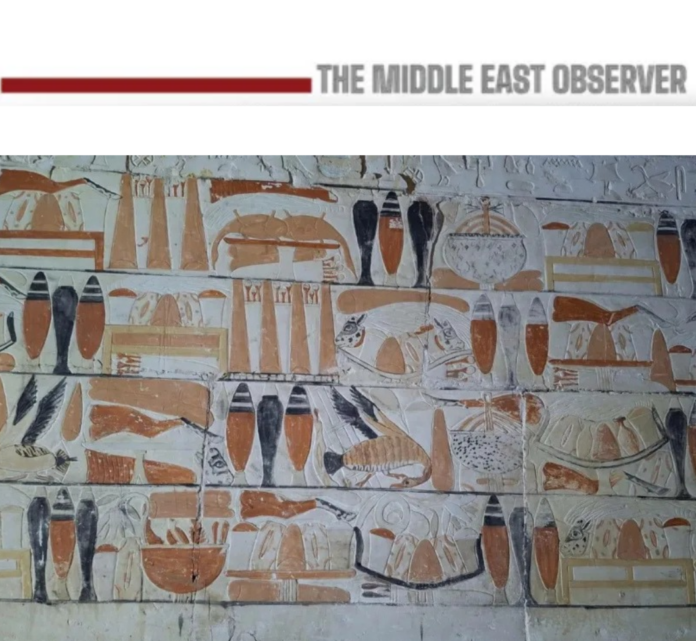
CAIRO — Egyptian archaeologists have uncovered an inscribed tomb at Saqqara containing bronze instruments that may have been used for medical purposes, offering a potentially revealing glimpse into the practices of ancient Egypt more than four millennia ago.
The discovery, announced by Egypt’s Ministry of Tourism and Antiquities, also includes two rare wooden statues and the burial chamber of a high-ranking Old Kingdom official whose identity, career and physical condition are emerging from the archaeological evidence.
The Egyptian mission, working under the Supreme Council of Antiquities, uncovered a mudbrick mastabanorthwest of King Merenre’s pyramid in South Saqqara. The rectangular funerary structure contains several burial shafts, one of which leads to a decorated chamber belonging to an official named Weni.
Who Was the Man Buried at Saqqara?
The chamber’s relatively well-preserved inscriptions identify Weni as a prominent figure in ancient Egypt’s administrative and religious establishment.
His titles included mayor, sem priest, overseer of royal expeditions, treasurer of the House of the North, sole companion and lord of Elkab.
Together, the titles indicate that Weni held responsibilities across royal administration and religious institutions, reflecting the influence of senior officials during the Old Kingdom.
Yet one title is conspicuously absent: physician.
That omission makes another discovery within the burial shaft particularly intriguing.
Bronze Instruments Raise Questions About Ancient Medicine
Archaeologists recovered a collection of bronze instruments that the Supreme Council of Antiquities believes may have served medical purposes.
Their precise function remains undetermined, and the absence of a medical title among Weni’s inscriptions means the objects cannot be taken as evidence that he practised medicine.
Mohamed Abdel Badie, head of the council’s Egyptian Antiquities Sector, said further research is required to establish how the instruments were used and what relationship they had to the tomb’s owner.
The discovery does not demonstrate that the objects were surgical tools or that they represented medical techniques comparable to modern practices.
Instead, their significance lies in the possibility that further study could clarify the role of such instruments in Old Kingdom society and explain why they were included in this particular burial.
Rare Wooden Figures and a Priestess’s False Door
The bronze objects were not the only unusual finds.
In a vaulted chamber directly above Weni’s burial room, the mission discovered two small wooden statues depicted in a rare devotional posture.
Their position within a separate chamber may help researchers understand how different spaces in Old Kingdom mastabas were used and how funerary objects were arranged.
The excavations also revealed a false door belonging to a woman named Sekhet Nebti, whose titles included priestess of Hathor.
In ancient Egyptian funerary belief, false doors served as symbolic points of connection between the living and the deceased, associated with the presentation of offerings.
The inscription offers further evidence of women holding religious positions during the Old Kingdom. The archaeological announcement did not establish a relationship between Sekhet Nebti and Weni.
What Weni’s Remains Reveal About His Health
Beyond the inscriptions and burial objects, researchers examined Weni’s skeletal remains to learn more about the man himself.
Preliminary findings suggest that he died after the age of 50 and suffered from advanced dental disease affecting his teeth and surrounding tissues.
According to excavation director Amr El-Tibi, his bones also show changes consistent with repeated physical strain.
The findings offer a rare opportunity to consider both Weni’s public position and aspects of his physical life, although the source of the strain remains unknown.
There is also no established evidence connecting his medical condition to the bronze instruments found in the burial shaft.
A Discovery That Adds to Saqqara’s Historical Record
Saqqara formed part of the ancient necropolis of Memphis, a major centre of Egyptian royal administration. The wider Memphis necropolis, including Saqqara, has been listed as a UNESCO World Heritage Site since 1979.
While its pyramids are internationally recognised, the tombs of officials and religious figures provide another record of how ancient Egyptian institutions operated and how burial traditions developed.
Weni’s tomb contributes to that understanding through its inscriptions, architectural features, human remains and unusual funerary objects.
The discovery adds to the historical significance of Saqqara, an established cultural tourism destination. However, Egyptian authorities have not announced plans to open Weni’s tomb to visitors, and no direct tourism or economic impact has been established.
The archaeological mission is continuing architectural, linguistic and scientific studies of the burial complex and its contents, with particular attention to the functions of the different chambers and the objects recovered from them.
Determining the purpose of the bronze instruments remains one of the most important unresolved questions. If their suspected medical use is confirmed, they could provide further evidence for research into ancient Egyptian medical practices.
For now, the tomb offers a detailed portrait of an Old Kingdom official — and an archaeological mystery whose answer still lies in the evidence under examination.
Related Articles:
1. Unveiling the Mysteries of Saqqara: The Timeless Legacy of Akhethotep and Ptahhotep
2. Rediscovery of King Thutmose II’s Tomb: A New Chapter in Egypt’s Archaeological Legacy
Read Also:
1. Ancient Egyptian General’s Tomb Revealed in Recent Excavation