

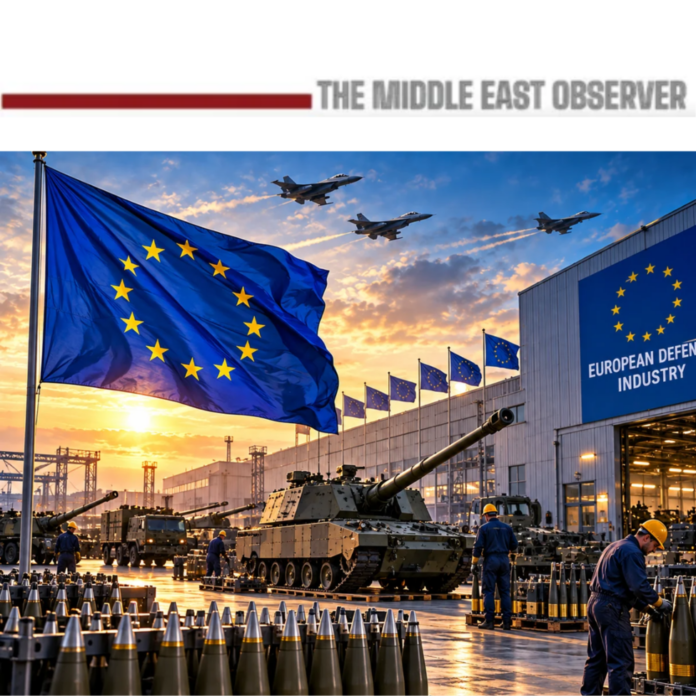
New missile, ammunition and air-defence investments show Europe’s rearmament shifting from budgets to factories, while Russia retains the advantage of an industrial base already operating at wartime scale.
Europe is accelerating the industrial phase of its rearmament, moving from higher defence budgets into missiles, ammunition, air-defence systems and production infrastructure as governments seek to narrow Russia’s wartime manufacturing advantage before 2030.
The shift has become more visible during October. Brussels has committed new funding to explosives, propulsion and warhead production; Britain and several European states are developing joint procurement mechanisms; France is accelerating air-defence orders; Poland is expanding Patriot support infrastructure; and European manufacturers are reporting sharply higher missile and ammunition backlogs.
The strategic problem is increasingly clear.
Europe has largely solved the budget problem. It has not yet solved the weapons-throughput problem.
Defence spending provides money. Industrial capacity determines what factories could make. Output measures what actually leaves those factories. Military capability depends on whether armed forces can deploy, sustain and replace those weapons in combat.
That distinction will determine whether Europe reaches meaningful defence readiness by 2030.
Russia Sets the Moving Benchmark
Russia entered large-scale wartime production years before most European governments began rebuilding military-industrial capacity.
Estonia’s Foreign Intelligence Service estimates Russian industry produced roughly 7 million large-calibre artillery shells, mortar rounds and rockets in 2025, compared with about 400,000 rounds in 2021.
The total included approximately 3.4 million howitzer rounds, alongside mortar ammunition, tank and infantry-fighting-vehicle rounds and multiple-launch rocket-system munitions.
Those figures should not be compared directly with European 155mm production because the Russian total combines several ammunition categories. They nevertheless illustrate the scale of Moscow’s mobilisation.
Russia is also continuing to finance expansion. Government documents reviewed by Reuters show Moscow plans around 17.1 trillion roubles, or $203 billion, of defence expenditure in 2027, 27% above the amount originally planned.
Europe is therefore not trying to catch a stationary target.
Its challenge is to expand production faster than Russia expands its own.
Europe’s Artillery Capacity Has Already Risen Fivefold
European production has nevertheless moved substantially since Russia’s 2022 invasion of Ukraine.
The International Institute for Strategic Studies estimates European 155mm ammunition capacity is roughly five times higher than in February 2022 and could more than double again by 2030.
The value of artillery-production contracts signed by European NATO countries between 2022 and 2025 was also 867% higher than during 2018–21.
Armoured-vehicle and unmanned-system production has increased as well.
But IISS still identifies significant weaknesses in artillery stocks, air defence, personnel, sustainment and force readiness.
That makes 2030 a readiness deadline, not a forecast that Europe will have surpassed Russia by then.
EU member states spent about €418 billion on defence in 2025, according to the European Defence Agency, with expenditure potentially reaching €547 billion by 2029.
The EDA nevertheless warned that significant capability gaps remain and called for a “decisive change” in the scale and pace of investment, industrial capacity and innovation.
The contradiction is central to Europe’s defence problem:
money is moving faster than factories.
October Push Moves From Budgets Into Production
The clearest recent shift has been towards the less visible industrial inputs required to manufacture weapons at scale.
On October 14, the European Commission allocated €168.2 million to eight industrial projects expected to mobilise about €1.26 billion across 17 production sites.
From 2027, those projects are expected to support annual capacity exceeding:
- 20,000 tonnes of energetic materials
- 3,500 missile and drone propulsion systems
- 200,000 loitering-munition warheads
- 60 million ammunition units
This matters because Europe cannot expand missile output simply by adding final assembly lines.
Rocket motors, explosives, propellants and warheads have become critical bottlenecks. If those remain scarce, additional spending cannot quickly translate into finished weapons.
European governments are also trying to reduce procurement fragmentation.
France, Germany, Italy, Poland and Britain called on October 26 for greater standardisation and defence-industrial cooperation, while the EU’s readiness roadmap seeks to have at least 40% of defence procurement conducted jointly by the end of 2027.
Larger and more predictable multinational orders would give manufacturers greater confidence to invest in additional capacity.
Britain, Poland and France Add Industrial Momentum
Britain added another layer on October 28.
Its National Wealth Fund and British Business Bank will deploy up to £5 billion over four years into defence, dual-use technologies and other strategically important sectors.
The figure is not £5 billion of new weapons orders. It represents investment and lending capacity intended partly to help defence companies and supply-chain businesses expand.
Britain, Finland, Poland and the Netherlands also plan to negotiate a Multilateral Defence Mechanism intended to become operational in 2027 and aggregate weapons demand across participating countries.
The day before, Britain and Poland announced deeper cooperation on large-calibre ammunition, drones and next-generation air-defence missiles.
Poland will separately host Europe’s only Patriot PAC-3 maintenance centre outside the US, with operations expected to begin in roughly a year.
Maintenance infrastructure does not increase weapons production directly, but it improves another critical measure of wartime endurance: how quickly damaged or expended capability can be returned to service.
France is meanwhile accelerating its own air-defence build-up.
Paris has ordered another four SAMP/T NG systems, bringing its total order to 12, with 10 expected to be delivered by the end of 2030.
The Franco-Italian system gives Europe an indigenous long-range air-defence option at a time when global demand for Patriot interceptors remains far above available supply.
Industry Backlogs Show Demand Is No Longer the Constraint
European manufacturers are now seeing that demand directly.
Norway’s Kongsberg reported on October 29 that third-quarter orders increased 145% year-on-year, driven largely by missiles, air defence and weapon stations.
Its backlog reached a record NOK174 billion.
The figures demonstrate the scale of demand now reaching European industry, although a backlog is not the same as production capacity.
The critical issue is how rapidly manufacturers can convert those orders into deliveries.
Germany’s Rheinmetall is expanding production across several European sites. Its new facility in Albacete, Spain, is designed to produce around 3 million medium-calibre ammunition components annually, while the group is targeting approximately 1.5 million 155mm artillery shells a year globally by 2030.
Germany is also seeking greater domestic production of the Patriot supply chain, including potentially the advanced PAC-3 MSE interceptor.
That programme has not yet been confirmed, underlining another European vulnerability: several critical weapons still depend on US technology, approvals or manufacturing capacity.
The Remaining Bottleneck Is Time
Europe’s economic base gives it the financial and technological capacity to build a much larger conventional defence industry.
But industrial expansion cannot be ordered into existence immediately.
Missile factories require specialised machinery and certification. Explosives plants face demanding safety and environmental requirements. Rocket motors and sophisticated electronics require specialised suppliers. Skilled engineers and technicians take time to train.
Testing capacity is becoming another constraint.
A Kiel Institute study previously estimated that production across several major land-warfare categories would have to rise by roughly fivefold overall for Europe to establish a decisive advantage over Russia.
That study predates much of the production expansion recorded during 2026, so it should not be treated as an exact measure of today’s gap.
Its core warning remains valid: orders placed late cannot compensate for factories that take years to expand.
Europe therefore faces several different races simultaneously.
Artillery ammunition is scaling relatively quickly.
Air- and missile-defence interceptors remain harder because of technical complexity and stretched supply chains.
Armoured vehicles require additional manufacturing depth.
Drones and autonomous systems may scale faster because they can draw more heavily on Europe’s civilian electronics, software and engineering industries.
2030 Will Be Judged by Output, Not Budgets
Matching Russia does not require Europe to produce an identical number of every Russian weapon.
European NATO countries possess advantages in combat aviation, submarines, sensors, precision weapons, intelligence and integrated command systems.
The more relevant industrial threshold is whether Europe can produce and replace critical weapons faster than they would be consumed in a high-intensity conflict.
That is where industrial capacity becomes credible deterrence.
Europe has already moved through the first phase of rearmament: higher spending.
It is now entering the second: factory expansion, supply-chain investment and procurement consolidation.
Between 2027 and 2029 will come the harder test — whether those investments generate sustained annual output of missiles, ammunition, drones and armoured vehicles.
Russia retains the advantage of having mobilised earlier.
Europe retains the advantage of a much larger combined economic base.
By 2030, the balance will therefore be judged less by defence-budget percentages than by throughput: how many weapons European factories can deliver each year, how quickly they can replenish losses, and whether that output is rising faster than Russia’s own military-industrial production.
Related news:
Europe’s Industrial Revival Faces Its Energy-Cost Test
Europe Charts a Common Path Towards Economic Sustainability and Strategic Unity
Read Also:
Greece Signs €3bn ‘Achilles Shield’ Deal as Israel Deepens European Defence Footprint
Starshield Dispute Exposes Ukraine’s Military Dependence as Peace Prospects Fade