
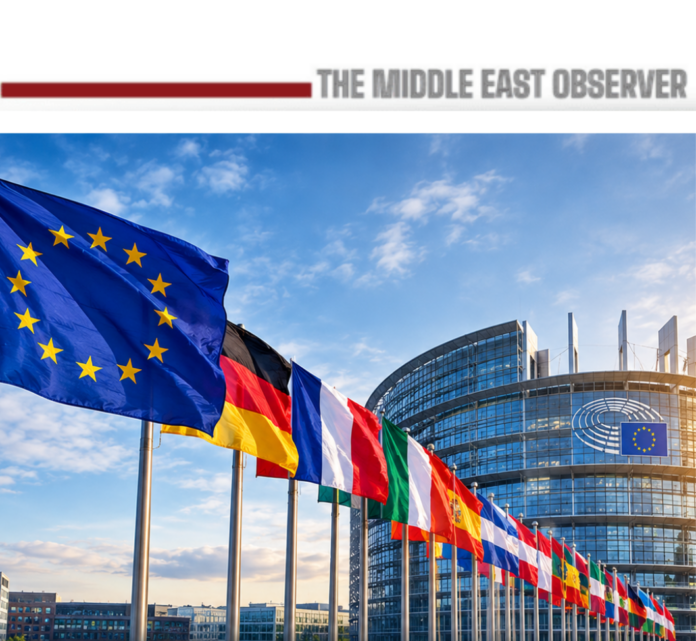
Europe’s drive towards deeper economic integration faces a critical financial test as EU leaders meet on 15–16 October amid rising energy costs, intensifying global competition and divisions over a €1.62 trillion budget proposal intended to support the bloc’s expanding economic and security ambitions.
The summit comes as Britain reconsiders its post-Brexit relationship, the European Union prepares for enlargement and NATO urges European governments to strengthen their industrial and defence capabilities.
Together, these developments reflect a fundamental reassessment of Europe’s future: economic competitiveness, energy sustainability and collective security can no longer be pursued independently.
That shift is acquiring an institutional foundation. In April, the EU’s principal institutions agreed a One Europe, One Market roadmap, establishing common economic priorities, legislative targets and implementation reviews through 2027.
The challenge now is whether Europe can finance those ambitions while maintaining industrial competitiveness, sustainable growth and political cohesion.
Brexit Exposes the Economic Value of European Integration
Britain’s 2016 decision to leave the EU was driven partly by expectations that greater national control over trade and regulation would open commercial opportunities across Asia, the Americas and other international markets.
A decade later, the economic evidence has complicated those expectations.
According to the UK House of Commons Library, the EU accounted for 41% of British exports and 50% of imports in 2025. Combined trade reached approximately £856 billion, equivalent to 46% of Britain’s total international trade in goods and services.
Europe’s commercial importance was already substantial before Brexit. What changed was Britain’s access to common trading arrangements and its influence over the rules governing its largest neighbouring market.
Manufacturers and smaller exporters have faced additional customs procedures, regulatory differences and administrative costs. Inflation-adjusted British goods exports to the EU were 14% below their 2019 level in 2025, although services exports performed considerably better.
The Office for Budget Responsibility estimates that Britain’s post-Brexit trading relationship will reduce long-term productivity by approximately 4% relative to continued EU membership.
Meanwhile, independent trade agreements have delivered more modest economy-wide benefits than some Brexit advocates originally anticipated, reinforcing the economic importance of geographically concentrated trade and integrated supply chains.
The political reassessment is increasingly visible.
On 14 October, Scotland Secretary Douglas Alexander argued that closer EU trade relations could offer greater economic benefits than retaining unrestricted freedom to negotiate separate agreements elsewhere.
Prime Minister Andy Burnham has reopened discussion of Britain’s long-term European relationship, acknowledging Brexit’s economic costs while stopping short of committing to renewed membership.
A UK–EU summit scheduled for 20 November will examine closer cooperation in agricultural trade, electricity, emissions trading and security.
The immediate objective is practical economic reintegration rather than an agreed reversal of Brexit.
Nevertheless, Britain’s experience illustrates a wider reality: national regulatory independence does not automatically deliver greater economic strength when investment, manufacturing and trade remain deeply connected to neighbouring markets.
Russia’s War Reinforces Europe’s Need for Collective Economic Security
Russia’s full-scale invasion of Ukraine in February 2022 transformed Europe’s economic concerns into broader questions of strategic security.
The war exposed vulnerabilities in energy supplies, defence production, infrastructure and critical technologies, demonstrating that military preparedness depends increasingly on reliable industrial capacity and resilient supply chains.
Britain remained a leading NATO member and supporter of Ukraine after Brexit. Yet the conflict reinforced the value of European cooperation in sanctions, energy infrastructure, defence procurement and technological development.
Uncertainty over American trade and security policies has added urgency.
Europe remains closely connected to Washington through military alliances, investment and advanced technologies. Governments are nevertheless seeking greater capacity to protect European interests when American priorities diverge.
The objective is not to dismantle transatlantic cooperation, but to reduce excessive dependence on decisions made elsewhere.
A Common European Economic Structure Takes Shape
Europe’s response has progressively shifted from managing individual crises towards strengthening common economic institutions.
In February 2025, the European Commission introduced its Clean Industrial Deal, linking industrial competitiveness and lower energy costs with decarbonisation, resource efficiency and clean-technology investment.
Three months later, the EU adopted its €150 billion SAFE instrument, providing long-term loans to support defence production and principally joint procurement.
A more comprehensive institutional commitment followed on 24 April 2026, when the European Parliament, Council and Commission signed the One Europe, One Market roadmap.
The agreement establishes five priorities: simpler regulation, deeper market integration, stronger international trade, affordable energy and decarbonisation, and accelerated digital and artificial intelligence development.
It also includes institutional responsibilities, legislative deadlines and quarterly reviews, with agreements on the principal initiatives targeted by the end of 2027.
Complementary proposals include EU Inc., an optional common corporate framework intended to reduce administrative barriers facing businesses operating across national borders.
A proposed European Competitiveness Fund would strengthen investment in strategic technologies and industries.
Under the Commission’s original budget proposal, the fund would receive approximately €234 billion between 2028 and 2034, alongside a separate €175 billion Horizon Europe research programme. Final allocations remain subject to negotiation.
These measures do not establish a single European economic government. They create an increasingly coordinated framework for market regulation, industrial development, investment, technological innovation and economic resilience.
Their underlying purpose is to enable European businesses to achieve the scale, financing and productive capacity needed to compete globally.
Enlargement and Defence Extend Europe’s Common Ambitions
On 6 October, the European Commission broadened this institutional agenda by presenting proposals to prepare the EU’s governance, policies and budget for additional members.
Ukraine, Moldova and Western Balkan candidates could extend Europe’s market, industrial networks and geopolitical influence, subject to accession requirements.
Enlargement would also intensify competition for agricultural subsidies, infrastructure investment and regional-development funding, making financial adjustments and institutional safeguards essential.
Slovakia’s forthcoming Visegrád summit on 4–5 November will test whether Central European countries can develop common positions on expansion and its economic consequences.
Defence presents a parallel challenge.
At the Warsaw Security Forum on 12 October, NATO’s Supreme Allied Commander Europe, General Alexus Grynkewich, outlined a defensive Theory of Victory designed to prevent an aggressor from occupying alliance territory.
He stressed that war was neither imminent nor inevitable.
The approach depends increasingly on sustained production of ammunition, drones, precision weapons, air-defence systems and secure communications.
Poland’s planned defence expenditure of approximately 4.8% of GDP in 2026 illustrates the financial scale involved.
EU defence-financing instruments complement NATO’s military responsibilities. Yet higher spending will strengthen European security only if it produces deployable capabilities, technological advances and reliable manufacturing capacity.
Enlargement and defence therefore raise the same economic question: can Europe expand its strategic responsibilities while generating sufficient investment, productivity and public revenue to sustain them?
Brussels Confronts the Cost of Greater Unity
The October European Council meeting has exposed the difficulties of reconciling those ambitions.
Ireland, which holds the rotating EU Council presidency, has proposed reducing the Union’s 2028–2034 budget from an earlier €1.76 trillion negotiating figure to €1.62 trillion, a reduction of approximately 8%.
The revision would cut proposed competitiveness and security-related allocations while largely protecting traditional agricultural and regional-development expenditure.
Sweden has rejected the compromise, while other major contributors remain concerned about costs and funding priorities.
Energy presents an equally difficult trade-off.
European manufacturers face rising fuel and electricity costs alongside growing Chinese competition. The EU’s goods-trade deficit with China reached approximately €360 billion in 2025.
Some governments, including Italy and the Czech Republic, are seeking relief from emissions-trading requirements to protect industrial competitiveness.
Nordic governments warn that weakening carbon-pricing incentives could discourage clean-energy investment and prolong dependence on imported fossil fuels.
Both positions reflect genuine economic pressures.
Europe needs affordable energy immediately, but long-term resilience requires investment in renewable generation, electricity networks, storage and more efficient industrial production.
The wider challenge is to ensure that coordinated policies stimulate productive investment rather than merely increasing subsidies, trade restrictions or public expenditure.
Trump’s Unintended Contribution to Europe’s Strategic Future
The next milestones will reveal whether Europe’s emerging framework can deliver results.
November’s Visegrád and UK–EU summits will test progress on enlargement and economic cooperation. The single-market roadmap targets legislative agreements by the end of 2027, while the 2028–2034 budget must reconcile industrial investment, sustainability, regional development and defence. Military-readiness objectives extend towards 2030 and beyond.
There is a striking geopolitical irony in this transformation.
President Donald Trump’s trade and security policies may ultimately have accelerated European integration by compelling governments to confront the economic and strategic costs of fragmentation.
Trump did not create Europe’s need for reform. Brexit, Russia’s invasion of Ukraine, competition from China and longstanding weaknesses within the single market had already exposed its vulnerabilities.
But Washington’s tariffs, pressure for greater European defence spending and changing diplomatic priorities have reinforced the case for stronger European institutions and greater independence in determining economic priorities.
That does not mean Europe is preparing to abandon its American partnership. Its more immediate ambition is to become a stronger and more capable partner, supported by competitive industries, sustainable energy, resilient supply chains and greater collective bargaining power.
Europe’s new direction is becoming clearer, although financing disputes and competing national interests continue to threaten implementation.
If the emerging framework succeeds, Trump’s unintended legacy may be to have helped accelerate a more cohesive Europe—one better equipped to define its economic identity, establish its strategic priorities and secure its future through collective strength.
The ultimate measure of success will not be how far Europe distances itself from Washington, but whether deeper integration delivers affordable energy, stronger productivity, sustainable prosperity and credible security.
Related News:
Europe Moves to Retain Scrap as Competition for Strategic Metals Intensifies.
Examines the strategic importance of recycled metals and Europe’s efforts to secure industrial raw materials.
Europe’s Industrial Revival Faces Its Energy-Cost Test.
Analyses how expensive energy threatens Europe’s industrial competitiveness.
Read Also:
2026 Marks Europe’s Shift From Premium EVs to Mass-Market Electrification.
Europe’s changing electric-vehicle market and competitive position in clean technologies.
Egypt Maps 50 Industrial Opportunities as Europe Recasts Its Supply Chains.
Examines potential consequences of European industrial restructuring for Egyptian manufacturers and investors.