
CAIRO — Egypt’s chemical and fertiliser exports to France rose 10.1% to $333 million in the first nine months of 2026, but growth lagged the European Union’s 16.2% expansion and the sector’s 33.6% global increase, highlighting France’s declining share of Egypt’s European chemical trade despite higher sales.
Exports to France increased by $30.5 million from $302.5 million a year earlier, placing the country seventh among Egypt’s ten largest destinations for chemical and fertiliser products, according to the Chemical and Fertilisers Export Council.
France accounted for approximately 9.6% of the sector’s $3.47 billion exports to the EU, down from an estimated 10.1% a year earlier — a decline of roughly 0.5 percentage points. The shift indicates that Egyptian exporters expanded more rapidly elsewhere in Europe.
The contrast is visible in other major European markets. Egyptian chemical and fertiliser exports reached $817.9 million in Italy and $503.1 million in Spain, approximately 2.5 times and 1.5 times the value shipped to France, respectively. While these differences reflect the scale of existing trade relationships, they do not necessarily indicate equivalent untapped demand in France.
The French market’s slower growth contrasts with a broader surge in Egyptian chemical exports. Total sector shipments climbed to $9.54 billion from $7.14 billion during January–September, generating an additional $2.4 billion in export earnings. France contributed just $30.5 million, or approximately 1.3%, of that increase.
Petrochemicals drove roughly half the sector’s additional export revenue, with shipments nearly doubling to $2.43 billion from $1.23 billion. Fertiliser exports rose 14.2% to $2.53 billion, while plastics and polymers increased 18.6% to $1.98 billion. Together, the three categories generated approximately $6.94 billion, representing nearly 73% of total sector exports.
France, however, has a different product profile from the sector’s main sources of global growth. Fertilisers dominated Egyptian shipments to the French market at $153 million, accounting for approximately 46% of the total, followed by organic chemicals at $85.4 million, or 25.6%.
Together, these two categories generated $238.4 million, equivalent to 71.6% of exports to France. Plastics and polymers contributed $37 million, petrochemicals $34 million and inorganic chemicals $18 million, leaving a relatively small share for other manufactured products.
This concentration makes export earnings sensitive to fertiliser prices, natural gas availability and production costs. Higher export values also do not necessarily indicate stronger physical demand or improved profitability. Without product-level shipment volumes and pricing data, the extent to which France’s 10.1% growth reflects higher volumes rather than price movements remains unclear.
Other international markets recorded substantially faster expansion, often driven by demand for particular Egyptian products. Exports to India surged more than 213% to $647 million, including $557.9 million in fertilisers, while shipments to China jumped more than 502% to $299 million, largely supported by $258.6 million in petrochemicals. Britain recorded a 194.4% increase to $290.3 million, and Saudi Arabia grew 81.7% to $378.3 million.
The geographical pattern reinforces the divergence. Although the EU remained the sector’s largest regional market, accounting for 36.4% of global exports, non-Arab Asian markets grew 44.2% to $2.28 billion, compared with the EU’s 16.2% increase. Arab markets reached $1.74 billion, up 12.7%.
Maintaining competitiveness in Europe will require Egyptian manufacturers to manage production costs and regulatory requirements. Natural gas supply remains particularly important for nitrogen-based fertiliser producers.
The EU’s Carbon Border Adjustment Mechanism entered its definitive phase in January 2026, imposing emissions-related compliance requirements on EU importers of covered fertilisers. Egyptian suppliers may consequently face greater pressure to provide verified emissions data and demonstrate production efficiency, while the financial impact will depend on product classification, embedded emissions and applicable rules.
The industry’s corporate structure presents another consideration. Egypt’s ten largest chemical and fertiliser exporters generated approximately $4.7 billion during the nine-month period, representing 49.3% of sector exports, highlighting the importance of major producers and the potential value of broadening participation among smaller manufacturers.
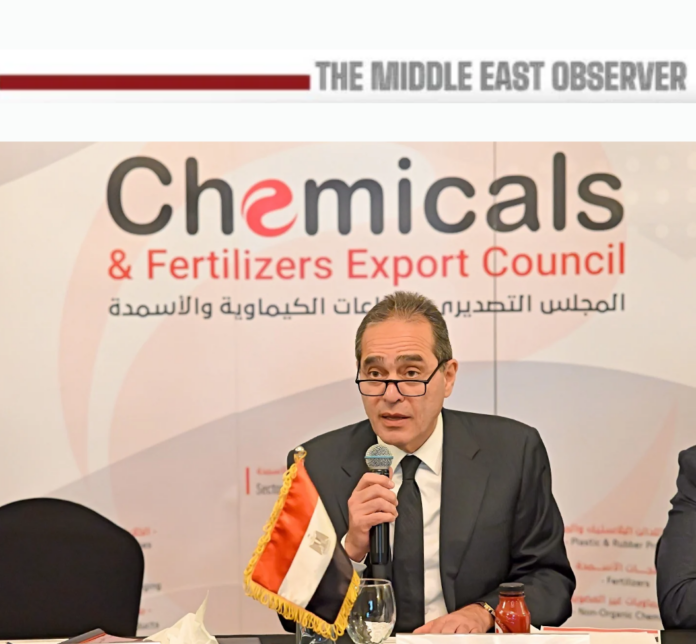
Khaled Abou El Makarem, chairperson of the Chemical and Fertilisers Export Council, said France remained an important European market, with the council prioritising stronger commercial relationships, product diversification and improved access for Egyptian suppliers.
A trade mission scheduled for February 1–6, 2027, will bring Egyptian exporters together with French importers and distributors. Its commercial significance will depend on whether participating companies can demonstrate competitive pricing, meet buyer requirements and secure sustained orders beyond the product categories currently dominating bilateral trade.
France’s declining share of Egypt’s EU chemical exports does not establish weakening French demand, but it shows that Egyptian suppliers are capturing growth more slowly there than elsewhere in Europe.
For Egypt, the test is whether exporters can translate the sector’s wider momentum into stronger French market penetration, a more diversified product mix and foreign-currency earnings less exposed to individual commodities and price cycles.
Related News:
1. Egypt’s ELAB Achieves Record LAB Output in 2025, Plans Capacity Expansion
2. Sidi Kerir Petrochemicals Company Hosts Review of Output and Feedstocks
Read Also:
1. MOPCO First-Half Profit Jumps 70% as Stable Gas Supplies Lift Output