

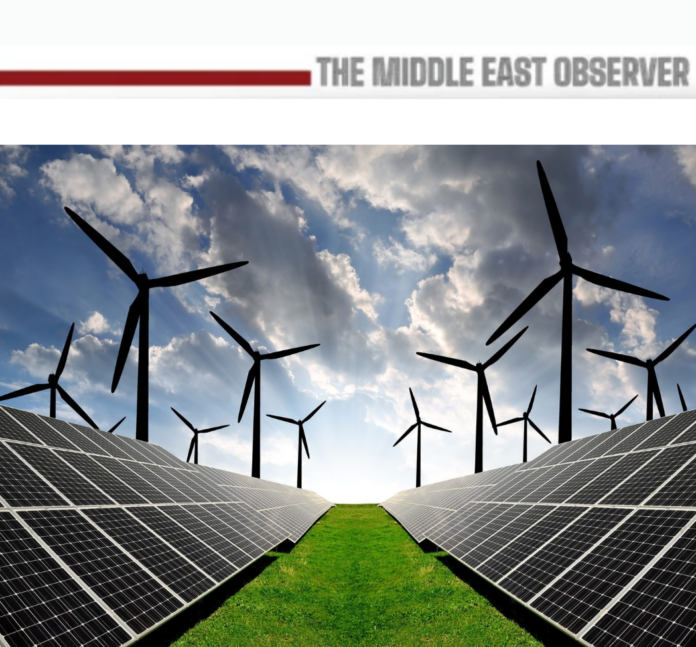
Egypt has secured financing packages totalling $563 million for two wind farms on the Red Sea coast and a solar power project with battery storage in Benban, supporting 500 megawatts (MW) of wind capacity and 258.5 megawatts-peak (MWp) of solar generation as the country seeks to expand electricity supplies and reduce reliance on fossil fuels.
Dubai-based Alcazar Energy Partners has arranged $436 million in debt financing for two 250 MW wind farms, Niat and Rasgha, near Ras Ghareb on the Gulf of Suez. The projects have a combined investment cost of $626 million and are expected to begin commercial operations by the end of 2028.
The European Bank for Reconstruction and Development (EBRD), European Investment Bank (EIB) and Germany’s development finance institution DEG are jointly providing the $436 million. The EBRD’s contribution comprises loans of up to $75 million and $70 million to the two project companies.
The wind farms are expected to generate more than 2.3 terawatt-hours of electricity annually and reduce greenhouse gas emissions by approximately 979,700 tonnes of carbon dioxide equivalent each year. Electricity will be sold to the Egyptian Electricity Transmission Company (EETC) under 25-year power purchase agreements.
Siemens Gamesa Renewable Energy will supply the turbines and provide operations and maintenance services, marking its return to the Egyptian market. Orascom Construction will undertake civil and electrical works.
The wind financing benefits from European Union-backed first-loss risk protection under the European Fund for Sustainable Development Plus, helping reduce investment risks and attract private capital into Egypt’s renewable energy sector.
Separately, the EBRD and DEG are providing a combined financing package of up to $127 million for a solar power plant with battery storage at Benban in Aswan.
The project, developed by Nefer Benban for Renewable Energy, a company owned by Infinity Power and HAU Energy, will combine a 258.5 MWp solar photovoltaic plant with a 120-megawatt-hour (MWh) battery energy storage system.
The EBRD is contributing up to $63.5 million, comprising $56 million from its own resources and $7.5 million in concessional financing from the Climate Investment Funds’ Clean Technology Fund. DEG is providing an equivalent amount.
The batteries will store electricity generated during daylight hours and release it during periods of peak demand after sunset, helping manage fluctuations in solar generation and improve grid stability.
The Benban plant is expected to supply electricity to approximately 310,000 homes and reduce annual carbon dioxide emissions by more than 349,000 tonnes. Its electricity will also be sold to EETC under a 25-year power purchase agreement.
The financing follows an earlier $65 million construction bridge loan agreed by the EBRD with HAU Energy in April 2026 for the same project. That earlier facility is separate from the newly announced financing package and is not included in the $563 million total.
Both investments support Egypt’s Nexus of Water, Food and Energy (NWFE) programme, which aims to facilitate the retirement of 5 gigawatts of inefficient fossil-fuel power capacity and the development of 10 gigawatts of privately financed renewable electricity generation.
The projects highlight the role of international development lenders in financing Egypt’s energy transition, while long-term electricity purchase agreements provide developers with revenue certainty. Their contribution to reducing fuel import dependence and electricity generation costs will depend on successful construction, grid integration and commercial operation.
Related News:
1. Alcazar, Siemens Gamesa Advance Egypt’s 500 MW Wind Farm
2. Hassan Allam Utilities and Infinity Power Sign a 1.2 GW Solar and Storage Deal in Egypt
Read Also:
1. 1 GW Ras Shokeir Deal Deepens Egypt’s Gulf of Suez Wind Push
2. Egypt Bets on Battery Storage and Manufacturing to Power Next Energy Phase
